Hyundai Creta vs Kia Seltos: Which Compact SUV Should You Buy in 2026?
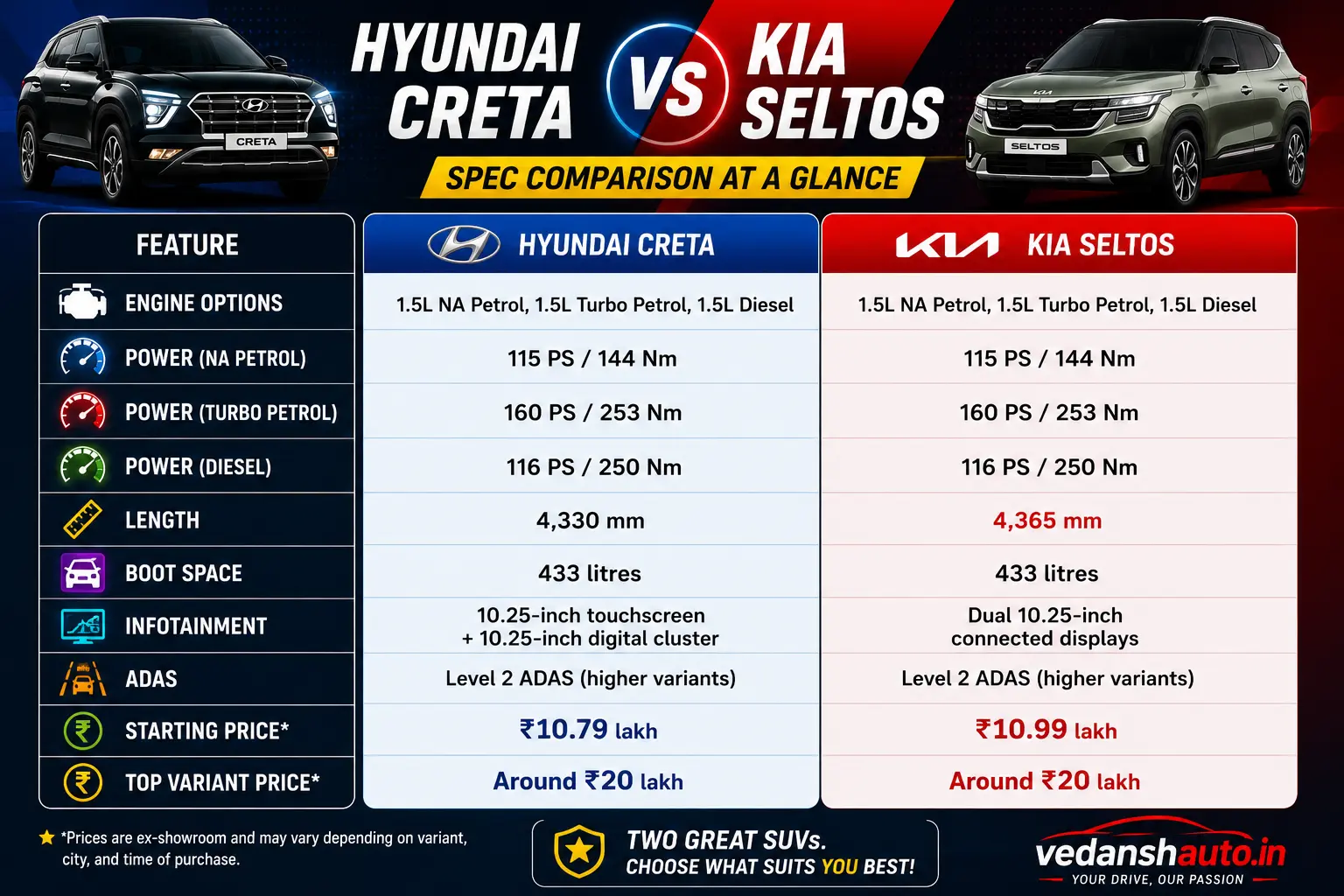
If you want to buy a compact SUV in India, chances are these two names are at the top of your list. The Hyundai Creta and the Kia Seltos are among the most popular SUVs in the country. They are well-equipped, refined and priced close enough to make the decision genuinely difficult.
Here’s something worth knowing upfront: both are excellent cars. They share engines, platforms and many underlying components. You will not make a bad choice here. However, they have distinct personalities, and the right one depends entirely on what you prioritise.
Quick Overview: What Each Car Stands For
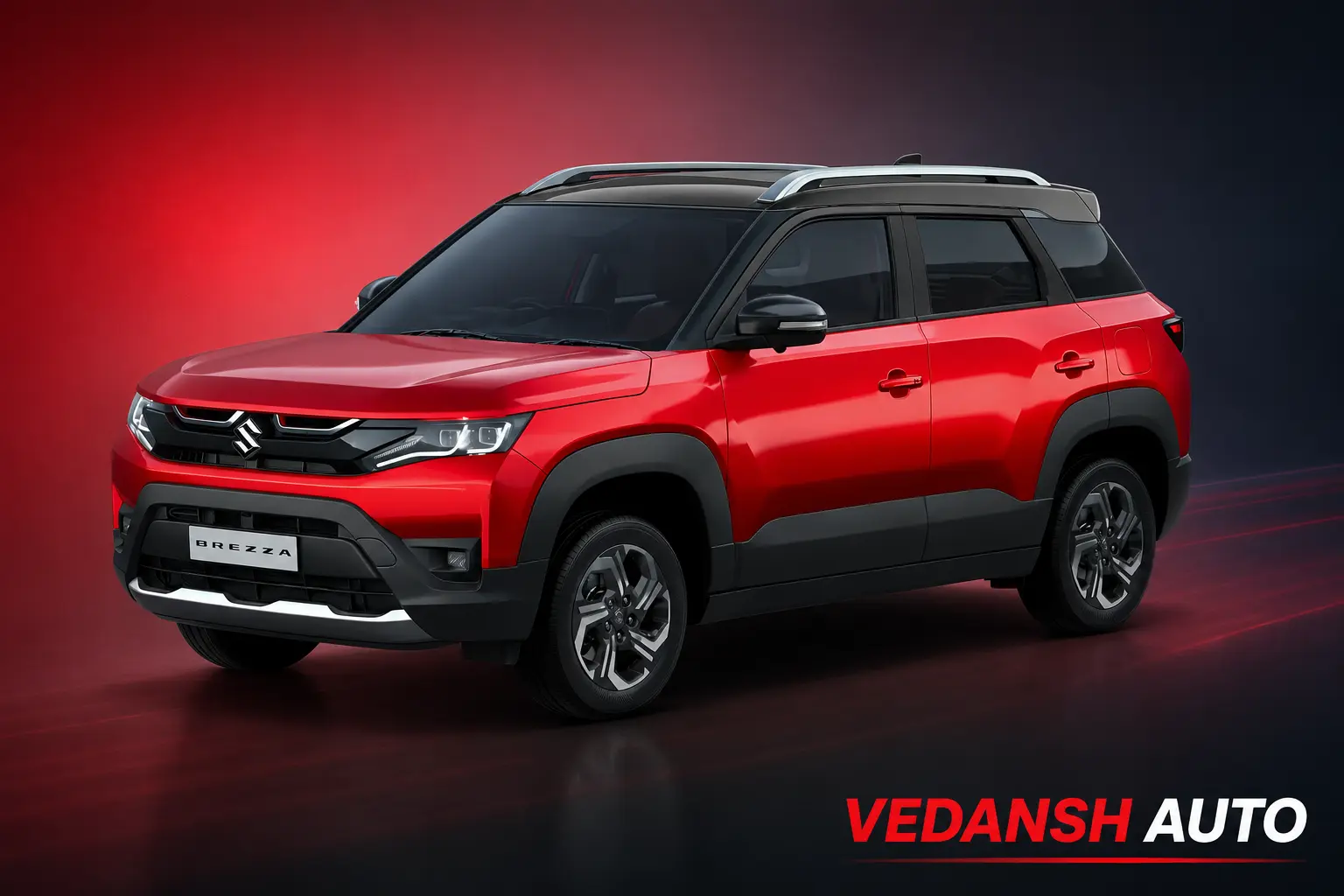
The Hyundai Creta is India’s best-selling SUV for an important reason. It is not just refined and versatile, but also appeals to a wide range of buyers. Whether you’re commuting through city traffic, driving on the highway or heading out on a family road trip, the Creta feels right at home.
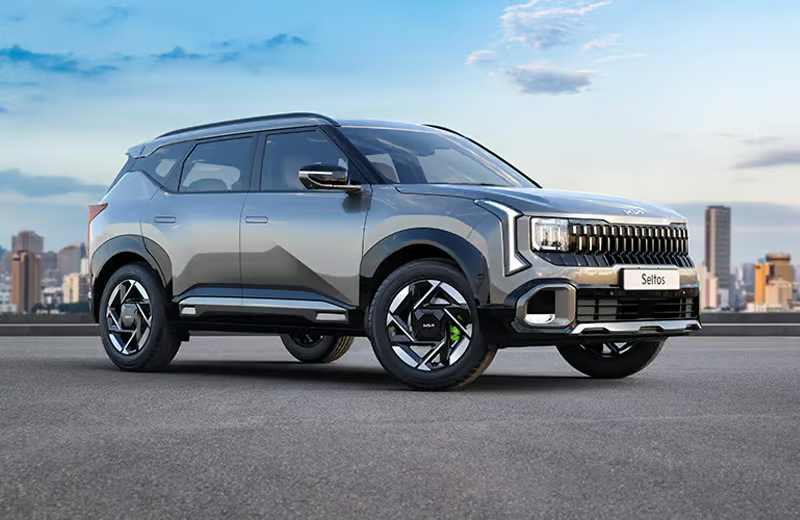
The Kia Seltos is Kia’s answer to the Creta and remains one of the most feature-rich compact SUVs in India. It offers bold styling, a premium cabin and a slightly sportier driving experience. While the two SUVs share their platform and engines, Kia positions the Seltos as the more youthful and technology-focused option.
Specs at a Glance
| Feature | Hyundai Creta | Kia Seltos |
| Engine Options | 1.5L NA Petrol, 1.5L Turbo Petrol, 1.5L Diesel | 1.5L NA Petrol, 1.5L Turbo Petrol, 1.5L Diesel |
| Power (NA Petrol) | 115 PS / 144 Nm | 115 PS / 144 Nm |
| Power (Turbo Petrol) | 160 PS / 253 Nm | 160 PS / 253 Nm |
| Power (Diesel) | 116 PS / 250 Nm | 116 PS / 250 Nm |
| Length | 4,330 mm | 4,365 mm |
| Boot Space | 433 litres | 433 litres |
| Infotainment | 10.25-inch touchscreen + 10.25-inch digital cluster | Dual 10.25-inch connected displays |
| ADAS | Level 2 ADAS (higher variants) | Level 2 ADAS (higher variants) |
| Starting Price* | ₹10.79 lakh | ₹10.99 lakh |
| Top Variant Price* | Around ₹20 lakh | Around ₹20 lakh |
*Prices may vary depending on variant, city, and time of purchase.
Design & Dimensions: Two Different Philosophies
The Creta’s design is contemporary and crowd-pleasing, which means it has a strong road presence without trying too hard. The connected LED DRLs, bold front fascia and clean overall shape give it a premium look that appeals to a broad audience. It’s the kind of SUV that looks good in almost any colour.
The Seltos takes a somewhat more aggressive approach to styling. It features Kia’s signature Star Map LED lighting, a bold front grille, sharp body lines and a sporty stance. The overall design feels more youthful and attention-grabbing than the Creta. While both SUVs have strong road presence, the Seltos is more likely to stand out in a crowded parking lot.
Dimensionally, the Seltos is 35 mm longer than the Creta. However, interior space is broadly similar, and both SUVs comfortably accommodate five adults. In terms of everyday use, the difference in cabin space is unlikely to be a deciding factor for most buyers.
Features & Tech: Seltos Has the Edge
This is where the two cars are quite different, and where the Seltos makes a particularly strong case for itself.
Kia Seltos (Top Variant) Highlights
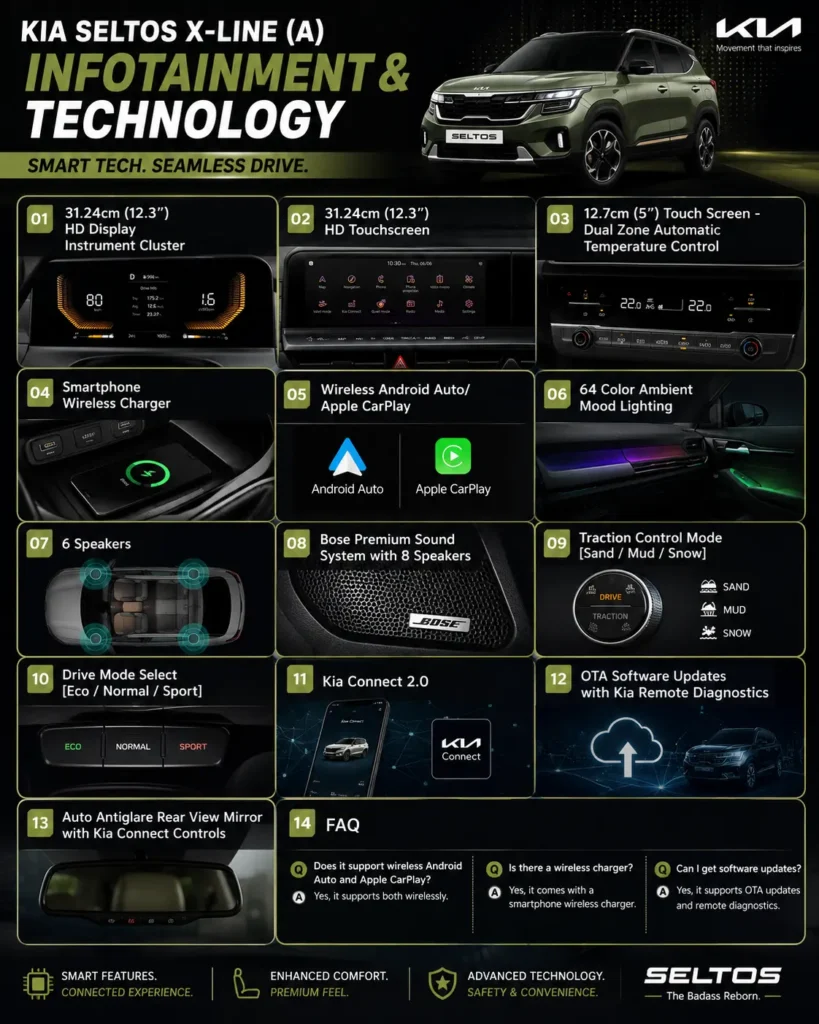
- Dual 10.25-inch connected displays for infotainment and instrumentation
- 10-way electrically adjustable driver seat with lumbar support and memory function
- 64-colour ambient lighting
- 8-speaker Bose sound system
- Dual-zone climate control
- Panoramic sunroof
- Ventilated front seats
- Wireless Android Auto and Apple CarPlay
- Wireless charging pad
- 360-degree camera
Take a look at the infotainment and technology features found in Kia Seltos X-Line(A):
Hyundai Creta (Top Variant) Highlights
- 10.25-inch touchscreen infotainment system
- 10.25-inch digital instrument cluster
- Panoramic sunroof
- Ventilated front seats
- Bose sound system
- Level 2 ADAS
- Wireless Android Auto and Apple CarPlay
- Hyundai Bluelink connected car technology
The Seltos’s dual-screen setup gives the cabin a more premium and technology-focused feel. The curved display layout looks modern and helps the interior feel more upmarket. Features such as ambient lighting and the powered driver’s seat with memory function add to the premium experience.
That said, the Creta’s interface is intuitive and easy to use. Hyundai’s Bluelink connected car ecosystem is mature, reliable and widely appreciated by owners. Buyers who want a cleaner cabin layout may actually prefer the Creta’s design.
Engines & Performance: Shared Muscle, Different Character
Both SUVs offer the same three engine options: a 1.5-litre naturally aspirated petrol, a 1.5-litre turbo-petrol and a 1.5-litre diesel.
The Creta is tuned with a focus on comfort and refinement. Throttle response is smooth and predictable, and the IVT automatic gearbox is among the smoothest in the segment. It handles city traffic effortlessly and remains relaxed during long highway drives.
The Seltos feels a bit sportier to drive. The steering has slightly better weight, the accelerator responds more quickly and the overall driving experience feels a little more engaging. Drivers who enjoy being behind the wheel may appreciate these differences. The turbo-petrol engine paired with the 7-speed DCT gearbox is especially enjoyable and delivers quick, responsive performance.
Ride & Handling: Creta for Comfort, Seltos for Engagement
The Creta has a softer suspension setup that prioritises passenger comfort. It absorbs potholes, broken roads and rough surfaces very well. For families and long-distance travellers, this is one of its biggest strengths.
The Seltos has a slightly firmer suspension setup, which helps it stay more stable around corners and feel confident at highway speeds. However, on rough city roads with potholes and bumps, it can sometimes feel a little less comfortable than the Creta.
The earlier Seltos was often criticised for having a firm ride, but Kia has improved the suspension tuning over time. Even so, the Creta continues to offer a softer and more comfortable ride overall.
For most Indian buyers, especially those who frequently drive on uneven city roads, the Creta’s suspension setup is likely to feel more comfortable in daily use.
Safety: Both Are Well Equipped
Both SUVs offer strong safety credentials. Standard safety equipment includes six airbags, ABS with EBD, electronic stability control, hill-start assist, ISOFIX child seat mounts, TPMS and a rear parking camera.
Higher variants of both SUVs offer comprehensive Level 2 ADAS suites that include features such as adaptive cruise control, lane keep assist, forward collision warning, lane departure warning and autonomous emergency braking.
The Seltos also offers features such as a 360-degree camera, blind-view monitor, all-wheel disc brakes and an electronic parking brake with auto hold on select variants.
Overall, both SUVs rank among the safest options in the compact SUV segment.
Price & Value: Where Does Your Budget Sit?
| Budget Range | Creta Option | Seltos Option |
| ₹11–13 lakh | E / EX Petrol variants | HTE / HTK Petrol variants |
| ₹13–16 lakh | S / SX Petrol & Diesel | HTK+ / HTX variants |
| ₹16–20 lakh | SX(O) variants | GTX+ / X-Line variants |
Both SUVs are priced very closely throughout their ranges. Kia generally offers a few more features at equivalent price points, while Hyundai focuses on refinement, comfort and long-term ownership appeal.
One important consideration is after-sales support. Hyundai’s service network remains larger than Kia’s, particularly in smaller cities and towns. While Kia has expanded rapidly, Hyundai still enjoys a noticeable advantage in overall service reach across India.
Which One Should You Buy?
Choose the Hyundai Creta if:
- You want a proven SUV with strong resale value
- Comfort and refinement are your top priorities
- You live in an area where Hyundai’s larger service network is beneficial
- You prefer a cleaner and simpler cabin design
- Family comfort and ride quality matter most
Choose the Kia Seltos if:
- You want maximum features for your budget
- The dual-screen setup and premium cabin appeal to you
- You enjoy a slightly sportier driving experience
- You prefer bold styling that stands out
- Features such as ambient lighting, a powered driver’s seat, and a 360-degree camera are important to you
Our Verdict
For the majority of buyers, the Hyundai Creta remains the safer long-term choice. It offers strong resale value, a wider service network, excellent ride comfort and a refined ownership experience that suits Indian roads and Indian families quite well.
The Kia Seltos, however, is the more feature-rich and exciting option. It offers a premium-looking cabin, a more engaging driving experience and a strong value proposition for buyers who prioritise technology and features.
The good news is that you cannot go wrong with either SUV. Both are among the best options in the segment. The key is deciding whether you value comfort and refinement more, or features and driving engagement.
Frequently Asked Questions
Yes. Both SUVs use the same 1.5-litre naturally aspirated petrol, 1.5-litre turbo-petrol, and 1.5-litre diesel engines. Transmission options are also largely similar. However, Hyundai and Kia tune the suspension, steering, and throttle response differently, giving each SUV its own driving character.
The Creta has historically commanded stronger resale value because of its higher sales volumes and wider demand in the used car market. The Seltos also holds its value well, but the Creta generally enjoys a slight advantage.
Routine service costs are broadly comparable because both SUVs share many components. However, Hyundai’s larger service network can make ownership more convenient, especially outside major cities.
Both SUVs offer good headroom and seating comfort for tall drivers. The Seltos’s powered driver’s seat with memory function can make it easier to find an ideal driving position, while the slightly longer body may offer a small advantage in rear-seat legroom.
📚 Also Read