Hyundai Creta Petrol vs Diesel: Which One Should You Buy
The Hyundai Creta is India’s best-selling SUV. However, when you walk into any showroom, the first thing you have to decide is not about colour or the variant. It’s this: petrol or diesel?
Both engines are refined, capable, and well-matched to the Creta’s character. But they suit very different kinds of buyers. This means that if you make a wrong choice, you will either be paying too much at the fuel pump or spending unnecessarily on a diesel you didn’t need.
Let’s break it down properly so you can get the right car.
Quick Specs Comparison
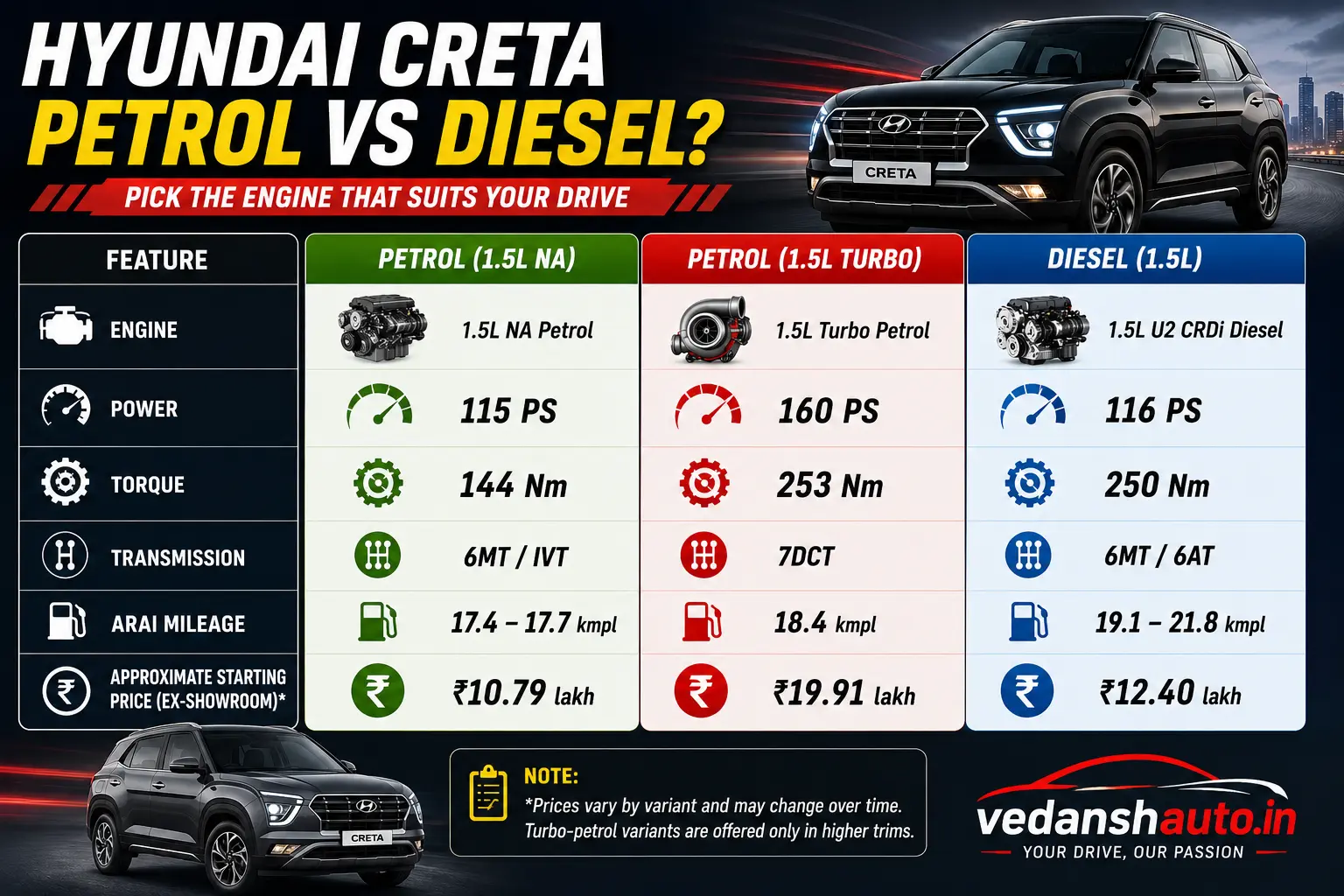
| Feature | Petrol (1.5L NA) | Petrol (1.5L Turbo) | Diesel (1.5L) |
| Engine | 1.5L NA Petrol | 1.5L Turbo Petrol | 1.5L U2 CRDi Diesel |
| Power | 115 PS | 160 PS | 116 PS |
| Torque | 144 Nm | 253 Nm | 250 Nm |
| Transmission | 6MT / IVT | 7DCT | 6MT / 6AT |
| ARAI Mileage | 17.4–17.7 kmpl | ~18 kmpl | 19.1–21.8 kmpl |
| Starting Price (ex-showroom) | ₹10.79 lakh | ₹19.91 lakh | ₹12.40 lakh |
The Petrol Case: Simpler, Smoother, City-Friendly
The Creta’s 1.5L naturally aspirated petrol is the entry point to the range and, for many buyers, the sweet spot. It’s smooth, refined, and genuinely enjoyable around town. The IVT automatic in this engine is particularly good. No jerks or hesitation, just seamless progress in stop-and-go traffic.
If you want more punch, the 1.5L turbo petrol (available in sportier variants) is a genuinely quick engine. With 160 PS and 253 Nm of torque, it’s the most exciting Creta to drive. Paired with the 7-speed DCT, it feels more like a sporty hatchback than a family SUV.
Petrol Creta Pros:
- Lower ex-showroom price (up to ₹1.5–2 lakh cheaper than equivalent diesel)
- Lower servicing costs; no DPF, no diesel-specific maintenance
- Smoother, quieter engine note, especially in city driving
- Turbo petrol option for those who want performance
- No concerns about diesel engine health in pure city use
Petrol Creta Cons:
- Higher per-km running cost vs diesel at current fuel prices
- Less torque in the base NA variant for highway overtaking
- Fuel costs add up if you’re clocking high mileage annually
The Diesel Case: Efficient, Torquey, Built for the Long Haul
Hyundai has done something impressive with the 1.5L diesel in the Creta. It’s so refined that it can be mistaken for a petrol engine. The noise, vibration, and harshness levels are genuinely low for a diesel in this segment.
The ARAI-certified mileage of 21.8 kmpl (manual) and 19.1 kmpl (automatic) are the best numbers in the Creta lineup. Real-world owner-reported figures typically come in between 17–18 kmpl in mixed driving, which are still better than petrol.
The diesel also has 250 Nm of torque from low in the rev range, which makes it effortless on highways and very capable when loaded with passengers and luggage.
Diesel Creta Pros:
- Best fuel efficiency in the range, which is ideal for high-mileage users
- Strong, accessible torque for highway driving and loaded conditions
- Better suited for long inter-city runs and hilly terrain
- Diesel prices remain lower than petrol in most Indian cities
Diesel Creta Cons:
- Higher upfront price (₹1.5–2 lakh more than equivalent petrol)
- Slightly higher servicing costs
- Less ideal for short city trips where the engine never fully warms up
- Requires a bit more warm-up time; not ideal for very short daily trips under 5 km
ALSO READ: Hyundai Creta vs KIA Seltos
5-Year Cost of Ownership: The Numbers That Actually Matter
Let’s do the math, since these numbers are very important.
Assumptions:
- Annual mileage: 15,000 km
- Petrol price: ₹102/litre | Diesel price: ₹95/litre
- Real-world mileage: Petrol — 15 kmpl | Diesel — 18 kmpl
- Price difference: Diesel costs ₹1.5 lakh more upfront
| Petrol | Diesel | |
| Annual fuel cost | ₹1,02,000 | ₹79,200 |
| Annual savings (diesel) | — | ₹22,800/year |
| Extra upfront cost (diesel) | — | ₹1,50,000 |
| Break-even point | — | ~6.6 years |
At 15,000 km/year and with current fuel prices, the diesel takes nearly 6.6 years to break even, which is longer than most people keep a car. But push that to 20,000+ km/year, and the break-even comes down to around 4–5 years, making diesel a more reasonable proposition.
At under 10,000 km/year, diesel almost never pays off.
ALSO READ: Hyundai Creta Automatic vs Manual
Who Should Buy the Petrol Creta?
The petrol is the right choice if:
- You drive mainly in the city: Delhi, Gurugram, Bengaluru, Mumbai
- Your annual mileage is under 12,000–15,000 km
- You take mostly short trips (under 15 km one way)
- You want lower upfront and maintenance costs
- You’re interested in the turbo petrol for a more spirited driving experience
- You park in a housing society or office with no overnight warm-up concerns
Who Should Buy the Diesel Creta?
Buying the diesel variant is better if:
- You regularly travel between cities: weekend trips, family outings, office commutes of 40+ km each way
- Your annual mileage is above 15,000–20,000 km
- You live in a Tier 2 city or area where highway driving dominates
- You frequently carry full loads
- You’re buying the car for 5–7+ years and want long-term fuel savings
- You tow a trailer, caravan, or regularly drive on ghat roads
Our Verdict
For most city buyers in 2025, the petrol Creta is the smarter buy.
The price gap between petrol and diesel has narrowed, fuel prices are closer than they used to be, and modern petrol engines are efficient enough for everyday use. Unless you are a genuinely high-mileage driver, the diesel premium is hard to justify.
That said, if you’re clocking more than 1,500 km a month or doing regular highway runs, the diesel will reward you. The refined, torquey engine and class-leading fuel economy make it one of the best diesel SUVs in the segment.
In short:
- City driver, under 15,000 km/year → Go Petrol
- Highway warrior, 15,000+ km/year → Go Diesel
Frequently Asked Questions
Historically, diesel SUVs have held resale value slightly better due to demand from high-mileage buyers. However, the gap is narrowing in cities where petrol-heavy demand is rising. Both variants of the Creta enjoy strong resale value overall.
You can, but it’s not ideal. Diesel engines perform best when they’re regularly run at highway speeds to clean out the particulate filter. Exclusive short-trip city use can lead to DPF issues over time. For purely city use, petrol is the better-suited engine.
If performance matters to you and budget allows, yes. The turbo petrol (available in sportier variants) is a significantly more exciting car. But if you’re looking at value and everyday use, the standard 1.5L petrol with IVT is hard to beat.
📚 Also Read