Hyundai Venue Turbo Review
 Published on 27 June 2026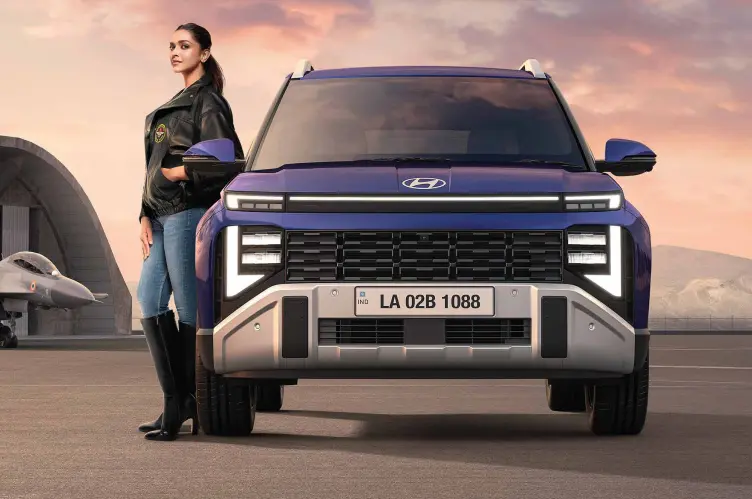
The Hyundai Venue Turbo has long been the pick of the Venue lineup. The naturally aspirated petrol can feel a bit strained on highways, while the diesel requires a higher upfront investment. Between these two, you have the 1.0-litre T-GDi turbo petrol that offers the right mix of performance and everyday usability. For 2026, Hyundai has given the Venue a substantial update. The big question is whether those changes are enough to keep the Venue Turbo among the best compact SUVs in an increasingly competitive segment.
Quick Specs: Hyundai Venue 1.0 Turbo Petrol (2026)
| Spec | Details |
| Engine | 1.0-litre T-GDi Turbo Petrol |
| Power | 120 PS |
| Torque | 172 Nm |
| Gearbox Options | 6-speed MT / 7-speed DCT |
| ARAI Mileage (MT) | 18.74 kmpl |
| ARAI Mileage (DCT) | 20.00 kmpl |
| Turbo Variants | HX2, HX5, HX6, HX8, HX10 |
| Price Range (Turbo) | Rs. 8.90 lakh to Rs. 14.65 lakh (ex-showroom, approx.) |
Exterior Design
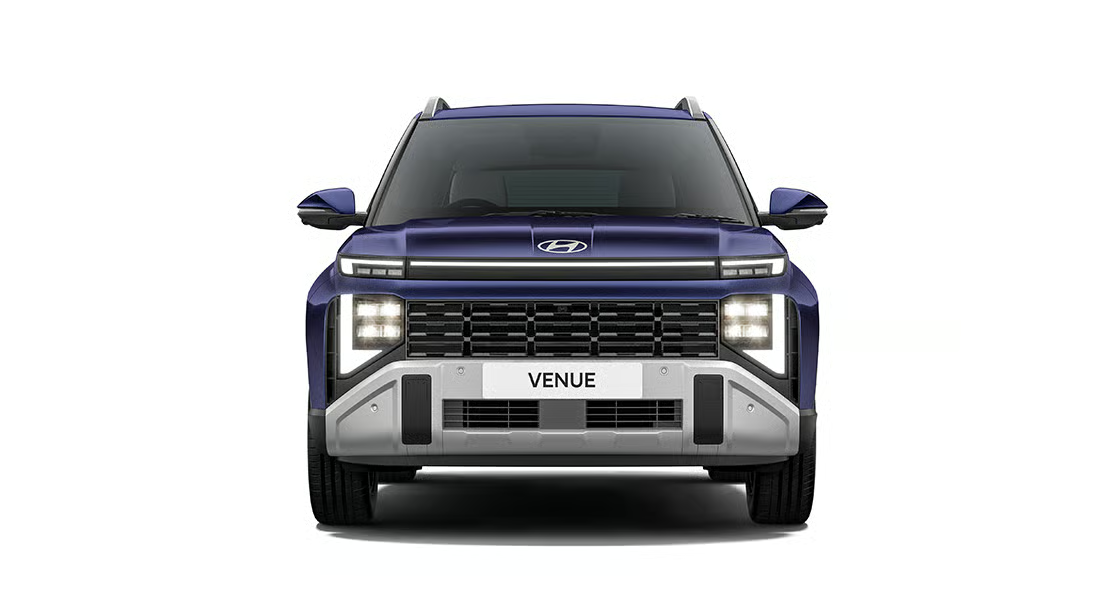
The 2026 Venue has had a full generational overhaul. It is no longer the same car with a fresh grille. Hyundai has moved it to the global K1 platform, which makes the body 30mm wider, 48mm taller, and the wheelbase 20mm longer than before. On the road, that extra size is visible. The Venue no longer looks like a crossover but like a proper compact SUV.
The front gets quad-beam LED headlamps with connected twin horn DRLs that give it a distinct light signature. The dark chrome radiator grille sits wide and flat, giving the nose a confident, upright look. At the sides, muscular wheel arch cladding, bridge-type roof rails, and 16-inch diamond-cut alloy wheels fill the body well without looking over-styled. The sculpted character lines are there but not overdone.
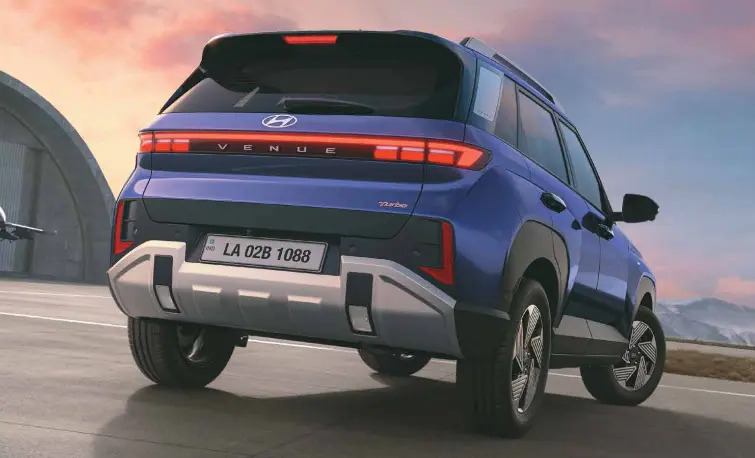
On lower variants the rear gets standard LED tail lamps, while higher variants from HX8 onwards get connected LED tail lamps that form a cohesive light signature with the front DRLs. Colour options include some standout choices like Hazel Blue Matte and Mystic Sapphire Matte, which were introduced with the April 2026 Knight Edition update, along with the more standard options. If you want the Venue Turbo to look sharp on the road, go for a dual-tone finish.
Interior and Features
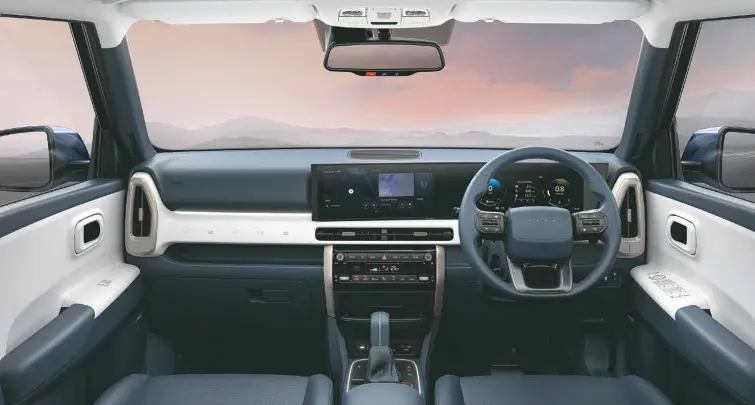
Step inside and this is where the new Venue makes its biggest statement. The top HX10 variant gets dual 12.3-inch curved displays. One is for the digital driver’s display and the other is for the ccNC (Connected Car Navigation Cockpit) infotainment, powered by NVIDIA. This is a first for any sub-4m SUV in India and these screens are actually larger than what the Creta gets. The HX10 also gets the full ccNC suite with BlueLink connected car services and Controller OTA updates for up to 20 vehicle systems. Mid variants (HX6 and HX8) get ccNC Basic with BlueLink connectivity but without OTA, and a 10.25-inch infotainment screen paired with a digital cluster. Lower variants get the same 10.25-inch screen without BlueLink.
The H-architecture cabin design uses a dual-tone Dark Navy and Dove Grey colour scheme on most variants. The D-cut steering wheel has a premium feel to it, and the terrazzo-textured crash pad is a genuinely distinctive design choice. The cosy coffee-table centre console with Moon White ambient lighting works well for long drives. Seating is comfortable up front with good cushioning and support. At the rear, there is enough knee room and headroom for two adults, and the rear AC vents are a welcome addition.
Higher turbo variants get a single-pane electric sunroof, wireless charging, multiple Type-C ports, a 360-degree camera with blind view monitor, and an 8-speaker Bose sound system on the top HX10 spec. Cruise control is available from the HX5 turbo upward. Drive modes (Eco, Normal, Sport) are available on the HX8 DCT and HX10 only. The MY2026 update adds a dashcam to the HX6 and HX10 turbo variants.
What is missing? The 360-degree camera is limited to the higher trims. Paddle shifters are available on the HX5 DCT, HX6 DCT, HX8 DCT, and HX10. If you are buying mid-spec, some of these features will require you to step up in variant.
Performance and Driving Experience
The 1.0-litre T-GDi puts out 120 PS and 172 Nm. Those numbers are familiar, but the driving experience on the new K1 platform feels more sorted than the previous generation. The engine does have mild turbo lag below 2,000 rpm. Under that threshold, particularly in slow-moving traffic, you will notice a slight hesitation before the power builds. Once the turbo spools up, the mid-range punch is strong and the car moves confidently on highways.
For the DCT variant: the 7-speed dual-clutch gearbox is mostly smooth once you are above 20 to 25 kmph. The issue comes at very low city speeds, around 10 to 20 kmph, where the DCT can feel like it is hunting for gears. This is a known characteristic of dual-clutch boxes in stop-and-go traffic, and the Venue is no exception. If your daily drive is mostly highway or flowing city roads, the DCT is excellent. If you are spending most of your time in dense, crawling traffic, the 6-speed MT is worth considering. It is a conventional three-pedal manual, which means full control over gear selection. It also avoids the low-speed hesitation that dual-clutch gearboxes can sometimes exhibit in crawling traffic. The trade-off is the physical effort of working the clutch in heavy stop-and-go traffic.
On the highway, the Venue Turbo is comfortable at 100 to 120 kmph. The engine remains relaxed at highway cruising speeds. The new platform and longer wheelbase contribute to improved stability at highway speeds. If you are on the HX8 DCT or HX10, drive modes (Eco, Normal, Sport) are available and make a noticeable difference in throttle response.
Ride and Handling
The K1 platform has improved rigidity, and that shows in the ride quality. On smooth roads, the Venue Turbo feels planted and settled. On broken city roads and speed breakers, the suspension deals with bumps reasonably well. It is not as plush as some rivals but it is not crashy either. Body roll is well controlled for an SUV of this size and class.
The steering is light at city speeds, which makes it easy to manoeuvre in tight parking spots and narrow lanes. At higher speeds, it firms up enough to feel connected. Overall, the handling is composed and confidence-inspiring without being sporty in any aggressive sense.
Fuel Efficiency: ARAI vs Real World
Hyundai claims 18.74 kmpl for the turbo manual and 20.00 kmpl for the DCT. Real-world numbers will be lower, as they always are.
In heavy city traffic, expect 8 to 12 kmpl from the turbo petrol. On highways at steady speeds, you can realistically see 14 to 16 kmpl. Mixed driving across city and highway should land somewhere between 12 to 14 kmpl for most buyers. The DCT variant tends to return slightly better efficiency on highways compared to the manual, thanks to its taller gearing. This is the reverse of what many buyers expect.
If you are a high-mileage user covering more than 1,500 km per month, the 1.5-litre diesel makes a stronger economic case. For moderate city use, the turbo petrol DCT is a good balance of performance and running cost.
Safety
The 2026 Venue has scored a 5-star Bharat NCAP safety rating, making it Hyundai’s second model to go through the Bharat NCAP crash tests. This is a significant achievement for a sub-4m SUV.
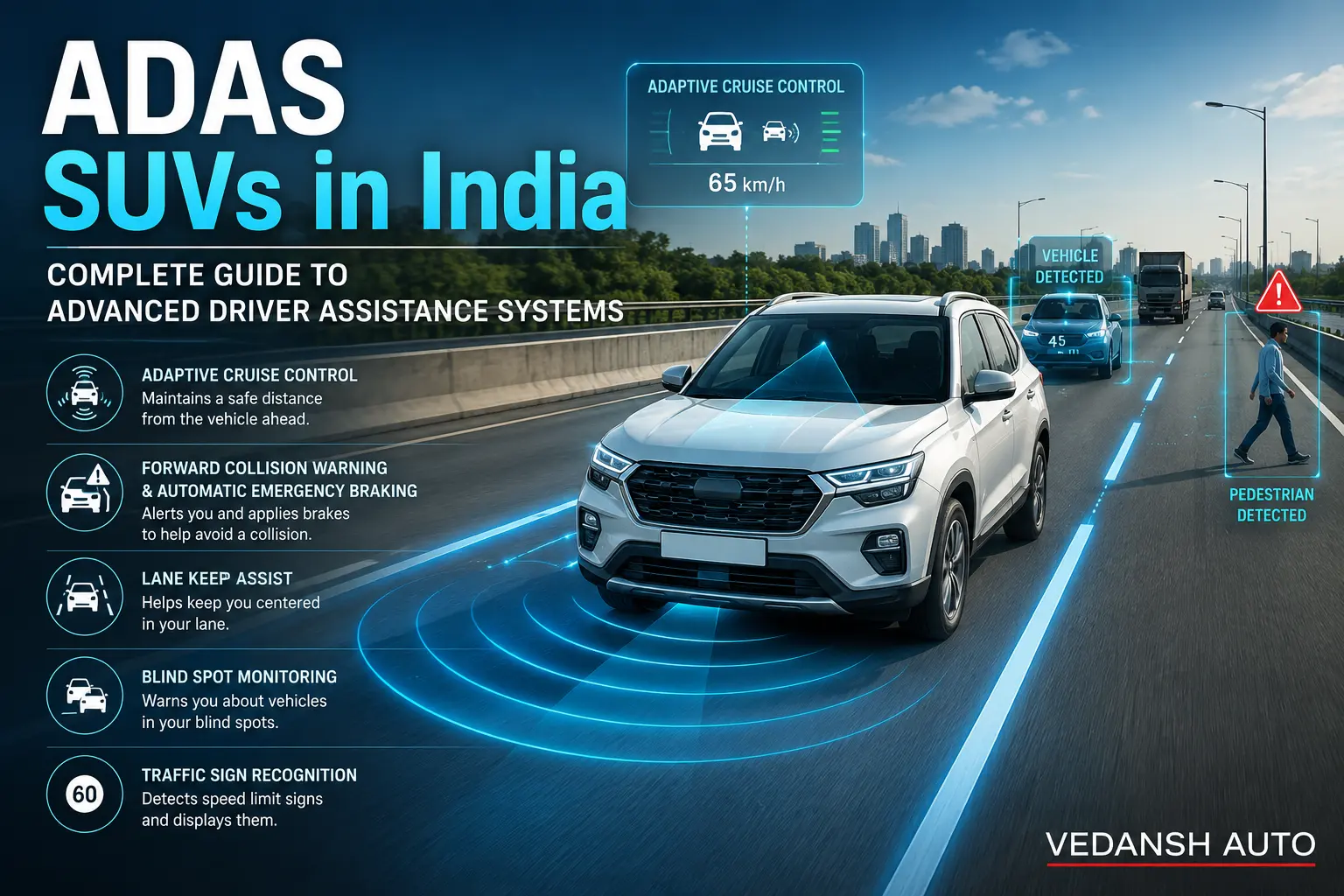
Standard safety equipment across all variants includes six airbags, front disc brakes, electronic stability control, and TPMS. Rear disc brakes and an electronic parking brake with auto hold come in on the HX8 and HX10 only. Lower variants get rear drum brakes. The top HX10 variant gets Level 2 ADAS with Hyundai SmartSense, which covers adaptive cruise control, lane keep assist, autonomous emergency braking, high beam assist, and park collision avoidance. The HX10 also gets a 360-degree surround view monitor with a blind view monitor.
For buyers who prioritise safety, the Venue 2026 is one of the strongest options in the segment.
Variants and Pricing
Prices below are approximate ex-showroom and based on publicly available dealer data. Verify with your nearest Hyundai dealer before booking, as prices vary by city and are subject to change.
| Variant | Transmission | Ex-Showroom Price (approx.) |
| HX2 1.0 Turbo | 6MT | Rs. 8.90 lakh |
| HX5 1.0 Turbo | 6MT | Rs. 9.90 lakh |
| HX5 1.0 Turbo | DCT | Rs. 10.91 lakh |
| HX6 1.0 Turbo | DCT | Rs. 12.17 lakh |
| HX8 1.0 Turbo | 6MT | Rs. 11.91 lakh |
| HX8 1.0 Turbo | DCT | Rs. 12.99 lakh |
| HX10 1.0 Turbo | DCT | Rs. 14.65 lakh |
Dual-tone (DT) variants carry a small premium of approximately Rs. 18,000 on top of the figures above.
Best value pick in the turbo lineup is the HX5 DCT at approximately Rs. 10.91 lakh. It gets cruise control, a sunroof, digital cockpit, and keyless start at a price that does not stretch too far from the base. If you want the full feature package including the Bose system, 360-degree camera, and ADAS, step up to the HX10, but be prepared to spend significantly more.
Verdict
The Hyundai Venue Turbo 2026 is a stronger product than its predecessor in almost every way. The new platform adds space, rigidity, and a genuinely premium cabin that punches above its price. The dual 12.3-inch curved screens are a clear class leader for the segment. The 5-star Bharat NCAP rating gives safety-conscious buyers strong reassurance.
The 1.0-litre turbo petrol engine with the DCT remains the most enjoyable powertrain in the Venue range for most buyers. The mild low-speed DCT hesitation is the only consistent criticism, and it is manageable once you get used to the car.
Who should buy it: Buyers who want a premium, tech-forward compact SUV for a mix of city and highway use. If the cabin experience matters and you want connected car tech, ADAS, and a strong safety rating in one package under Rs. 15 lakh, the Venue Turbo is a very strong choice.
Who should think twice: Buyers who spend 90% of their time in dense stop-and-go city traffic. In that use case, the DCT low-speed behaviour can get tiring. Consider the 6MT variant instead, or look at rivals with a traditional torque converter automatic.
Pros:
- Dual 12.3-inch curved displays on HX10, class-first for sub-4m SUVs
- 5-star Bharat NCAP safety rating
- Strong mid-range performance from the 1.0 T-GDi
- New K1 platform: more space, better rigidity
- Level 2 ADAS on HX10
- Wide variant spread from HX2 to HX10 gives buyers genuine choice
Cons:
- DCT hesitates at crawling speeds in heavy traffic
- Premium features only available in top variants
- Top variants command a noticeable premium
📚 Also Read