Maruti Suzuki Posts Record Q2 Sales of 6.97 Lakh Units, But Profit Falls 27%
 Published on 28 October 2026
Maruti Suzuki India Limited (MSIL) has reported its highest-ever quarterly sales for July-September 2026, with strong growth in both small cars and SUVs. Profit, however, came under pressure from higher commodity costs and investment losses.
The Board approved the Q2 and H1 FY 2026-27 results on 27 October 2026.
Quick summary: Q2 FY 2026-27
| Metric | Q2 FY26-27 | Q2 FY25-26 |
| Total sales volume | 696,654 units | Up 26.5% YoY |
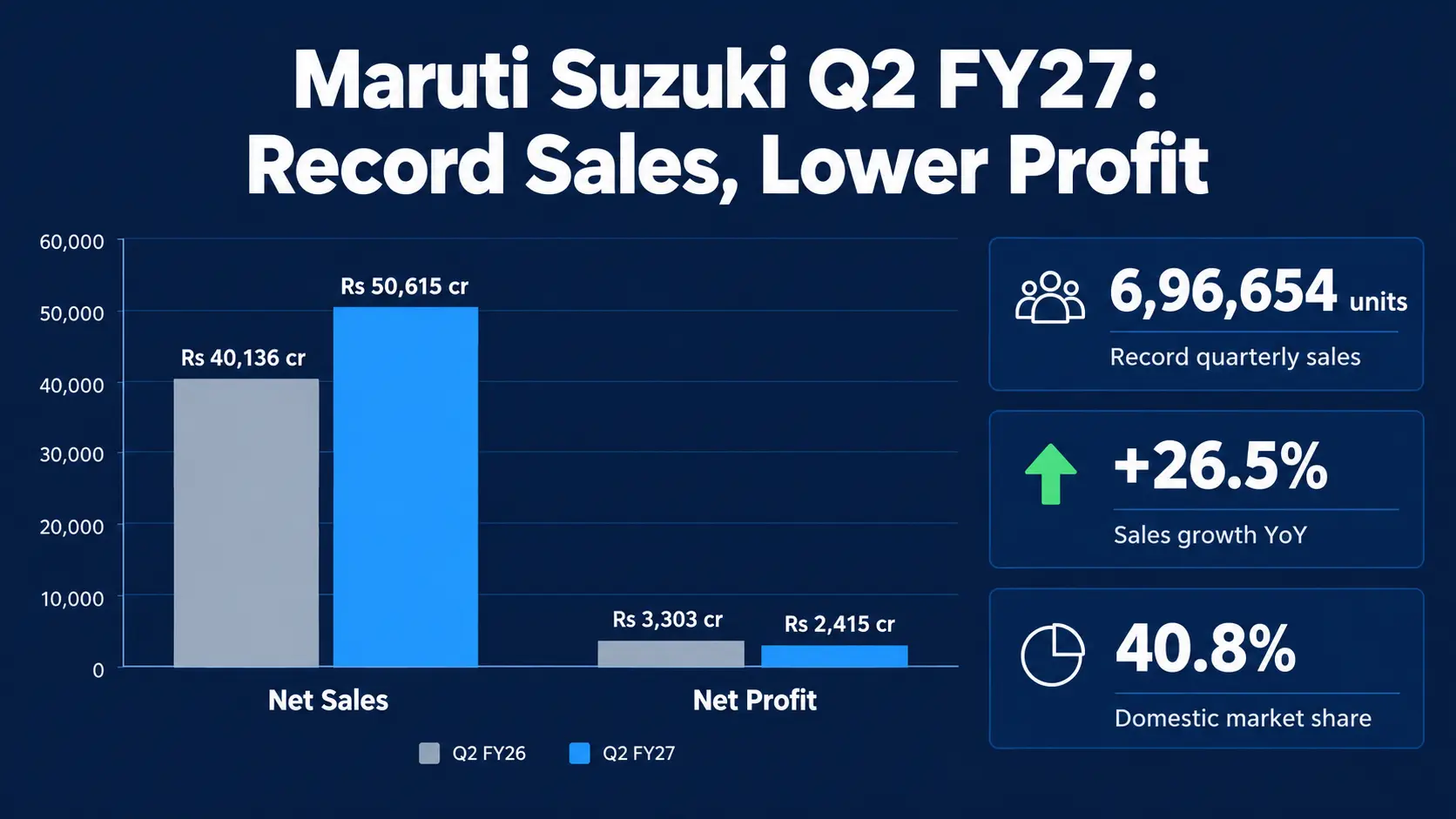
| Net sales | Rs 50,615 crore | Rs 40,136 crore |
| Operating profit (EBIT) | Rs 2,804 crore | Rs 3,382 crore |
| Net profit | Rs 2,415 crore | Rs 3,303 crore |
| Exports | 108,119 units | 110,487 units |
Record volumes, driven by small cars and SUVs
MSIL sold 696,654 units in the quarter, its best ever, and 26.5% higher than the same period last year. Growth in the domestic passenger vehicle market was broad-based:
- Small car sales grew 35.9%.
- SUV sales grew 68.2%.
The company said its recently introduced SUVs got a strong market response and contributed to this growth.
Market share rises to 40.8%
Domestic market share went up by 2.2 percentage points to 40.8%. Demand is still ahead of supply, even after recent capacity additions. At the end of the quarter, network inventory was only about 17 days, and pending bookings stood at about 2 lakh units. For buyers, this suggests waiting periods on popular models may continue.
Exports slip slightly
Exports were 108,119 units, slightly lower than 110,487 units a year ago (a fall of about 2%). The company said this came amid a challenging geopolitical situation.
Record revenue, but profit is lower
Net sales touched a record Rs 50,615 crore, up about 26% from Rs 40,136 crore. Profit moved the other way:
- Operating profit (EBIT) was Rs 2,804 crore, down about 17% from Rs 3,382 crore. MSIL blamed commodity price increases linked to the West Asia conflict. On a quarter-on-quarter basis, EBIT grew 10.8% over Q1 FY27.
- Net profit was Rs 2,415 crore, down about 27% from Rs 3,303 crore. The company said non-operating income fell sharply due to mark-to-market losses on its invested surplus.
H1 FY 2026-27 (April-September)
| Metric | H1 FY27 | H1 FY26 |
| Total sales volume | 1,379,378 units | Up 27.9% YoY |
| Domestic sales | 1,146,523 units | Not stated |
| Exports | 232,855 units | Not stated |
| Net sales | Rs 1,00,575 crore | Rs 76,756 crore |
| Net profit | Rs 5,767 crore | Rs 7,061 crore |
MSIL’s half-yearly sales of 1,379,378 units are also its highest ever. Net sales crossed Rs 1 lakh crore for the first half of a financial year, though net profit was about 18% lower than last year.
Osamu Suzuki Centre of Excellence announced
The Board also approved setting up a Section 8 company for the Osamu Suzuki Centre of Excellence. It is named to honour the late Osamu Suzuki, who helped transform the Indian car industry over more than four decades.
The Centre will use Japanese manufacturing philosophy and Mr. Suzuki’s teachings to promote vocational and future-ready technical skills across Indian manufacturing. It will operate as a Corporate Social Responsibility (CSR) activity.
What this means for car buyers
Strong bookings and low dealer stock show that demand for Maruti Suzuki cars remains high. The rising SUV share also shows buyers are moving to newer models. The profit pressure is a company-level issue, and the release does not mention any price changes.
FAQs
What were Maruti Suzuki’s Q2 FY 2026-27 sales?
Maruti Suzuki sold 696,654 units in Q2 FY 2026-27, its highest-ever quarterly total and 26.5% higher than last year.
What is Maruti Suzuki’s market share now?
Domestic market share rose by 2.2 percentage points to 40.8% in Q2 FY 2026-27.
Why did Maruti Suzuki’s profit fall in Q2?
Operating profit fell because of commodity price increases linked to the West Asia conflict. Net profit fell further due to mark-to-market losses on invested surplus.
How many bookings are pending?
Pending bookings were about 200,000 units at the end of the quarter, with network inventory at about 17 days.
What is the Osamu Suzuki Centre of Excellence?
It is a CSR initiative approved by the Board to spread Japanese manufacturing philosophy and build technical skills across India’s manufacturing sector.