2026 Maruti Baleno Level 2+ ADAS Explained
Published on 14 September 2026
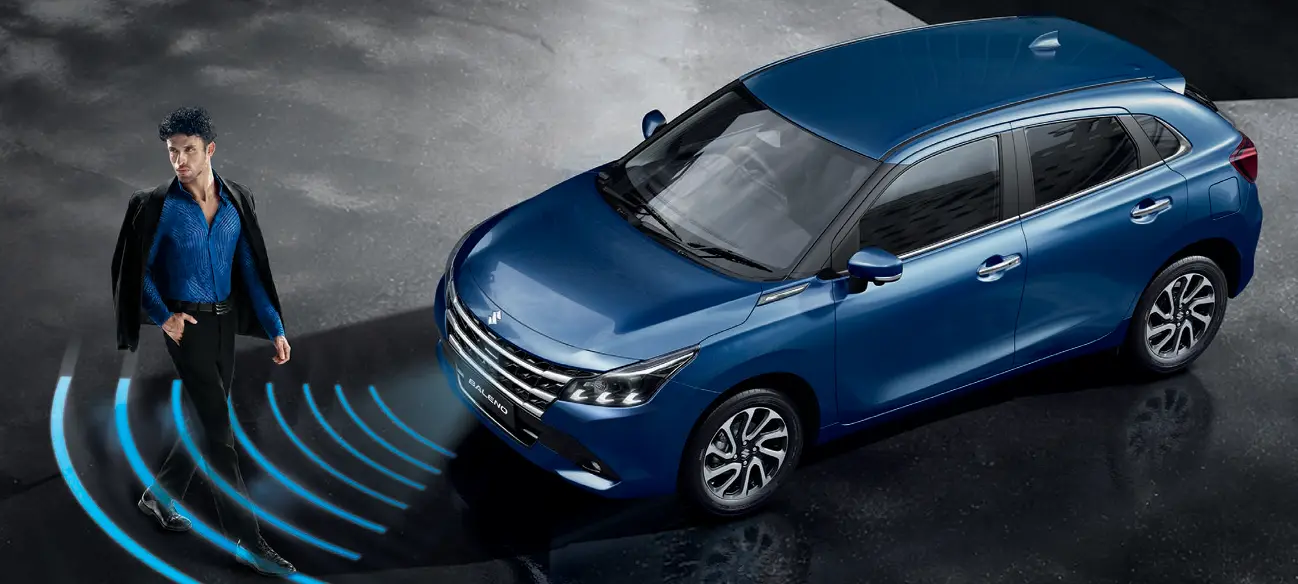
The 2026 Maruti Baleno facelift gets one of its biggest technology upgrades in the form of Level 2+ Advanced Driver Assistance Systems (ADAS).
The system is available only on the top-spec Alpha (O) variant. It combines a monocular camera and millimetre-wave radar to monitor the road ahead and assist the driver in situations such as maintaining a safe following distance, staying within the lane and responding to potential collisions.
The Baleno’s ADAS package includes Adaptive Cruise Control, Lane Keep Assist, Lane Departure Prevention, Lane Departure Warning, Advanced Emergency Braking, Forward Collision Warning, High Beam Assist and Vehicle Sway Warning.
Maruti Suzuki describes these as driver-assistance features rather than a replacement for the driver. The system can support the driver, but the person behind the wheel remains responsible for controlling the vehicle and paying attention to the road.
So, what exactly does the Baleno’s Level 2+ ADAS package do?
What is Level 2+ ADAS in the Baleno?
ADAS stands for Advanced Driver Assistance Systems. These systems use sensors, cameras and software to monitor the vehicle’s surroundings and provide assistance in specific driving situations.
In the 2026 Baleno, the ADAS system uses a monocular camera and millimetre-wave radar. The camera helps the system identify road features and objects, while the radar helps detect objects and their relative movement. The two work together to provide the assistance functions available on the Alpha (O).
It is important to understand what this means. Level 2 assistance does not make the car self-driving. The driver still has to remain alert and be ready to take control.
Which Baleno gets Level 2+ ADAS?
The ADAS package is exclusive to the Alpha (O) variant.
The lower Sigma, Delta, Zeta and Alpha variants do not get the ADAS functions.
The Alpha (O) is available with both the 5-speed manual and 5-speed AMT petrol powertrains. There is no CNG version of the Alpha (O).
This means buyers do not have to choose an automatic Baleno to get ADAS. The feature is available with the manual as well.
Baleno ADAS features explained
The 2026 Baleno gets eight main ADAS functions. Here’s what each one means in everyday driving.
1. Adaptive Cruise Control
Adaptive Cruise Control (ACC) goes beyond conventional cruise control.
A conventional cruise control system maintains a speed selected by the driver. Adaptive Cruise Control can also monitor the vehicle ahead and adjust the Baleno’s speed to maintain a suitable gap.
Maruti Suzuki specifically lists Adaptive Cruise Control with Curve Speed Reduction on the Alpha (O).
This can be particularly useful on highways, where maintaining a steady speed while repeatedly adjusting for slower traffic can become tiring.
For example, if the Baleno is travelling at a set speed and approaches a slower vehicle ahead, the system can reduce the car’s speed. When the road ahead clears, it can resume the set speed, subject to system conditions.
Maruti’s official Baleno website describes ACC as adjusting the car’s speed to maintain a safe distance from the vehicle ahead.
However, ACC should not be treated as a substitute for watching the road.
2. Lane Keep Assist
Lane Keep Assist (LKA) helps the car remain within its lane.
The system monitors lane markings and can provide steering assistance when it detects that the vehicle is moving away from its intended lane.
Maruti describes LKA as using sensor technology to monitor road markings and provide steering assistance to help maintain the intended lane.
This can be useful on highways and other roads with clearly visible lane markings, particularly when the driver makes a small unintended deviation.
It does not mean the Baleno can safely drive itself around corners or navigate traffic without driver input.
3. Lane Departure Prevention
Lane Departure Prevention (LDP) takes the lane-assistance system a step further.
While Lane Departure Warning alerts the driver when the car is moving out of its lane, Lane Departure Prevention is designed to help prevent the departure by providing corrective assistance.
Maruti Suzuki lists both Lane Keep Assist and Lane Departure Prevention separately, which means they should not be treated as the same function.
As with other ADAS functions, the effectiveness of the system depends on factors such as road conditions, lane markings and the circumstances in which the system is operating.
4. Lane Departure Warning
Lane Departure Warning (LDW) alerts the driver when the system detects an unintended movement out of the lane.
Unlike Lane Departure Prevention, the warning function does not mean that the system is actively steering the car back into its lane.
Maruti lists LDW separately from LKA and LDP.
This distinction matters because ADAS features often get grouped together even though they perform different jobs.
5. Advanced Emergency Braking
Advanced Emergency Braking (AEB) is one of the most important safety features in the Baleno’s ADAS package.
The system is designed to detect potential collisions and, when appropriate, apply braking assistance to help reduce the severity of or avoid a collision.
The AEB system includes detection for:
- Cars ahead
- Stationary cars
- Motorcycles ahead
- Stationary motorcycles
- Pedestrians ahead
- Crossing pedestrians
- Bicycles ahead
- Crossing bicycles
Maruti’s official description says that Automatic Emergency Braking can detect potential collisions and apply braking force autonomously to help mitigate the risk.
This is an important safety aid, but it should not be interpreted as a guarantee that every collision will be prevented.
6. Forward Collision Warning
Forward Collision Warning (FCW) works as an alert system for potential frontal collisions.
- Cars ahead
- Stationary cars
- Motorcycles ahead
- Stationary motorcycles
- Pedestrians ahead
- Crossing pedestrians
- Bicycles ahead
- Crossing bicycles
The important difference is that Forward Collision Warning is primarily an alert, whereas Advanced Emergency Braking can intervene with braking when the system determines that intervention is necessary.
In simple terms, FCW can warn the driver about a potential collision, while AEB can provide braking assistance in certain situations.
7. High Beam Assist
High Beam Assist (HBA) helps manage the use of the car’s high beam.
The system can detect relevant conditions ahead and assist with switching between high and low beam to avoid unnecessarily dazzling other road users.
Maruti Suzuki lists High Beam Assist as one of the eight ADAS functions available on the Alpha (O).
This is particularly useful during night driving on roads where the driver frequently encounters oncoming traffic.
It is more of a convenience and visibility feature than a collision-avoidance system, but it is still part of the Baleno’s ADAS package.
8. Vehicle Sway Warning
Vehicle Sway Warning is designed to identify signs of unusual vehicle movement or driver behaviour associated with the vehicle moving around within the lane.
Vehicle Sway Warning is separate from the lane-related assistance systems.
This is particularly relevant during long highway journeys, where driver fatigue can become a concern.
It should be viewed as an additional warning system rather than a system that can determine whether a driver is actually tired or impaired.
Baleno ADAS: camera + radar combination
One of the interesting aspects of the 2026 Baleno is the hardware used for its ADAS system.
The level 2 ADAS uses a monocular camera and millimetre-wave radar to read the road ahead.
Using two sensing technologies allows the system to gather different types of information about the road environment.
The camera can interpret visual information such as lane markings and objects, while radar can assist with detecting objects and their relative movement.
The combination is then used by the vehicle’s electronic systems to provide functions such as ACC, lane assistance, collision warnings and emergency braking.
What can the Baleno ADAS actually do?
It is useful to divide the eight functions into three broad groups.
Helps maintain speed and distance
Adaptive Cruise Control can adjust the vehicle’s speed according to traffic ahead while maintaining a suitable following distance.
Helps keep the car in its lane
Lane Keep Assist, Lane Departure Prevention and Lane Departure Warning work together to monitor lane position, warn the driver and provide assistance where appropriate.
Helps respond to potential hazards
Forward Collision Warning and Advanced Emergency Braking are designed to identify potential forward collisions and either alert the driver or provide braking assistance.
High Beam Assist helps with night-time lighting, while Vehicle Sway Warning adds another layer of driver assistance.
Does the Baleno’s ADAS make it a self-driving car?
No.
This is probably the most important thing buyers should understand about ADAS.
The term “Level 2” can sound more advanced than it actually is. The technology can assist with steering, braking and acceleration in specific circumstances, but it does not turn the Baleno into an autonomous vehicle.
Maruti states that ADAS is not a substitute for human eye and driver vigilance. It also says system performance can vary according to road and driving conditions and that the driver remains responsible for safe, vigilant and attentive driving.
Therefore, the driver should continue to:
- Watch the road
- Keep their hands and attention ready for driving
- Follow traffic rules
- Be prepared to take control
- Avoid relying on ADAS to handle a situation automatically
ADAS should be thought of as driver assistance, not driver replacement.
When could Baleno ADAS be most useful?
The technology is likely to be most useful in situations where the driver has to repeatedly make small adjustments.
Highway driving
Adaptive Cruise Control can reduce the need to constantly adjust the accelerator when traffic speeds change.
Lane assistance can also be useful on highways with clearly visible lane markings.
Long-distance journeys
Features such as ACC, lane assistance and Vehicle Sway Warning can provide additional assistance during longer drives.
They do not remove the need for breaks or driver attention, but they can reduce some of the workload.
Night driving
High Beam Assist can make night driving more convenient by helping manage the high beam.
Sudden forward hazards
Forward Collision Warning and Advanced Emergency Braking are designed to provide assistance when the system detects a potential forward collision.
What else does the Baleno Alpha (O) offer?
The Alpha (O) is not simply an Alpha with ADAS added.
It already gets the Baleno’s higher-end equipment, including a 360 View Camera, Head Up Display, wireless charging with active cooling, ventilated front seats, leatherette upholstery, Clarion premium sound system and 22.86 cm SmartPlay Pro+ infotainment system.
The variant therefore combines ADAS with the Baleno’s most comprehensive comfort and technology package.
It is also the only variant in the range with the full ADAS suite.
Is Level 2+ ADAS worth paying more for?
That depends on how and where you drive.
If most of your driving is in congested city traffic at low speeds, features such as Adaptive Cruise Control and lane assistance may not be used as frequently as they would be on highways.
For buyers who regularly travel on expressways and highways, however, ACC, lane assistance, collision warning and emergency braking can be more useful.
The other consideration is that the Alpha (O) already includes several premium features. So the decision is not simply about paying extra for ADAS. Buyers are also getting the higher-spec cabin, 360 View Camera, HUD, ventilated seats and premium sound system.
2026 Baleno ADAS: Feature summary
| ADAS feature | What it does |
| Adaptive Cruise Control | Adjusts speed to maintain a suitable gap from traffic ahead |
| Lane Keep Assist | Provides steering assistance to help maintain lane position |
| Lane Departure Prevention | Helps prevent unintended lane departure |
| Lane Departure Warning | Warns the driver about lane departure |
| Advanced Emergency Braking | Can apply braking assistance when a potential collision is detected |
| Forward Collision Warning | Warns the driver about a potential forward collision |
| High Beam Assist | Assists with high/low beam management |
| Vehicle Sway Warning | Warns about unusual vehicle movement/sway |
The exact operation of each function can depend on road, traffic, weather, lane-marking and other conditions. The manufacturer’s documentation should be treated as the final reference for system operation.
Final verdict
The 2026 Maruti Baleno’s Level 2+ ADAS package is one of the most significant additions to the facelift.
The system combines a monocular camera and millimetre-wave radar and brings eight driver-assistance functions to the top-spec Alpha (O): Adaptive Cruise Control, Lane Keep Assist, Lane Departure Prevention, Lane Departure Warning, Advanced Emergency Braking, Forward Collision Warning, High Beam Assist and Vehicle Sway Warning.
The most useful features for many buyers are likely to be Adaptive Cruise Control, lane assistance, Forward Collision Warning and Advanced Emergency Braking, particularly during highway driving.
But the technology should not be confused with autonomous driving. The driver remains responsible for monitoring the road and controlling the vehicle at all times.
For buyers who regularly drive on highways and want the additional assistance, the Alpha (O) makes the Baleno considerably more interesting than the lower variants. For those who mainly drive in city traffic, the value of ADAS will depend more on how frequently they use the car on open roads.
The bigger takeaway is that ADAS is no longer limited to expensive SUVs and premium cars. With the facelift, Maruti Suzuki has brought radar-and-camera-based driver assistance to the Baleno’s segment, making the technology accessible to a much wider group of Indian car buyers.