What Is Electronic Stability Control in a Car and How Does It Work?
Published on 28 August 2026
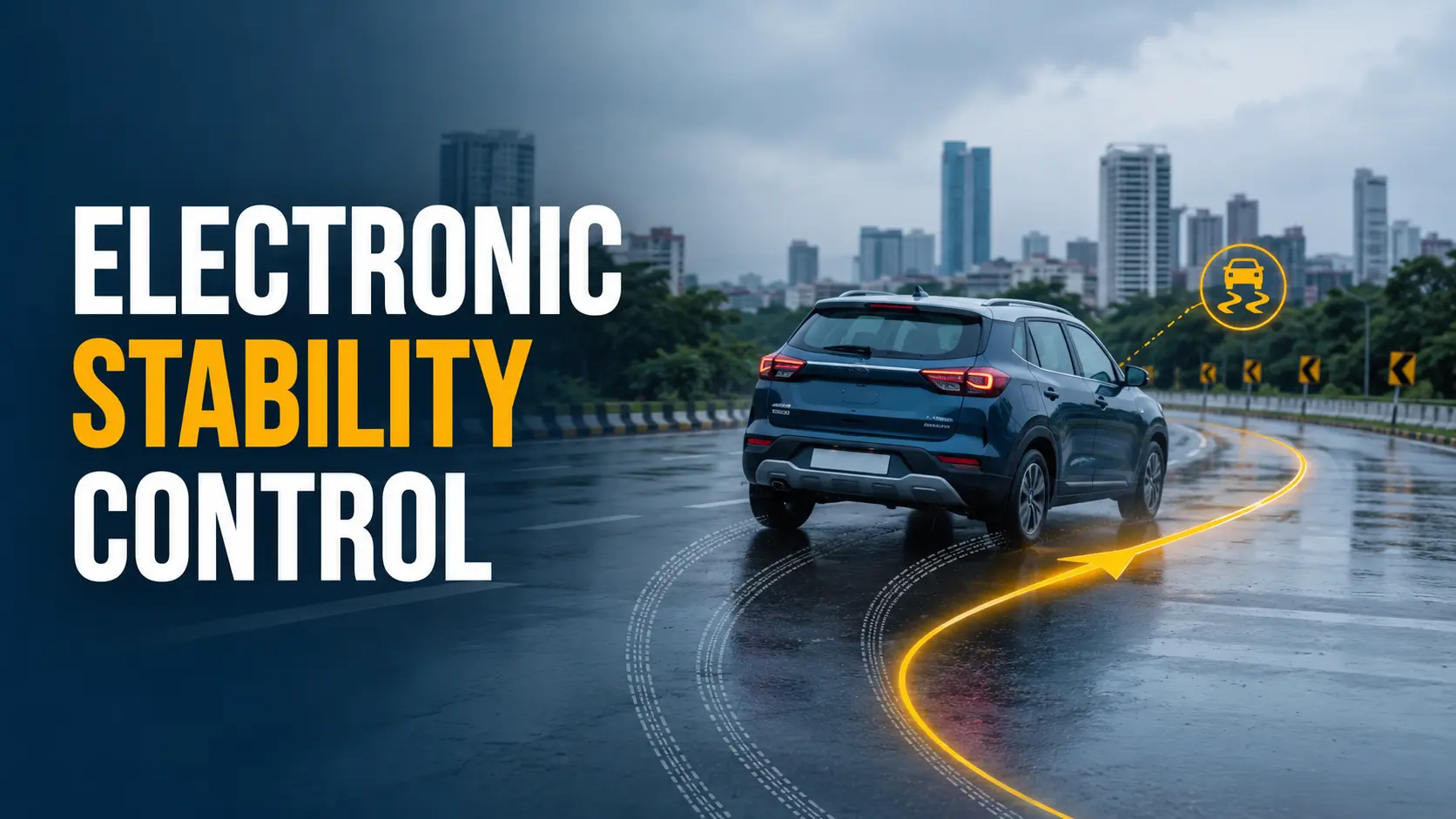
Imagine taking a sharp turn on a wet road and suddenly feeling the car slide away from the direction in which you are steering. Your hands are turning the wheel one way, but the car continues moving in another. This is exactly the type of situation in which Electronic Stability Control can help.
Electronic Stability Control (ESC) is an active safety feature available in many modern cars, although it may not be standard on every model or variant. It works quietly in the background and intervenes when it detects that the car is beginning to lose stability or move away from the driver’s intended path.
ESC cannot prevent every accident. It also cannot compensate for excessive speed, worn tyres or careless driving. However, during a sudden skid, it can improve the driver’s chances of maintaining or regaining control.
In this guide, we explain what ESC is, how it works, when it activates and why it is particularly useful on Indian roads.
What Is Electronic Stability Control?
Electronic Stability Control, commonly known as ESC, is a safety system that helps the driver maintain directional control when the car begins to skid.
The system monitors the movement of the car and compares it with the direction in which the driver is steering. If it detects that the vehicle is not following the intended path, it can automatically brake selected wheels and reduce engine power.
The driver continues steering throughout this process. ESC works in the background to help the car move closer to the intended direction.
Different manufacturers use different names for this technology:
- ESC: Electronic Stability Control
- ESP: Electronic Stability Programme
- VSC: Vehicle Stability Control
- VSA: Vehicle Stability Assist
- DSC: Dynamic Stability Control
The names may differ, but their main purpose is broadly the same: to help the driver maintain control when the car begins to lose directional stability.
How Does ESC Work?
ESC constantly receives information from sensors located around the car. Depending on the system, these sensors monitor:
- Steering-wheel position
- Speed of each wheel
- Direction in which the car is moving
- Sideways movement of the vehicle
- Rotation of the car around its vertical axis, known as yaw
The system compares where the driver wants the car to go with where it is actually moving. It performs this comparison several times every second.
If ESC detects a significant difference, it can:
- Apply braking force to one or more individual wheels
- Reduce engine power
- Create a corrective turning force
- Help the car move closer to the driver’s intended path
For example, suppose a driver enters a curve slightly too quickly and the front of the car begins sliding towards the outside of the turn. ESC can detect the difference between the steering input and the car’s actual direction. It may then brake selected wheels and reduce engine power to help stabilise the car.
The exact intervention varies according to the vehicle, road conditions, speed, direction of the skid and the way the system has been calibrated.
When Does ESC Activate?
ESC does not wait for a collision to happen. It can intervene as soon as it detects that the vehicle is losing directional stability.
Common situations in which ESC may activate include:
- Taking a corner faster than the available tyre grip allows
- Driving on a wet, sandy or slippery road
- Making a sudden steering movement to avoid an obstacle
- One side of the car moving onto gravel or a broken road edge
- The car beginning to understeer or oversteer
- Changing lanes suddenly at a relatively high speed
- Braking while turning on a slippery road
For example, a driver may need to swerve suddenly on a highway to avoid an obstacle. If the rear of the car begins to swing out, ESC can brake selected wheels and manage engine power to help stabilise the vehicle.
When ESC activates, the driver may notice:
- The ESC warning light flashing on the dashboard
- A brief reduction in acceleration
- Braking from one or more individual wheels
- A pulsing sensation through the car
These signs normally indicate that the system is working. The driver should ease off the accelerator, avoid sudden steering inputs and continue looking in the intended direction of travel.
Understeer and Oversteer Explained Simply
The terms understeer and oversteer frequently appear in explanations of ESC. Both describe situations in which the car is not following the direction intended by the driver.
Understeer
Understeer occurs when the front tyres lose grip before the rear tyres.
The car turns less than the driver intends and moves towards the outside of the corner. It may feel as if the vehicle wants to continue straight even though the steering wheel is turned.
Oversteer
Oversteer occurs when the rear tyres lose grip before the front tyres.
The rear of the car begins to slide outwards and the vehicle turns more sharply than the driver intends. If the slide becomes severe, the car may begin to spin.
ESC responds differently depending on how the vehicle is losing stability. It can brake selected wheels and reduce engine power to create a corrective turning force. The exact wheels it brakes depend on the direction of the skid, vehicle speed and system calibration.
ESC vs Traction Control: What Is the Difference?
Many car buyers confuse ESC with traction control because both systems use similar sensors and braking components. However, they solve different problems.
| Feature | Electronic Stability Control | Traction Control |
| Main purpose | Helps the car follow the driver’s intended direction | Reduces excessive wheelspin |
| When it works | When the vehicle begins to lose directional stability | When a driven wheel loses grip during acceleration |
| What it controls | Braking at selected wheels and engine power | Mainly engine power and braking of a spinning wheel |
| Common situation | A sudden turn or emergency lane change | Accelerating on a wet or loose surface |
Suppose you accelerate hard from a standstill on a wet road and one of the driven wheels begins spinning. Traction control can reduce engine power or brake the spinning wheel so that it regains grip.
If the complete vehicle begins sliding away from the direction in which you are steering, ESC intervenes to improve directional stability.
Traction control is normally included as part of the broader ESC system rather than being a completely separate unit.
ESC vs ABS: Are They the Same?
ESC and ABS, or Anti-lock Braking System, are related, but they are not the same.
- ABS helps prevent the wheels from locking during hard braking.
- Preventing wheel lock allows the driver to retain some steering control while braking.
- ESC helps the vehicle follow the direction intended by the driver.
- ESC uses wheel-speed sensors and braking components shared with the ABS.
- ESC can apply braking force to individual wheels even when the driver is not pressing the brake pedal.
In simple terms, ABS helps prevent wheel lock during hard braking, while ESC helps the car follow the direction in which the driver is steering.
Electronic Brakeforce Distribution (EBD) is another related feature. It adjusts braking force between the front and rear wheels according to factors such as vehicle load and available grip. It works with ABS but performs a different function from ESC.
ESC vs Hill Hold Assist
Buyers comparing car variants often see ESC and Hill Hold Assist listed together. They are separate features.
Hill Hold Assist briefly maintains brake pressure when the driver moves from the brake pedal to the accelerator on an incline. This helps stop the car from rolling backwards while starting.
ESC helps maintain directional stability when the vehicle begins to skid or move away from the driver’s intended path. It can work on flat roads, corners and inclines.
The two features may share some sensors and braking components, but they are designed for different situations.
Why Is ESC Important on Indian Roads?
Indian roads can present several situations in which ESC may prove useful:
- Sudden lane changes to avoid potholes, animals or slow-moving vehicles
- Slippery roads during the monsoon
- Sand, gravel or broken tarmac near the edge of a road
- Sharp exits and loop ramps on expressways
- Emergency braking while turning
- Blind bends on hill roads
- Sudden changes in grip between different road surfaces
ESC is useful in hatchbacks, sedans, MPVs and SUVs. It can be particularly valuable in taller vehicles because their higher centre of gravity can make sudden direction changes more demanding.
However, body type alone does not determine stability. Tyres, speed, suspension, track width, weight distribution, road surface and vehicle load also affect how a car responds during an emergency manoeuvre.
Can ESC Prevent an Accident?
ESC can reduce the risk of losing control in many situations, but it works within the physical limits of the car and its tyres.
It may not prevent an accident if:
- The car is travelling far too quickly for the conditions
- The tyres are worn, damaged or underinflated
- The road offers almost no grip
- The vehicle begins aquaplaning
- The driver makes an extreme steering input
- There is not enough space to avoid an obstacle
ESC makes better use of the grip available at the tyres, but it cannot create additional grip on an extremely slippery surface.
It should be treated as an additional safety net, not permission to drive faster. Maintaining a safe speed, using good-quality tyres and leaving enough distance from other vehicles remain essential.
What Does the ESC Warning Light Mean?
The ESC warning light can mean different things depending on whether it flashes or remains continuously illuminated.
The light flashes while driving
A flashing light usually means that ESC or traction control is actively intervening. The system may be reducing wheelspin, managing engine power or applying braking force to selected wheels.
Occasional flashing on a wet or loose surface is normally not a fault. However, repeated activation during ordinary driving may indicate that you are driving too quickly for the available grip or that the tyres need inspection.
The light remains on
A light that stays on continuously may mean:
- ESC has been manually switched off
- The system has detected a fault
- An ABS or wheel-speed sensor needs inspection
- Another related electronic component has developed a problem
Check whether ESC has been switched off accidentally. If the light remains on after restarting the car, drive cautiously and arrange an inspection.
Avoid high speeds and sudden manoeuvres because the stability system may not be available. If the ABS or brake warning light also appears, follow the instructions in the owner’s manual and seek assistance promptly.
Should You Ever Turn ESC Off?
ESC should normally remain switched on during regular road driving.
Temporarily reducing or switching off its intervention may be useful when:
- The car is stuck in deep mud or sand
- Some wheelspin is required to free the vehicle
- The manufacturer recommends it for a particular off-road situation
Depending on the car, pressing the ESC button may only switch off traction control or reduce stability-control intervention. It may not disable the complete system.
Some vehicles automatically reactivate ESC when the engine is restarted or when the car crosses a particular speed. The exact behaviour varies, so check the owner’s manual before switching anything off.
Is ESC Available in All Cars and Variants?
Do not assume that every car or every variant comes with ESC. Its availability can differ according to:
- Model
- Variant
- Engine
- Transmission
- Model year
One car may offer ESC across its entire range, while another may reserve it for selected variants. Carmakers may also update their safety equipment without making major changes to the exterior.
The most reliable way to confirm availability is to check the latest official brochure and the variant-wise safety feature list before booking.
Should You Buy a Car Without ESC?
If two cars meet your requirements and one offers ESC while the other does not, the car with ESC should generally receive preference, provided its overall safety package is also satisfactory.
However, ESC should not be considered in isolation. Also examine:
- Structural crash protection
- Number and placement of airbags
- ABS with EBD
- Three-point seat belts
- Tyre quality
- Braking performance
- Electronic safety features
- Crash-test results, where available
Check the year of the crash test, the variant tested and the assessment protocol. An older safety rating may not be directly comparable with a newer Bharat NCAP or Global NCAP result.
Active safety features such as ESC help reduce the chances of losing control. Passive safety features such as airbags, seat belts and structural protection help protect occupants if a collision occurs. A well-rounded safety package needs both.
How to Check Whether a Car Has ESC
Follow these steps before booking a new car:
- Download the latest official brochure for the model.
- Open the variant-wise feature table.
- Look under the safety section.
- Search for ESC, ESP, VSC, VSA or DSC.
- Check whether it is standard or limited to selected variants.
- Confirm the feature with the dealer.
- Make sure it appears on the final variant specification sheet.
Do not rely only on verbal confirmation or an online listing because specifications can change.
Final Verdict
Electronic Stability Control is an important active safety feature that can help a driver maintain directional control during a skid or sudden manoeuvre. It is particularly valuable during emergency lane changes, sharp turns and driving on wet or slippery roads.
ESC cannot overcome excessive speed, worn tyres or a complete loss of grip. However, it adds a useful safety net that can reduce the risk of a developing skid becoming harder to control.
If you are choosing between two suitable variants, prioritising the one with ESC is a sensible decision.
FAQs
Is ESC the same as ESP?
Yes. ESP stands for Electronic Stability Programme and is another name used for electronic stability control. Manufacturers may use different names, but the basic purpose is similar.
Is ESC useful at low speeds?
ESC can intervene at different speeds depending on the vehicle and situation. Its stability benefit becomes particularly important when enough speed and steering force are present for the car to lose directional control.
Does ESC work on wet roads?
Yes. ESC can be particularly helpful on wet roads because reduced tyre grip makes a skid more likely. However, it cannot prevent aquaplaning or create grip where none is available.
Can ESC stop a car from skidding?
ESC can detect developing instability and intervene before the skid becomes harder to control. However, it cannot prevent every skid or restore grip once the tyres have exceeded their physical limits.
Is ESC more important in an SUV?
ESC is important in every type of car. It can be particularly valuable in taller vehicles because their higher centre of gravity can make sudden direction changes more demanding. Tyres, speed, suspension and road conditions also affect stability.
Does ESC reduce engine power?
Yes. ESC can briefly reduce engine power while applying braking force to selected wheels. This helps the system stabilise the car.
Can I drive with the ESC warning light on?
If the light remains on, ESC may be switched off or the system may have developed a fault. Drive cautiously, avoid high speeds and sudden manoeuvres, and arrange an inspection. If the ABS or brake warning light also appears, consult the owner’s manual and seek assistance promptly.
Does ESC work without ABS?
ESC relies on wheel-speed sensors and individually controlled braking components shared with the ABS. A fault in the ABS can therefore prevent ESC from operating correctly.
Should ESC always remain switched on?
Yes, ESC should normally remain switched on during regular road driving. It should only be switched off or reduced temporarily in specific situations recommended by the vehicle manufacturer.
Is ESC the same as Automatic Emergency Braking?
No. ESC helps control a developing skid by braking selected wheels and managing engine power. Automatic Emergency Braking detects a possible collision ahead and applies the brakes if the driver does not respond in time.
How can I check whether my car has ESC?
Check the latest official brochure and its variant-wise safety feature table. Look for terms such as ESC, ESP, VSC, VSA or DSC. You can also check the owner’s manual or confirm the feature with an authorised dealer.