What Is TPMS in a Car and Do You Really Need It?
Published on 1 September 2026
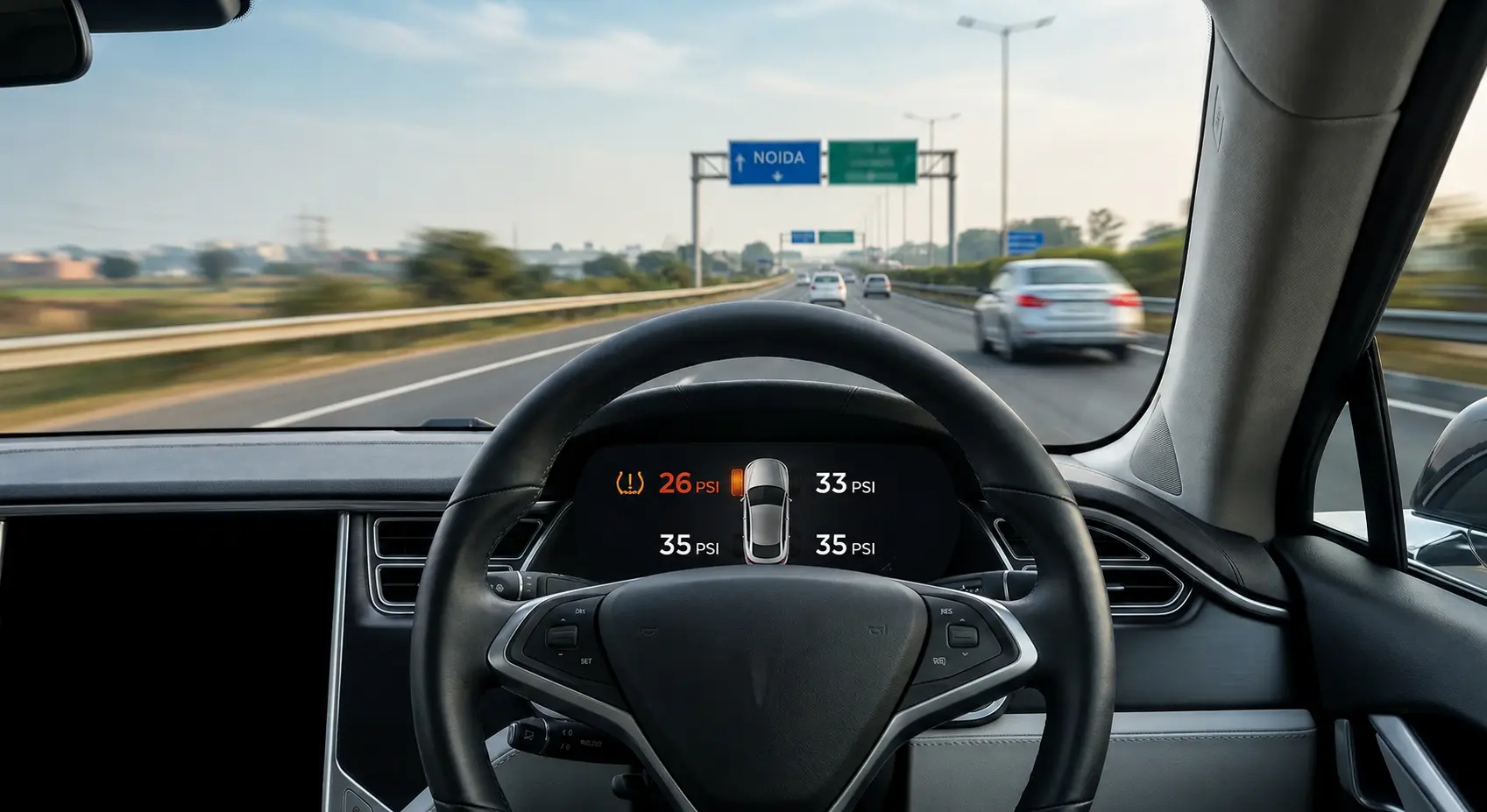
A tyre can lose pressure without looking completely flat. You may notice the problem only when the steering feels heavier, the car starts pulling to one side or the tyre becomes badly damaged. This is where a Tyre Pressure Monitoring System can help.
TPMS monitors the pressure in your car’s tyres and warns you when it detects a problem. It is now available in several popular cars in India, although it may be limited to selected variants.
But how does TPMS work, and is it important enough to influence your car-buying decision? Let us understand.
What Is TPMS in a Car?
TPMS stands for Tyre Pressure Monitoring System. It is an electronic safety feature designed to warn the driver when one or more tyres have low pressure.
Depending on the type of system, the warning may appear as:
- A low tyre-pressure symbol on the instrument cluster
- A message asking you to check the tyres
- Individual pressure readings for all four tyres
- A warning identifying the affected tyre
Some advanced systems can also display tyre temperature.
TPMS does not inflate the tyre or repair a puncture. It only alerts you that the tyre pressure requires attention.
How Does TPMS Work?
The exact working of TPMS depends on the system used in the car. Some systems have pressure sensors fitted inside the wheels. Others use information from the car’s ABS wheel-speed sensors.
For example, imagine that one of your tyres develops a slow puncture after picking up a nail. The tyre may continue losing air while the car is parked or being driven. A TPMS can detect the pressure drop and warn you before the tyre becomes visibly flat.
This gives you an opportunity to stop safely, inspect the tyre and arrange a repair.
Direct TPMS vs Indirect TPMS
There are two main types of tyre-pressure monitoring systems.
| Point | Direct TPMS | Indirect TPMS |
| How it works | Uses pressure sensors fitted to the wheels | Uses ABS wheel-speed data |
| Pressure display | Can show individual tyre pressures | Usually provides a general warning |
| Accuracy | Generally more accurate | May not detect small pressure differences immediately |
| Additional parts | Requires separate sensors | Uses sensors already present in the car |
| Maintenance | Sensor batteries may eventually require replacement | Normally requires less additional hardware maintenance |
| Recalibration | May be needed after sensor or wheel changes | Often needed after adjusting tyre pressure or rotating tyres |
Direct TPMS
A direct system measures the actual air pressure inside each tyre. The sensor sends this information to the car, where it can be displayed on the instrument cluster or infotainment screen.
Direct TPMS is useful because it can tell you which tyre has low pressure. However, its sensors have batteries that may eventually run out. Care is also required while repairing or replacing a tyre because the sensor can be damaged by improper handling.
Indirect TPMS
An indirect system does not measure the air pressure directly. Instead, it uses the car’s wheel-speed sensors to detect changes in how a tyre rotates. An underinflated tyre has a slightly different rolling diameter and may rotate differently from the other tyres.
Indirect TPMS is simpler, but it may only provide a general warning rather than individual pressure readings. It may also need to be reset after the tyres are inflated, rotated or replaced.
Popular Cars in India That Offer TPMS
TPMS is gradually becoming available across different price segments. It is no longer limited to expensive luxury cars.
Some popular models offering TPMS on selected variants include:
| Car model | TPMS availability |
| Hyundai i20 | Available on selected variants |
| Hyundai Grand i10 NIOS | Available on selected variants and editions |
| Hyundai Venue | Highline TPMS available on selected variants |
| Hyundai Creta | Highline TPMS available on selected variants |
| Tata Nexon | Available on selected variants |
| Tata Nexon.ev | Available on selected variants |
| Maruti Suzuki Brezza | Available on selected variants |
| MG Hector | Available on selected variants |
| MG ZS EV | Available on selected variants |
A Highline TPMS can display information for individual tyres instead of giving only a general low-pressure warning.
Feature availability can differ between variants and may change when a manufacturer updates the model. Always check the latest official brochure and variant-wise feature list before booking a car.
What Does the TPMS Warning Light Mean?
The TPMS warning symbol usually looks like a tyre cross-section with an exclamation mark in the centre.
The warning can appear for several reasons:
- One or more tyres have low pressure
- A tyre has developed a slow puncture
- There has been a major change in temperature
- The tyres were recently rotated or replaced
- The system needs to be recalibrated
- A pressure sensor is not working properly
- A sensor battery has run out
If the warning appears while driving, reduce your speed and avoid sudden steering or braking. Stop at a safe place and inspect the tyres.
A tyre may be underinflated even if it does not look flat. Check all four tyres using a reliable pressure gauge. Inflate them according to the pressure recommended by the manufacturer, which is usually mentioned on the driver-side door frame or in the owner’s manual.
If the warning remains after correcting the pressure, the tyre may have a puncture or the TPMS may need to be reset.
What Are the Benefits of TPMS?
Early warning of pressure loss
A slow puncture can go unnoticed for several days. TPMS can warn you before the pressure falls to a more dangerous level.
Better handling and braking
Incorrect tyre pressure can affect steering response, grip and braking performance. Maintaining the correct pressure helps the tyres work as intended.
Improved tyre life
Regularly driving with low pressure can cause uneven wear and excessive heat. Correct inflation may help the tyres last longer.
Better fuel efficiency
Underinflated tyres create additional rolling resistance. This means the engine has to work harder to move the car, which can reduce fuel efficiency.
Greater convenience
Checking pressure manually is still necessary, but TPMS provides an additional layer of monitoring between those checks. This is particularly helpful before or during a long journey.
What Are the Limitations of TPMS?
TPMS is useful, but it cannot detect or prevent every tyre-related problem.
A sudden tyre burst may happen too quickly for the system to provide a useful advance warning. TPMS also cannot identify worn tread, sidewall cracks, wheel-alignment problems or physical damage to a tyre.
Some systems provide a warning only after the pressure has fallen by a certain amount. Therefore, the absence of a warning does not always mean that the pressure is exactly correct.
Direct TPMS sensors can also add to maintenance costs. Their batteries have a limited life, and the sensors may require replacement after several years. They can also be damaged during tyre removal if the technician is not careful.
The spare tyre may not be monitored either. You should check its pressure separately, especially before a highway journey.
Do You Really Need TPMS?
TPMS is not essential for making a car move, but it is a genuinely useful safety feature. It is particularly valuable for:
- People who frequently drive on highways
- Owners who undertake long-distance journeys
- Cars used by several family members
- Drivers who frequently carry passengers or luggage
- Cars fitted with low-profile tyres
- Owners who may forget to check tyre pressure regularly
It can be especially helpful on highways because a pressure problem may otherwise remain unnoticed until the tyre begins affecting the car’s stability.
However, TPMS should not be the only reason to select a considerably more expensive variant. Safety features such as electronic stability control, six airbags and good crash protection may deserve greater priority. If two suitable variants are closely priced, the one with TPMS can offer additional convenience and peace of mind.
Is an Aftermarket TPMS Worth Buying?
You can install an aftermarket TPMS if your car does not have a factory-fitted system. These products generally use either internal or external sensors.
External TPMS
External sensors are attached to the tyre valves in place of the regular valve caps. They are relatively easy to install and can often be transferred to another car.
However, they are exposed to water, dirt, accidental damage and theft. They also need to be removed or handled carefully while inflating the tyres.
Internal TPMS
Internal sensors are fitted inside the wheels. They are better protected and usually provide a cleaner installation. However, fitting them requires removing the tyres from the wheels. Installation is more expensive, and professional fitting is recommended.
Before buying an aftermarket system, check:
- Whether it shows individual tyre pressures
- The claimed accuracy of its readings
- Battery life and battery availability
- Availability of replacement sensors
- Water and dust resistance
- Display visibility during the day
- Warranty and after-sales support
- Whether high-pressure and high-temperature alerts can be adjusted
Avoid buying solely on the basis of the lowest price. An inaccurate or unreliable system can create unnecessary warnings or fail to alert you when there is a genuine problem.
How to Maintain Your TPMS and Tyres
Follow these basic steps to get the most from the system:
- Check tyre pressure manually at least once a month
- Measure pressure when the tyres are cold
- Follow the manufacturer’s recommended pressure
- Check the pressure before a long highway trip
- Inspect tyres for cuts, cracks and uneven wear
- Recalibrate the system when required
- Tell the tyre technician that the wheels have TPMS sensors
- Do not ignore a warning that keeps returning
- Check the spare tyre separately
Do not use the maximum pressure printed on the tyre sidewall as your everyday target. Follow the pressure recommended by the car manufacturer.
Final Verdict
TPMS is more than a fancy display feature. It can provide an early warning of pressure loss, help protect your tyres and reduce the chances of unknowingly driving on an underinflated tyre.
It cannot prevent every puncture or tyre burst, and it does not replace regular pressure checks. Still, it is a valuable safety and convenience feature, particularly for highway users and people who travel long distances.
If your preferred car variant includes TPMS without a large price increase, it is worth having. If your car does not offer it, a reliable aftermarket system can also be useful when installed and maintained properly.
Frequently Asked Questions
Can TPMS detect a puncture?
TPMS can detect the loss of pressure caused by a puncture. It cannot identify the actual object or damage that caused the tyre to lose air.
Can I drive with the TPMS warning light on?
You should not ignore the warning. Reduce your speed, avoid sudden movements and check the tyres at the earliest safe opportunity. Driving on a badly underinflated tyre can damage it and affect vehicle control.
Does TPMS show the exact tyre pressure?
A direct TPMS may display the pressure of each tyre. Some systems provide only a general warning. The information shown depends on the car and the type of TPMS used.
Can TPMS be fitted to an older car?
Yes. Several internal and external aftermarket systems are available. Choose a reliable product that is suitable for your wheel and valve type.
Does TPMS monitor the spare tyre?
In most cars, TPMS monitors only the four tyres being used. The spare tyre should be checked manually.
Does TPMS replace manual pressure checks?
No. You should still check tyre pressure regularly with a reliable gauge and inspect the tyres for damage and wear.