Petrol vs Diesel vs CNG vs EV: Which Fuel Type Suits You
 Published on 21 August 2026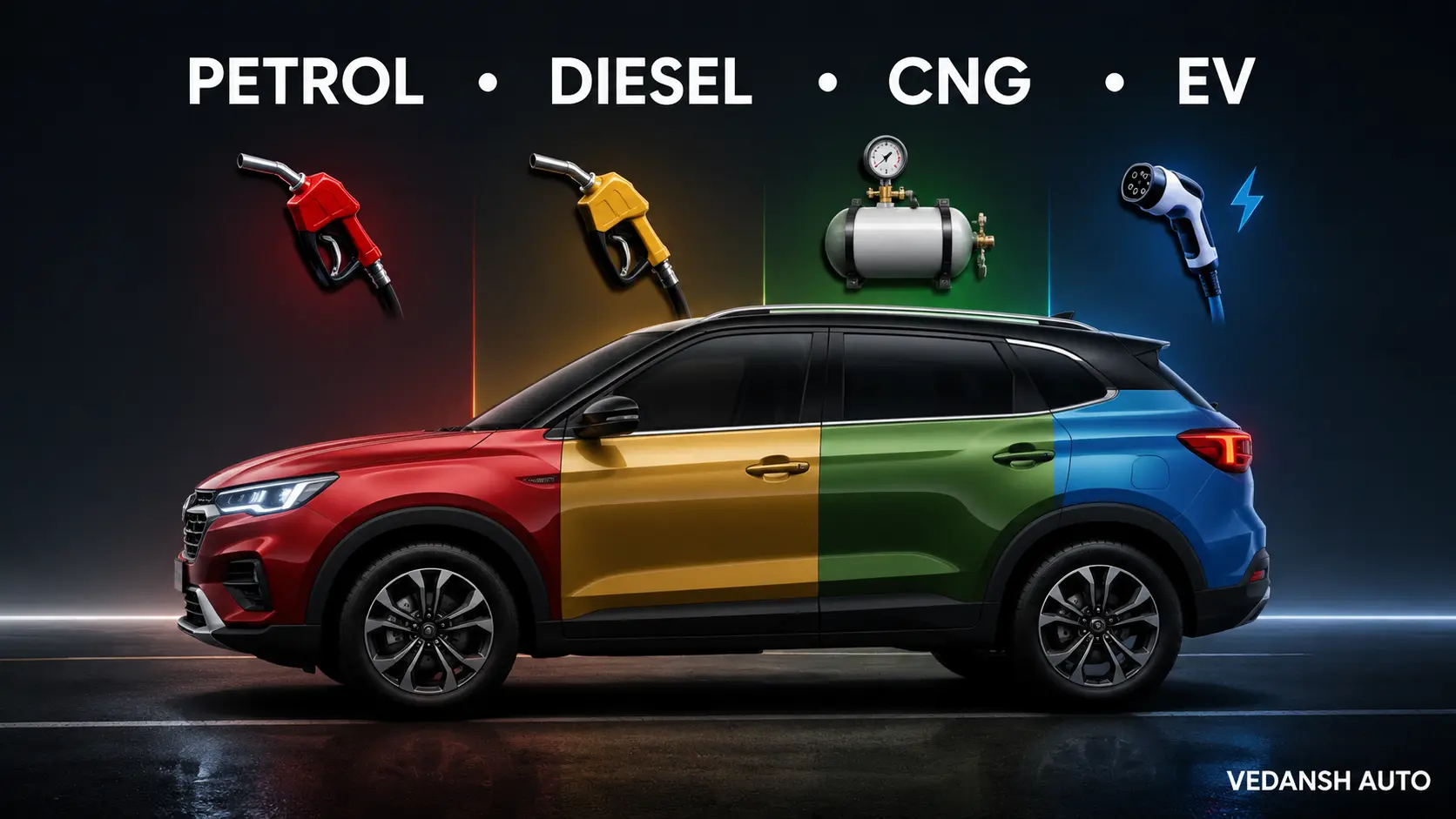
Choosing a fuel type used to be simple. You picked petrol or diesel, and that was that. Today, Indian buyers have four real options on the table, petrol, diesel, CNG, and electric. Each one suits a different kind of driver. There is no single “best” fuel type for everyone. The right choice depends on how much you drive, where you drive, and what you can access near your home.
In this post, we break down each fuel type with real examples, so you can see which one actually fits your daily routine.
Petrol Cars: Who Should Choose Them
Petrol is still the default choice for most first-time buyers in India, and for good reason. Petrol engines are smooth, quiet, and easy to maintain. If your monthly running is low, petrol works out cheaper overall because petrol cars usually cost less upfront than diesel or CNG variants.
Think of a young professional in Delhi who drives about 30-40 km a day, mostly office commute and weekend errands. A petrol hatchback like the Maruti Swift or Hyundai i20 makes perfect sense here. The running cost stays manageable at this low mileage, and the buyer avoids the extra upfront cost of diesel or CNG variants.
Good fit if: you drive under 1,000 km a month, mostly within the city, and want low maintenance without thinking about fuel stations.
Diesel Cars: Who Should Choose Them
Diesel cars make sense once your monthly running goes up significantly. Diesel engines generally deliver better mileage on highways and have more torque, which helps with loaded SUVs and long-distance trips. But diesel cars usually cost more to buy and to service, so they only pay off with high usage.
Consider a sales manager who travels between cities every week, covering 2,000 km or more a month, mostly highway driving. A diesel SUV like the Hyundai Creta diesel or Tata Harrier fits this lifestyle well. The extra upfront cost gets recovered over time because diesel is more efficient at high mileage and on long runs.
Good fit if: you regularly drive long distances, especially highway routes, and your monthly running crosses 1,500-2,000 km.
CNG Cars: Who Should Choose Them
CNG has become one of the most practical choices for Indian city drivers. Running cost on CNG is much lower than petrol, often less than half per kilometre. This makes it a favourite among cab drivers and daily commuters who put a lot of kilometres on the odometer within city limits.
Picture an app-based cab driver in Mumbai who drives 100-150 km every day within the city. Switching to a CNG car like the Maruti WagonR CNG or Toyota Glanza CNG can bring down fuel expenses drastically compared to petrol, directly improving take-home earnings.
The trade-off is reduced boot space because of the CNG cylinder, and CNG stations are still not as widespread in smaller towns as in metro cities. So this works best if you live in a city with good CNG station coverage.
Good fit if: you drive a lot within city limits daily, and CNG stations are easily available near your home or workplace.
Electric Cars (EVs): Who Should Choose Them
EVs are gaining ground fast in India, especially for buyers who can charge at home. Running cost on electricity is very low, and EVs need less regular maintenance since there is no engine oil, no clutch, and fewer moving parts. The catch is charging infrastructure, which is still developing outside major cities, and highway charging can involve some planning.
Think of a family in Bangalore with a fixed daily school run and office commute of around 40-50 km. They have a dedicated parking spot at home where they can install a charger. A Tata Punch EV or Tata Nexon EV suits this household well as a second car, charging overnight and costing very little to run day to day.
Good fit if: you have access to home charging, your daily driving is predictable and within city limits, and you are comfortable planning ahead for occasional long trips.
Quick Comparison
| Fuel Type | Ideal Daily Running | Best Suited For | Running Cost |
| Petrol | Low to moderate | City driving, first-time buyers | Moderate |
| Diesel | High | Highway travel, SUVs | Low at high usage |
| CNG | High, city-focused | Cab drivers, daily commuters | Very low |
| EV | Moderate, predictable | Home charging, urban families | Very low |
How to Decide: 3 Questions to Ask Yourself
- How much do I drive daily or monthly? Low mileage favours petrol, high mileage favours diesel or CNG.
- Do I have access to CNG stations or home charging? Without this access nearby, CNG and EV become less practical, no matter how attractive the running cost looks.
- Am I mostly driving in the city, or do I take frequent highway trips? City-heavy driving suits CNG and EV, while highway-heavy driving still favours diesel.
Conclusion
There is no universal winner between petrol, diesel, CNG, and EV. Each fuel type suits a different kind of driver and a different driving pattern. Petrol works well for low mileage city use, diesel makes sense for high mileage and highway trips, CNG is ideal for daily commuters watching their fuel bill, and EVs suit urban families with home charging access. The smartest approach is to match the fuel type to your actual driving habits, not just the sticker price at the showroom.
FAQs
1. Which fuel type is cheapest to run in India?
CNG usually has the lowest running cost per kilometre, followed closely by EVs if you charge at home. Diesel becomes cost-effective only at high monthly mileage, while petrol tends to be the costliest to run long-term.
2. Is CNG safe for daily use?
Yes, factory-fitted CNG kits from manufacturers are tested and safe for daily use. It is best to avoid low-quality aftermarket kits and get your CNG system checked regularly at authorised service centres.
3. Should I buy an EV if I don’t have home charging?
It is possible, but it becomes less convenient. Without home charging, you will depend on public charging stations, which are still limited in many Indian cities. If your daily driving is predictable and short, it can still work, but home charging makes EV ownership much easier.