Car Insurance Renewal Tips India: How to Save on NCB and IDV
Published on 21 July 2026
Renewing your car insurance is not just a formality you tick off once a year. It directly affects how much you pay and how much you receive if something goes wrong. Many car owners in India simply auto-renew with the same insurer without checking their No Claim Bonus (NCB), their Insured Declared Value (IDV), or whether a better deal is available elsewhere.
This guide shares practical car insurance renewal tips to help you save money and avoid common mistakes, including how NCB and IDV work at renewal time.
Why You Should Not Let Your Car Insurance Lapse
Driving without valid insurance is illegal under the Motor Vehicles Act, 1988. Every car on Indian roads must have at least a valid third-party insurance policy.
However, there is another cost that many people overlook. If your policy lapses for more than 90 days after expiry, you lose your accumulated No Claim Bonus (NCB). You will also need a fresh inspection of your vehicle before a new policy is issued, which can delay your cover and add unnecessary hassle.
Renewing your policy on time protects both your legal compliance and the valuable discount you have earned over the years.
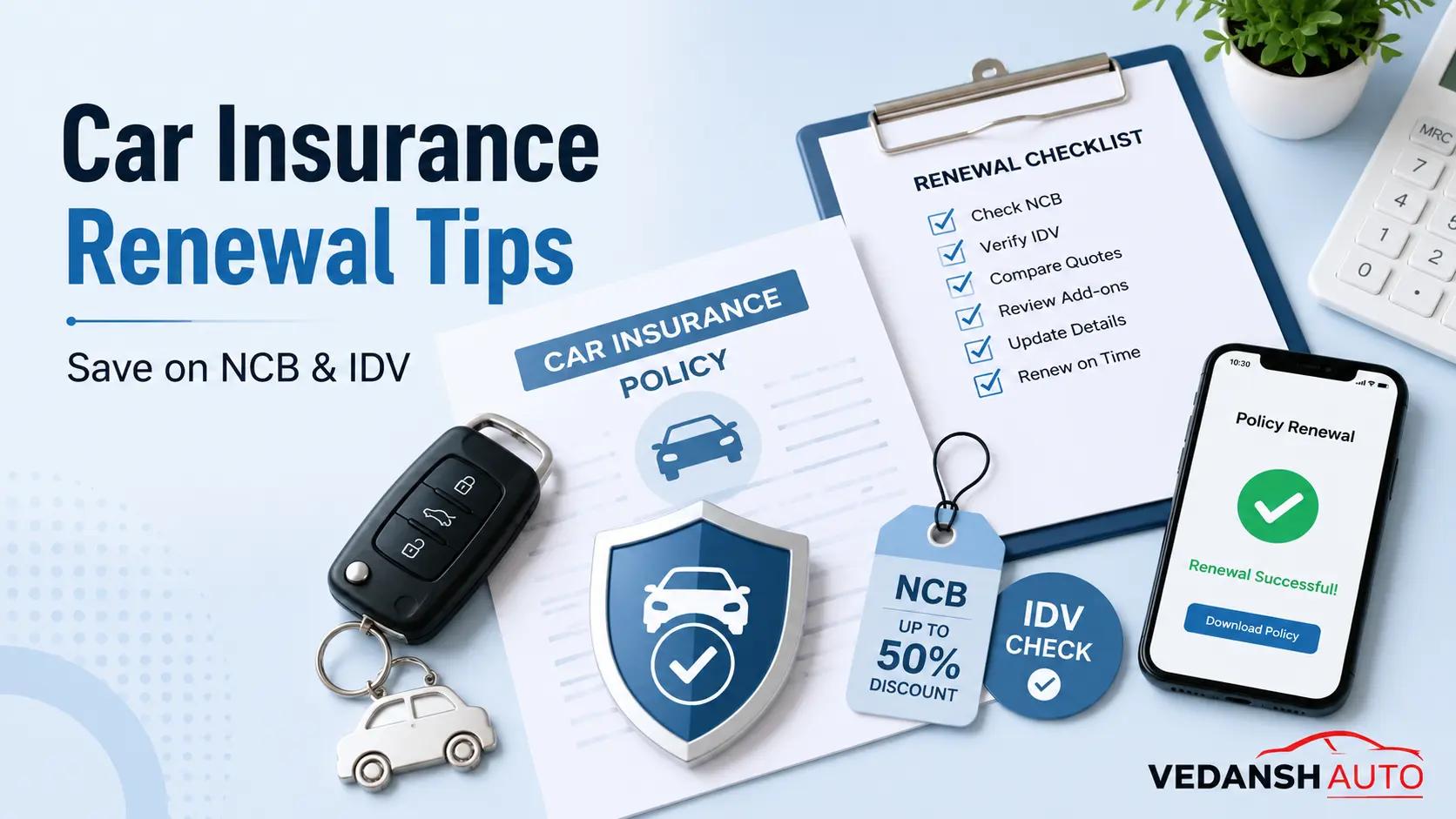
Before You Renew: A Quick Checklist
| Before Renewal | Why It Matters |
| Check your NCB | Can reduce your own-damage premium by up to 50% |
| Verify the IDV | Helps avoid under-insuring your car |
| Compare quotes from at least three insurers | You may get lower premiums or better benefits |
| Review your add-ons | Remove unnecessary covers or add useful ones |
| Check the cashless garage network | Ensures convenient repairs if you need to make a claim |
Understand Your NCB Before Renewing
Your No Claim Bonus (NCB) is a discount you earn for every consecutive claim-free year, and it can significantly reduce your renewal premium.
NCB slabs are standard across insurers:
| Consecutive Claim-Free Years | NCB Discount |
| 1 year | 20% |
| 2 years | 25% |
| 3 years | 35% |
| 4 years | 45% |
| 5 years or more | 50% (maximum) |
A few things to remember:
- NCB applies only to the Own Damage (OD) premium and not to the mandatory Third-Party (TP) premium.
- Filing an own-damage claim usually resets your NCB to zero. For minor repairs, paying from your own pocket can often save more money in the long run.
- NCB belongs to you, not the vehicle. You can transfer it when buying another car or when switching insurers.
- Do not let your policy lapse for more than 90 days, or your accumulated NCB will generally be lost.
- Always check that your renewal quote reflects your correct NCB slab before making payment.
Check and Correct Your IDV
The Insured Declared Value (IDV) is the maximum amount your insurer will pay if your car is stolen or declared a total loss. It is calculated using the manufacturer’s listed selling price after applying depreciation based on the age of the vehicle.
Here is why IDV matters:
- A lower IDV reduces your premium but also lowers your claim payout if your car is stolen or written off.
- Most insurers allow you to increase or decrease the proposed IDV by around 15%, so it is worth checking whether it reasonably reflects your car’s current market value.
- For older cars, compare the proposed IDV with the vehicle’s approximate resale value before accepting it.
A simple rule is that your IDV should broadly reflect your car’s current market value after depreciation rather than the lowest figure that simply reduces your premium.
Understand the Deductible
Every car insurance policy includes a compulsory deductible, which is the amount you pay yourself before the insurer settles a claim.
Many insurers also allow you to choose a voluntary deductible. Opting for a higher voluntary deductible can reduce your premium, but it only makes sense if you are comfortable paying more out of your own pocket whenever you make a claim.
Car Insurance Renewal Tips
With NCB and IDV in mind, here are some practical steps to follow before renewing:
- Do not auto-renew without comparing quotes. Check prices from at least three insurers before paying.
- Review your add-ons. Zero Depreciation (also called Nil Depreciation or Bumper-to-Bumper cover) is valuable for newer cars, while Engine Protection and Consumables Cover are worth considering if you drive frequently or in flood-prone areas.
- Consider Return to Invoice cover if your car is relatively new. It helps bridge the gap between the insurer’s settlement amount and your car’s invoice value if it is stolen or declared a total loss.
- Check the insurer’s cashless garage network. Ensure there is a convenient authorised garage near your home or workplace.
- Renew online where possible. Online renewals are often quicker and may offer lower premiums than offline renewals.
- Update your policy details. Check your address, mobile number, nominee details and any accessories fitted to the vehicle.
- Renew before the expiry date. Avoid inspection delays and the risk of losing your NCB.
Compare More Than Just the Premium
The cheapest premium is not always the best policy. When comparing renewal quotes, consider:
- Premium amount
- Claim settlement experience
- Cashless garage network
- Available add-ons
- Customer support
- Mobile app and online claim process
For example:
- ICICI Lombard, HDFC ERGO, Bajaj Allianz and Tata AIG have extensive cashless garage networks and comprehensive coverage options.
- ACKO follows a digital-only model, offering online renewals and app-based claims with competitive pricing.
- Policybazaar is an insurance comparison platform rather than an insurer. It lets you compare quotes from multiple insurers before making a decision.
Comparing at least one traditional insurer, one digital insurer and an aggregator usually gives you a good understanding of the available options.
Documents Needed for Car Insurance Renewal
Keep these documents ready:
- Existing insurance policy
- Vehicle Registration Certificate (RC)
- Valid photo ID
- NCB certificate (if switching insurers)
- Vehicle inspection report (only if the policy has lapsed)
Common Mistakes to Avoid During Renewal
- Waiting until the last minute and risking a policy lapse.
- Accepting the default IDV without checking whether it reflects your car’s value.
- Filing a small own-damage claim that could wipe out years of accumulated NCB.
- Removing useful add-ons simply to reduce the premium.
- Not checking the cashless garage network before renewing.
- Comparing insurers based only on premium instead of claim experience and service quality.
Frequently Asked Questions
Can I renew my car insurance after it has expired?
Yes. However, if the gap exceeds 90 days, you generally lose your accumulated NCB, and most insurers will require a vehicle inspection before issuing a new policy.
Can I renew my policy with a different insurer?
Yes. You can switch insurers during renewal while retaining your NCB, provided you obtain the required NCB certificate from your previous insurer and there has not been a lapse beyond the permitted period.
Does NCB transfer if I switch insurers?
Yes. NCB belongs to the policyholder rather than the insurer or the vehicle, and it can be transferred when changing insurers.
Can I change my IDV at renewal?
Yes. Most insurers allow you to adjust the proposed IDV by around 15%. It is worth reviewing this figure rather than automatically accepting the default value.
Is third-party insurance enough?
Third-party insurance is mandatory by law, but it only covers damage caused to other people or their property. A comprehensive policy also covers damage to your own vehicle and usually provides much better financial protection.
Is it better to renew online or through an agent?
Online renewal is usually quicker and may offer lower premiums, while an experienced insurance advisor or agent can help you understand policy features and choose suitable add-ons.
What happens if I file a small claim just before renewal?
An own-damage claim usually resets your NCB to zero. If the repair cost is relatively small, paying for it yourself may save more money over future renewals than making a claim.
Final Word
Renewing your car insurance is not just about paying the next premium. It is an opportunity to verify your NCB, review your IDV, reassess your add-ons and compare insurers to make sure you are getting the right cover at a competitive price. Spending a few extra minutes before renewing can help you save money today while ensuring better financial protection if you ever need to make a claim.