CNG, Hybrid and EV Cars Overtake Petrol in India: What Buyers Need to Know
Published on 7 September 2026
For years, petrol was the default choice for most Indian car buyers. Diesel lost ground, CNG remained a practical option for high-mileage users, and electric cars were still considered a relatively new technology.
That picture is changing.
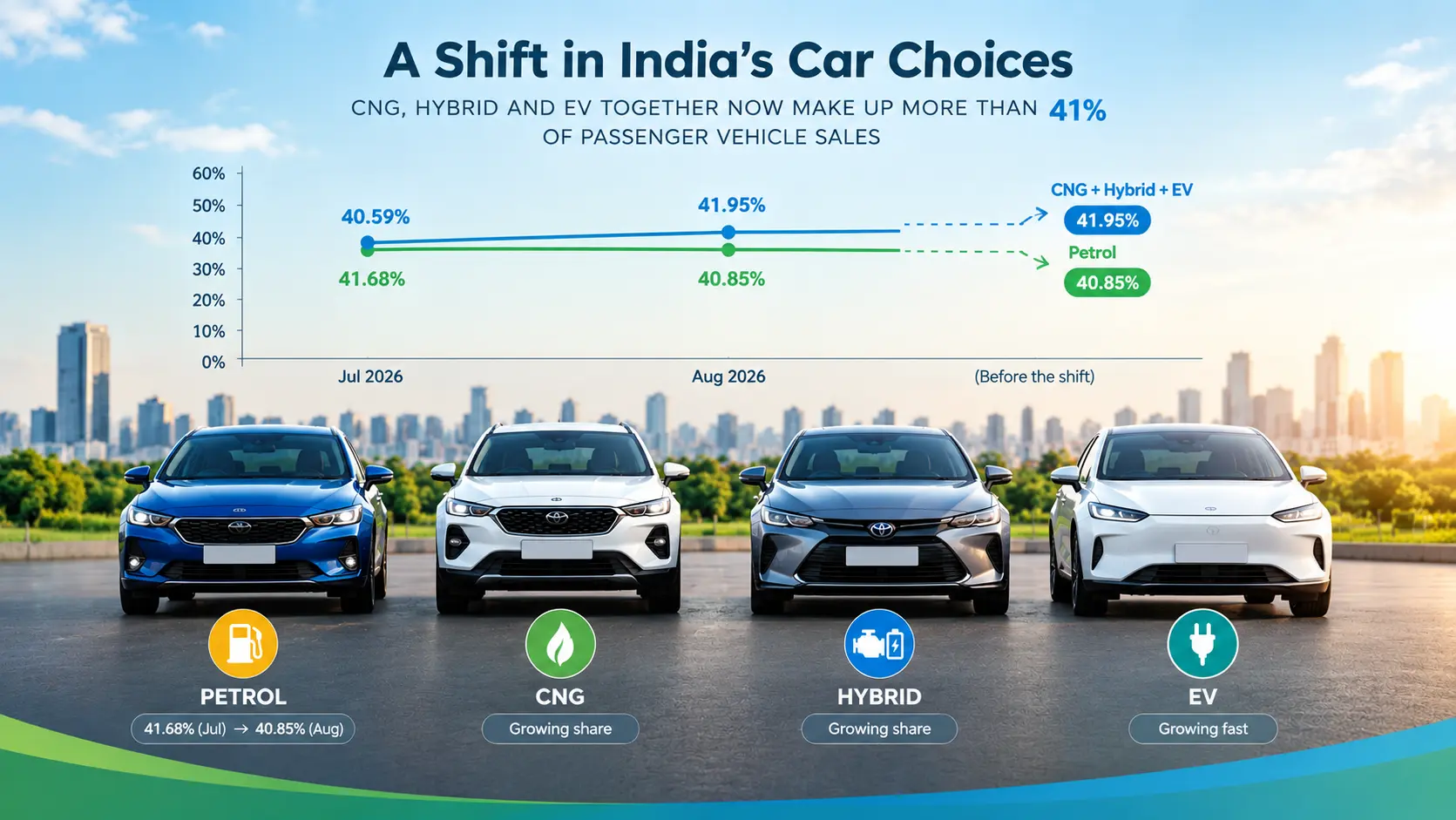
In August 2026, CNG, hybrid and electric passenger vehicles together accounted for 41.95% of India’s passenger vehicle retail sales, according to data from the Federation of Automobile Dealers Associations (FADA). Petrol-powered vehicles accounted for 40.85%. It was the first time that these alternative powertrains collectively overtook petrol in a single month.
The difference is small, but the change is significant. It suggests that Indian buyers are becoming less dependent on petrol and are increasingly looking at running costs, fuel availability, technology and long-term ownership when choosing a car.
However, this does not mean petrol cars are suddenly becoming unpopular. Petrol remains the largest individual powertrain category. The important change is that buyers now have more realistic alternatives.
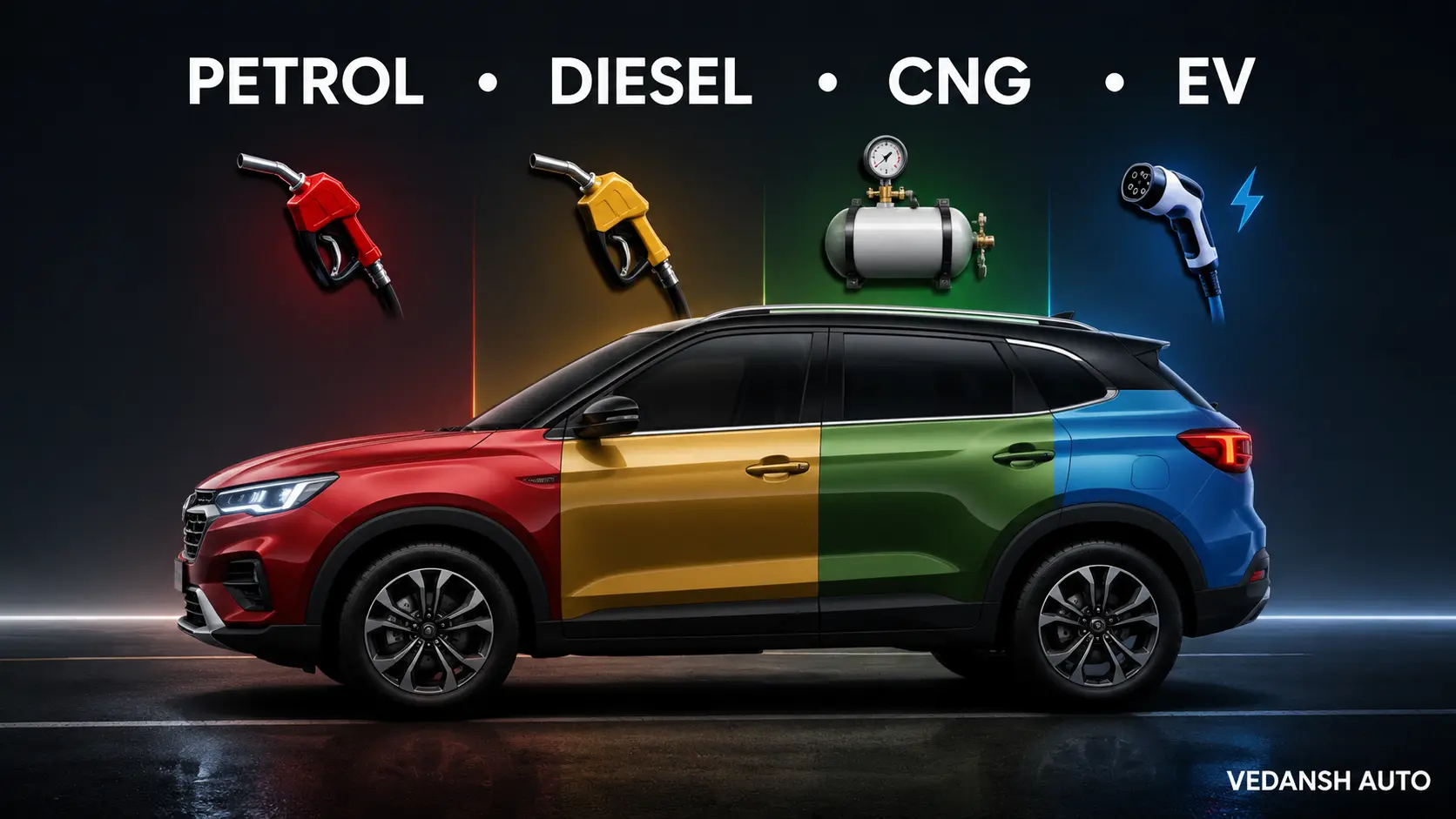
So, should you buy a petrol, CNG, hybrid or electric car in 2026? The answer depends largely on how and where you drive.
Why Are Indian Buyers Moving Away From Petrol?
There is no single reason behind the shift.
CNG has been gaining popularity because of its lower running cost, while hybrids offer better fuel efficiency without requiring owners to change their refuelling habits. Electric cars are also becoming more attractive as manufacturers introduce more models and charging infrastructure gradually expands.
There is another factor that has received considerable attention this year: E20 petrol.
India has completed its nationwide transition to E20, a petrol blend containing up to 20% ethanol. The government and automotive industry have repeatedly said that newer vehicles are designed to work with E20. FADA president Sai Giridhar recently said cars launched from 2023 onwards are E20-compliant, while older cars may experience some loss in fuel efficiency but are unlikely to face serious problems.
At the same time, concerns about E20 have influenced some potential buyers. A LocalCircles survey published earlier this year found that 43% of prospective buyers said uncertainty around E20 and possible future higher ethanol blends could make them postpone or reconsider a vehicle purchase.
These concerns do not mean petrol cars are unsafe or unsuitable. They do show that fuel technology and future running costs have become part of the car-buying conversation.
CNG, Hybrid and EV Sales Are Growing
The shift did not happen overnight.
In July 2026, CNG, hybrid and electric vehicles together accounted for 40.59% of passenger vehicle retail sales, compared with 41.68% for petrol. The gap was therefore only 1.09 percentage points even before the August milestone. A year earlier, the difference was much larger.
CNG is currently the biggest contributor to this change.
Electric cars are growing quickly too. Vahan data compiled by Nuvama showed that electric passenger vehicle registrations reached 30,325 units in August 2026, up 50% year on year. EVs accounted for 7.4% of passenger vehicle registrations during the month. Registrations during the first five months of FY2026-27 were up 85% year on year.
That does not mean EVs have replaced petrol. They have not. But the numbers show that electric cars are moving beyond the early-adopter stage.
Hybrid cars are also becoming more relevant, particularly for buyers who want better fuel efficiency without depending on charging infrastructure.
Petrol vs CNG vs Hybrid vs EV: Which Is Best?
There is no single winner because each powertrain suits a different type of buyer.
| Factor | Petrol | CNG | Hybrid | EV |
| Purchase cost | Usually lower | Usually higher than petrol | Higher | Usually higher |
| Running cost | Higher | Low | Low | Very low |
| Refuelling | Very convenient | Convenient in areas with CNG stations | Same as petrol | Requires charging |
| Long-distance travel | Excellent | Good where CNG is available | Excellent | Depends on charging network |
| City driving | Good | Good for high running | Excellent | Excellent |
| Maintenance | Familiar and straightforward | Similar to petrol with additional CNG components | More complex | Generally lower |
| Best suited to | Mixed use and low-to-moderate running | High-mileage users | City + highway users | Regular city users with charging access |
These are broad guidelines rather than rules. The right choice depends on your annual running, access to fuel or charging, budget and how long you plan to keep the car.
When Does a CNG Car Make Sense?
CNG remains one of the most practical alternatives to petrol for Indian buyers.
If you drive a lot every month, particularly in a city where CNG stations are easily available, the lower fuel cost can make a CNG car attractive.
For example, someone driving 1,500-2,000 km every month can potentially recover the higher purchase price of a CNG variant faster than a buyer who drives only 500-600 km a month.
CNG is particularly worth considering for:
- Daily commuters
- People covering high annual kilometres
- Taxi and commercial users
- Buyers who regularly drive in cities with good CNG availability
There are compromises. Boot space can be reduced in some cars because of the CNG cylinder, and refuelling convenience depends heavily on local infrastructure.
For many private buyers, however, CNG remains the most straightforward way to reduce fuel expenditure without changing their driving habits.
Should You Consider a Hybrid Car?
Hybrids occupy an interesting middle ground.
A strong hybrid can use its electric motor extensively during low-speed driving and assist the petrol engine when more power is required. Unlike a pure EV, you do not need to plan your journey around charging stations.
This makes hybrids particularly attractive to buyers who:
- Drive extensively in cities
- Want better fuel efficiency
- Frequently travel on highways
- Do not have convenient home charging
- Want to keep the convenience of petrol
The biggest obstacle is the initial purchase price. A hybrid can cost considerably more than a comparable petrol car, so the higher upfront cost needs to be considered alongside expected fuel savings.
For buyers keeping a car for several years and driving significant distances, that calculation can make more sense than it does for someone with low annual mileage.
Is an EV Now a Practical Choice?
For many Indian buyers, yes. But it still depends heavily on where you live and how you use your car.
The rapid growth in EV registrations shows that consumer acceptance is improving. More models are available across different price ranges, while charging infrastructure is expanding. EV registrations were up 50% year on year in August, although they fell 12% from July, showing that growth is not necessarily linear every month.
An EV can make particular sense if you:
- Have access to home or workplace charging
- Mostly drive in the city
- Cover a predictable daily distance
- Want low running costs
- Plan to keep the car for several years
Highway users should pay more attention to the availability of fast chargers along their regular routes.
Battery warranty, charging speed, real-world range and the availability of service support should also be considered before buying.
Does E20 Mean You Should Avoid Petrol Cars?
No.
This is an important distinction because the E20 debate has created considerable confusion among buyers.
The government has stated that E20 is safe and that the transition followed testing and industry consultation. In July, the Ministry of Petroleum and Natural Gas said vehicle owners should not have concerns about E20, with Maruti Suzuki also stating that it had found no issues in more than 1.5 crore older vehicles serviced through its network.
FADA has also said that vehicles launched from 2023 are E20-compliant. Older vehicles may experience some reduction in fuel efficiency, according to FADA’s president, but this is different from saying that E20 will damage every older petrol engine.
Therefore, if you are buying a new petrol car in 2026, E20 compatibility should not by itself be a reason to reject the car.
However, it is reasonable to check the manufacturer’s E20 compatibility information, particularly if you are buying a used or older petrol vehicle.
What Does This Mean for Petrol Cars?
Petrol is not going away.
The August numbers actually make that clear. Petrol still accounted for 40.85% of passenger vehicle retail sales, making it the biggest individual powertrain category. The 41.95% figure for alternative fuels is a combined number covering CNG, hybrids and EVs.
The bigger change is that petrol no longer has the same dominance it once enjoyed.
A buyer considering a ₹8 lakh to ₹15 lakh car today can find petrol, CNG and increasingly electric options, while hybrids are becoming more accessible higher up the market.
That means car manufacturers will need to compete not only on price and features but also on running cost and powertrain choice.
For consumers, this is good news. More choices mean you can select a car based on your actual usage rather than simply choosing the fuel type everyone else is buying.
Which Fuel Type Should You Choose in 2026?
A simple way to approach the decision is to start with your usage.
Choose petrol if you want the lowest upfront cost, drive relatively few kilometres and want maximum refuelling convenience.
Choose CNG if you drive a lot, have easy access to CNG stations and want to reduce your monthly fuel bill.
Choose a hybrid if you want excellent fuel efficiency but still need the convenience of a petrol-powered car for long-distance travel.
Choose an EV if most of your driving is in or around the city and you have reliable access to charging.
The important lesson from the latest sales data is not that one fuel has won.
It is that Indian car buyers are becoming more conscious of the total cost and convenience of owning a car, rather than simply looking at the purchase price.
The fact that CNG, hybrid and electric cars collectively overtook petrol in August is therefore worth watching. Whether the trend continues through the festive season will be an even more useful indicator of how quickly India’s passenger-car market is changing.
Frequently Asked Questions
Are CNG, hybrid and EV cars more popular than petrol cars in India?
Together, they accounted for 41.95% of passenger vehicle retail sales in August 2026, compared with 40.85% for petrol. This was the first month in which the combined alternative-fuel category overtook petrol.
Which alternative fuel is most popular in India?
CNG currently contributes the largest share of the combined alternative-fuel category. Hybrid and electric vehicles are also growing, but their individual shares remain smaller than CNG.
Is petrol still a good choice in India?
Yes. Petrol remains the largest individual powertrain category. It can make sense for buyers with moderate annual running who prioritise lower upfront cost and easy refuelling.
Is CNG cheaper to run than petrol?
Generally, yes. CNG typically costs less per kilometre than petrol, although the actual saving depends on fuel prices, real-world mileage and the vehicle you choose.
Should you buy an EV instead of a CNG car?
It depends on your usage. An EV can offer very low running costs if you have convenient charging, while CNG is often more practical for buyers who need quick refuelling and regularly travel longer distances.
Are new cars compatible with E20 petrol?
FADA has said vehicles launched in India from 2023 onwards are E20-compliant. Buyers should still check the manufacturer’s specifications, particularly when considering an older used car.
Will petrol cars disappear from India?
There is no indication that petrol cars are about to disappear. Petrol still represented 40.85% of passenger vehicle retail sales in August 2026. The more likely trend is a market with several powertrain options competing for buyers.
Sources:
- FADA August 2026 retail data: FADA August auto retail sales coverage by DD India
- Reuters: Alternative-fuel car sales in India top petrol on cost, E20 concerns
- Autocar Professional: Passenger Vehicle Retail Sales Cross 4 Lakh in August 2026
- Economic Times: Petrol loses its crown as alternative fuels overtake it
- Financial Express: FADA chief on E20 compatibility and older cars
- Press Information Bureau: Government clarification on E20 fuel and vehicle compatibility
- India Today: E20/E30 uncertainty and vehicle-buying decisions survey
- New Indian Express: E20 concerns and the move towards CNG, hybrids and EVs