Mahindra Charge_iN Reaches 50 Charging Stations
 Published on 29 September 2026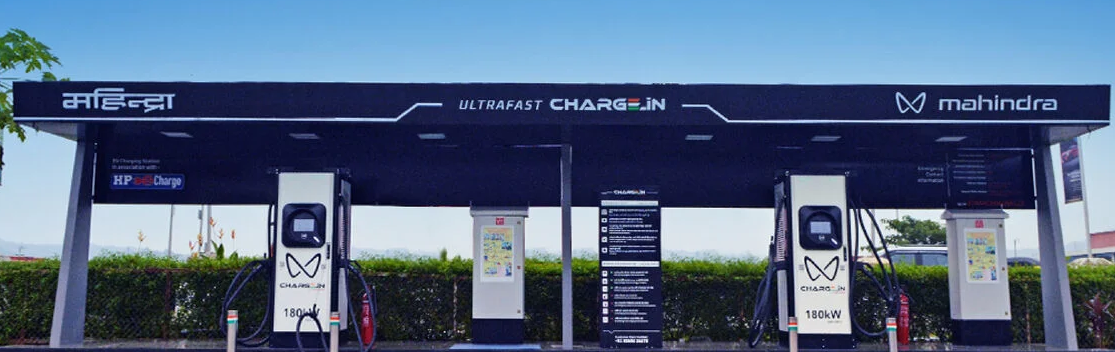
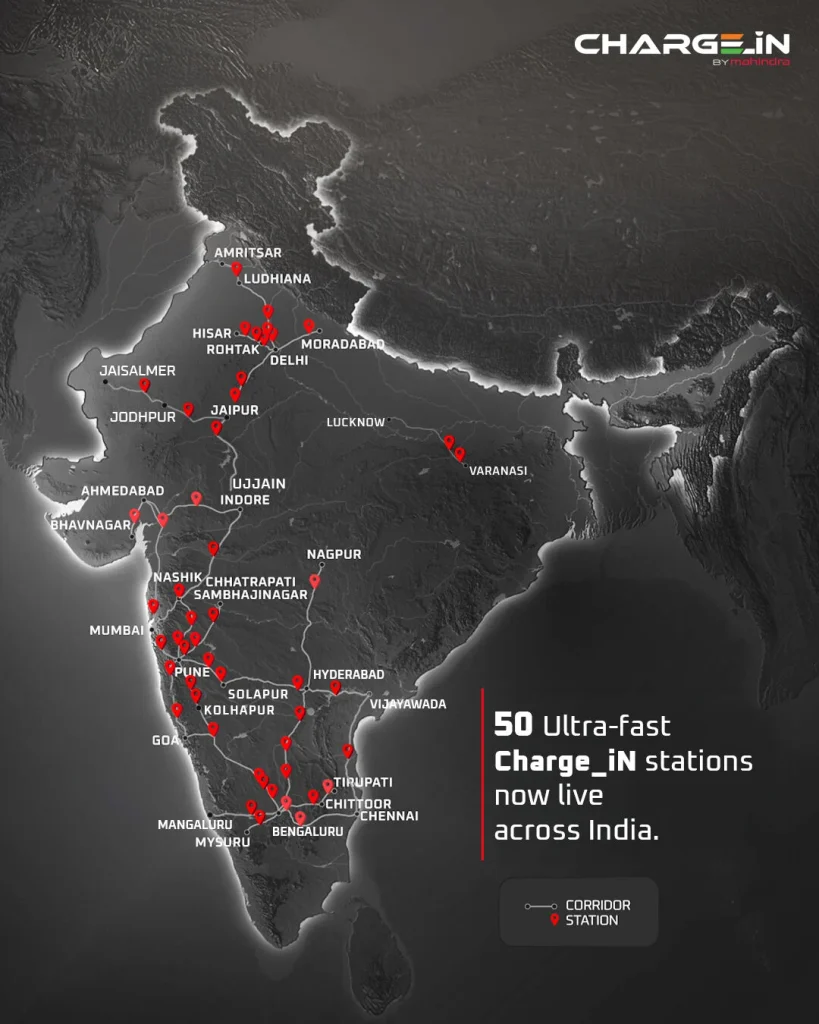
Mahindra’s Charge_iN public EV charging network has reached 50 live charging stations and more than 200 charging points across India. The company has also opened its first Charge_iN station under its partnership with Hindustan Petroleum Corporation Limited (HPCL) on the Mumbai-Pune Expressway.
Mahindra plans to expand the network to 250 stations with approximately 1,000 charging points by December 2027.
The expansion is particularly relevant for electric car owners who regularly travel between cities. Unlike many urban charging locations, Charge_iN is being developed around major highway corridors, with stations located alongside restaurants, cafés and other wayside amenities.
Mahindra Charge_iN Reaches 50 Locations
Charge_iN was announced by Mahindra in November 2025 as an ultrafast public charging network focused on highway travel. The company initially opened stations at Hoskote on NH 75 near Bengaluru and Murthal on NH44, around 50 km from Delhi.
At launch, Mahindra announced plans for 250 charging stations and more than 1,000 charging points by the end of 2027.
The network has now reached 50 operational locations and more than 200 live charging points.
The latest milestone also includes the first Charge_iN station developed under Mahindra’s collaboration with HPCL.
First Charge_iN Station With HPCL Opens on Mumbai-Pune Expressway
The latest Charge_iN location is at HP Auto Care Centre, Sajgaon, Pune-Expressway, on the Mumbai-Pune Expressway.
It is the first Charge_iN station to become operational under Mahindra’s collaboration with HPCL. The two companies signed their agreement in March 2026 to develop EV charging infrastructure at HPCL retail outlets across India.
Mahindra says several additional stations under the collaboration are currently at different stages of development and construction.
The partnership gives Charge_iN access to HPCL’s large network of fuel stations, which can provide established locations along major roads and highways.
HPCL says its wider HP e-Charge network currently has more than 5,600 EV charging stations and more than 150 battery-swapping stations. These figures refer to HPCL’s overall charging network and should not be confused with the number of Charge_iN stations.
Charge_iN Uses 180 kW Dual-Gun Chargers
One of the main features of the Charge_iN network is its use of 180 kW dual-gun DC fast chargers.
Mahindra says these chargers can take its Electric Origin SUVs, including the XEV 9e, BE 6 SPORTEQ and XEV 9S, from 20% to 80% charge in approximately 20 minutes under standard test conditions.
However, the 20-minute figure should not be treated as a universal charging time for every EV.
The actual charging time depends on several factors, including:
- The vehicle’s maximum DC charging capability
- Battery state of charge
- Battery temperature
- Ambient temperature
- Charger output
- Other operating conditions
Mahindra itself notes that actual charging times can vary from the stated figure.
This means an EV capable of accepting a lower maximum DC charging rate will not necessarily charge at 180 kW simply because it is connected to a 180 kW Charge_iN charger.
Charge_iN Is Open to EVs From Other Brands
Charge_iN is not restricted to Mahindra electric cars.
EV owners from other manufacturers can use the network through the Charge_iN by Mahindra app, the Me4U app and leading charging aggregator platforms. Mahindra says the network will also be available through HPCL’s HP eCharge app.
This is important because the usefulness of a public charging network depends partly on how many EV owners can access it.
Mahindra EV owners also have access to a much larger pool of public charging points through the Me4U app. Mahindra says approximately 35,000 public charging points, including HP eCharge stations, can be accessed through various charge-point operators via the app.
The 35,000 figure is therefore not the size of the Charge_iN network. It refers to the wider set of public charging points available to Mahindra EV owners through the Me4U platform.
Charge_iN Is Focused on Highway Charging
Mahindra is positioning Charge_iN primarily around major inter-city routes rather than treating it as another urban charging network.
The company says its stations are being placed along major highway corridors and co-located with wayside amenities such as restaurants and cafés.
This makes the charging stop part of a normal highway break.
For an EV owner on a long journey, a charging stop can therefore be combined with:
- A meal
- A coffee break
- A washroom stop
- A short rest
The actual time needed for charging will still depend on the vehicle and its battery state, but locating fast chargers at established highway stopping points can make the charging process easier to plan.
From 50 Stations to 250: Mahindra’s 2027 Target
Mahindra’s current network is still considerably smaller than its planned 2027 footprint.
| Milestone | Charge_iN network |
| November 2025 launch | First 2 stations |
| September 2026 | 50 live stations, 200+ charging points |
| December 2027 target | 250 stations, approximately 1,000 charging points |
Mahindra announced the 250-station and 1,000-plus-point target when it launched Charge_iN in November 2025. The latest announcement confirms that the company continues to work towards that December 2027 target.
Going from more than 200 live charging points today to approximately 1,000 by the end of 2027 means the company still has a substantial expansion programme ahead.
Mahindra says additional HPCL collaboration sites are already at different stages of development and construction.
What Does Charge_iN Mean for EV Owners?
The expansion gives EV owners another network of high-power charging locations to consider for inter-city travel.
For Mahindra EV owners, it adds charging locations designed around the company’s Electric Origin SUVs. For owners of other compatible EVs, the open-network approach means Charge_iN can also be used as another option when planning highway journeys.
However, having a charging station on a route does not automatically mean it will be available when you arrive. EV owners should still check the location, charger status and compatibility through the relevant charging app before starting a long journey.
It is also worth checking the charging capability of your particular EV. A 180 kW charger can provide high power, but the vehicle determines how much power it can actually accept.
Why the HPCL Partnership Matters
The HPCL partnership gives Mahindra another route for expanding its public charging network.
Fuel stations are already positioned along major roads and highways, which makes them practical locations for EV charging infrastructure. The March 2026 agreement between Mahindra and HPCL specifically envisaged setting up EV charging stations at HPCL retail outlets across India.
The first operational Charge_iN station under this partnership is now live at Sajgaon on the Mumbai-Pune Expressway.
If additional locations under the agreement become operational as planned, the partnership could become an important part of Charge_iN’s expansion towards its 2027 target.
Mahindra Charge_iN: What EV Owners Should Know
Here are the key points from the latest expansion:
- 50 Charge_iN stations are now live across India.
- The network has more than 200 live charging points.
- Charge_iN stations use 180 kW dual-gun DC fast chargers.
- Mahindra quotes approximately 20 minutes for a 20% to 80% charge for specified Electric Origin SUVs under standard test conditions.
- The network is open to EVs from other brands.
- Stations are being positioned along major highway corridors.
- The latest station at Sajgaon on the Mumbai-Pune Expressway is the first under the Mahindra-HPCL partnership.
- Mahindra’s target is 250 stations and approximately 1,000 charging points by December 2027.
The Bigger Picture
Mahindra’s Charge_iN expansion is part of the wider effort to make long-distance EV travel easier in India.
The network has grown from the two stations announced at launch in November 2025 to 50 live locations in September 2026. The next stage will be much larger, with Mahindra targeting 250 stations and approximately 1,000 charging points by December 2027.
For EV owners, the most useful part of the development is not simply the number of charging points. The location of those chargers, their availability, the charging capability of individual EVs and the presence of highway amenities will determine how useful the network is for actual road trips.
As more Charge_iN and other public charging stations become operational, EV buyers will have more options to consider when planning longer journeys beyond the city.
Mahindra Charge_iN FAQs
What is Mahindra Charge_iN?
Charge_iN is Mahindra’s public EV charging network focused on high-power charging for electric cars. The network uses 180 kW dual-gun DC fast chargers and is being expanded across major highway corridors in India.
How many Charge_iN stations are there?
Mahindra says Charge_iN has reached 50 live locations with more than 200 charging points across India as of September 2026.
Can non-Mahindra EVs use Charge_iN?
Yes. Charge_iN is an open network that can be accessed by EV owners across brands through the Charge_iN by Mahindra app, Me4U and leading charging aggregator platforms. Mahindra also says the network will be available through the HP eCharge app.
How fast are Charge_iN chargers?
Charge_iN stations use 180 kW dual-gun chargers. Mahindra says its XEV 9e, BE 6 SPORTEQ and XEV 9S can charge from 20% to 80% in approximately 20 minutes under standard test conditions. Actual charging time varies according to the vehicle and operating conditions.
Where are Charge_iN stations located?
Mahindra says the stations are being positioned along major highway corridors and at locations with wayside amenities such as restaurants and cafés. The network is intended to support both inter-city and long-distance EV travel.
How many charging stations does Mahindra plan to build?
Mahindra plans to expand Charge_iN to 250 stations with approximately 1,000 charging points by December 2027.