Tata Nexon EV vs Tata Nexon Petrol 2026 – Which One Should You Buy?
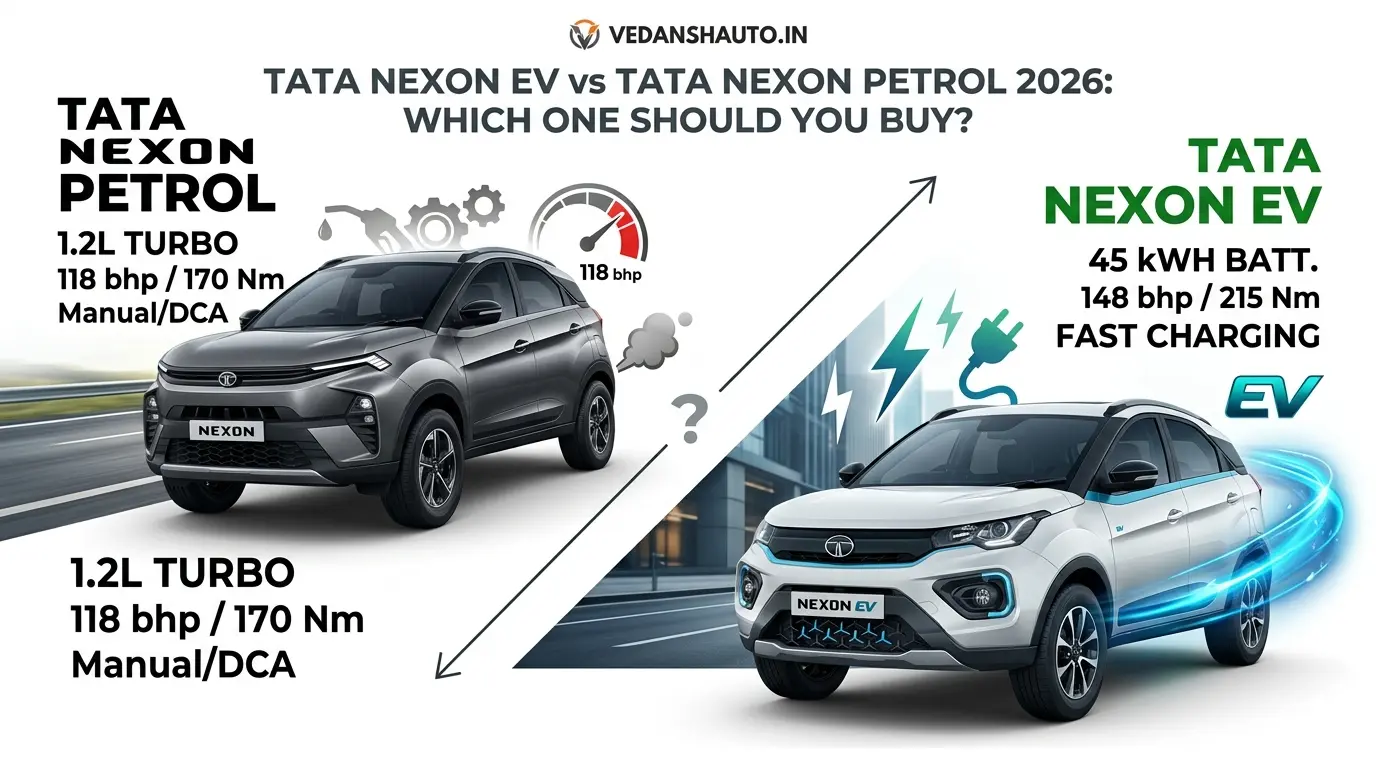
The Tata Nexon EV on-road price in New Delhi starts at approximately ₹13.17 Lakh, while the Nexon Petrol starts at ₹8.28 Lakh. That is a significant upfront difference. However, when charged mainly at home, the Nexon EV can cost around 80 to 90% less per kilometre to run than the petrol version. So, the right choice depends on a few simple factors like your daily driving distance, access to home charging and how long you plan to keep the vehicle. This detailed comparison covers pricing, running costs, performance, practicality and ownership experience to help you decide which Nexon suits your needs best.
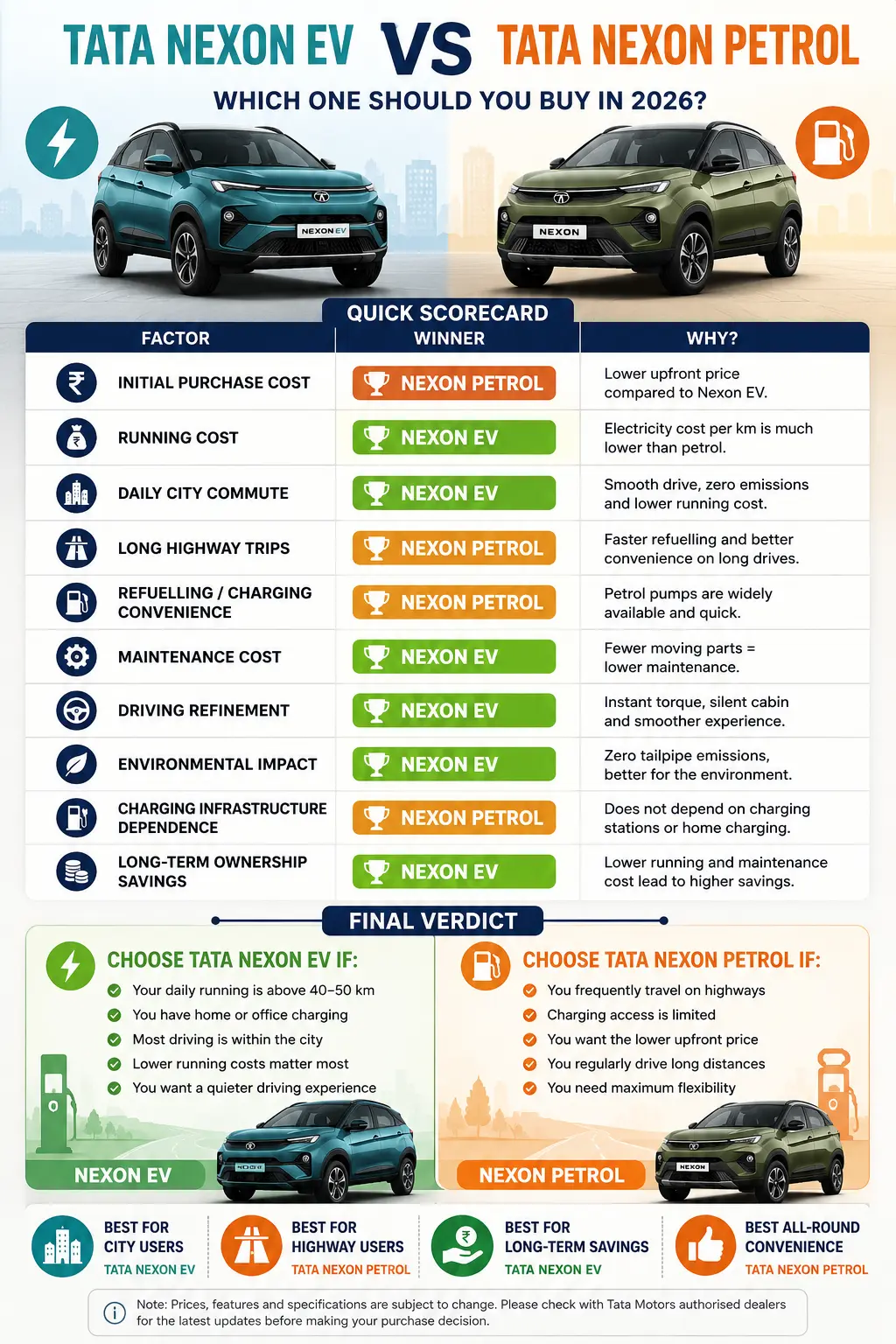
Quick Comparison: Nexon EV vs Nexon Petrol
| Parameter | Nexon Petrol | Nexon EV |
| Starting On-Road Price (Delhi) | ₹8.28 Lakh | ~₹13.17 Lakh |
| Top Variant On-Road Price (Delhi) | ₹16.79 Lakh | ~₹18.40 Lakh |
| Powertrain | 1.2L Turbo Petrol | Electric Motor |
| Power | 118 bhp | 127 bhp (MR) / 148 bhp (45 kWh) |
| Fuel / Range | 17.44 kmpl (ARAI) | 275 km (MR) / 489 km (MIDC-certified) |
| Real-World Efficiency | 12–14 kmpl (city) | 200–230 km (MR city) / 330–380 km (45 kWh mixed) |
| Running Cost per km | ~₹7.85 | ~₹1.0–1.3 (home charging) |
| Transmission Options | Manual, AMT, DCA | Single-speed automatic |
| Boot Space | 350 litres | 350 litres + 11.6 litre frunk |
| Home Charging Needed | No | Strongly recommended |
| 0–100 km/h (approx.) | ~10–11 sec | ~8.9 sec (45 kWh) |
Price Comparison in New Delhi
Tata Nexon Petrol – Key Variants On-Road Price (Delhi)
| Variant | On-Road Price (Delhi) |
| Smart (Petrol) – Base | ₹8.28 Lakh |
| Pure Plus (Petrol) – Mid | ₹10.03 Lakh |
| Creative (Petrol) – Popular | ₹11.20 Lakh |
| Creative Plus S (Petrol) | ₹12.00 Lakh |
| Fearless Plus PS Dark (Petrol) – Top Petrol | ₹14.43 Lakh |
| Fearless Plus PS Dark Diesel AMT – Top Overall | ₹16.79 Lakh |
Tata Nexon EV – All Variants Ex-Showroom Price
| Variant | Battery | Range (ARAI) | Power | Ex-Showroom |
| Creative Plus MR | 30 kWh | 275 km | 127 bhp | ₹12.49 Lakh |
| Fearless MR | 30 kWh | 275 km | 127 bhp | ₹13.29 Lakh |
| Fearless Plus MR | 30 kWh | 275 km | 127 bhp | ₹13.79 Lakh |
| Creative 45 | 45 kWh | 489 km | 148 bhp | ₹13.99 Lakh |
| Fearless Plus S MR | 30 kWh | 275 km | 127 bhp | ₹14.29 Lakh |
| Empowered MR | 30 kWh | 275 km | 127 bhp | ₹14.79 Lakh |
| Fearless 45 | 45 kWh | 489 km | 148 bhp | ₹14.99 Lakh |
| Empowered LR | 45 kWh | 489 km | 148 bhp | ₹15.99 Lakh |
| Empowered Plus 45 | 45 kWh | 489 km | 148 bhp | ₹16.99 Lakh |
| Empowered Plus 45 Red Dark | 45 kWh | 489 km | 148 bhp | ₹17.19 Lakh |
| Empowered Plus A 45 | 45 kWh | 489 km | 148 bhp | ₹17.29 Lakh |
| Empowered Plus A 45 Dark | 45 kWh | 489 km | 148 bhp | ₹17.49 Lakh |
| Empowered Plus A 45 Red Dark | 45 kWh | 489 km | 148 bhp | ₹17.49 Lakh |
The on-road price gap between the Nexon Petrol Creative (₹11.20 Lakh) and the Nexon EV Creative Plus MR (approximately ₹13.17 Lakh) is roughly ₹1.97 Lakh. At that gap, the running cost savings of the EV can recover the price difference in approximately 2 to 3 years for a typical Delhi commuter who drives 1,200 to 1,500 km per month. We calculate this in detail in the next section.
Running Cost Comparison – The Real Numbers
This is the section on which the EV vs petrol decision depends heavily. We have used current, real-world figures applicable to New Delhi.
Petrol cost per km
Petrol in Delhi is currently priced at ₹102.12 per litre. The Nexon Petrol delivers approximately 12 to 14 kmpl in mixed city and highway driving. Taking a conservative 13 kmpl as the real-world average, the cost per km works out to approximately ₹7.85 per km.
EV cost per km (home charging)
Actual charging costs depend on your household electricity tariff, monthly consumption slab and local utility charges. For most Delhi households, electricity rates typically fall in the ₹6.50 to ₹8.00 per unit range. With the Nexon EV consuming roughly 14 to 16 kWh per 100 km in everyday driving, the running cost generally works out to around ₹1.00 to ₹1.30 per km when charged primarily at home.
EV cost per km (public fast charging)
Public fast charging in Delhi NCR typically costs between ₹18 and ₹22 per unit. At ₹20 per unit, the per-km cost rises to approximately ₹3.00. If you rely mostly on public charging, the EV cost advantage narrows considerably.
Monthly cost comparison for 1,500 km per month:
| Nexon Petrol | Nexon EV (Home Charging) | Nexon EV (Public Charging) | |
| Cost per km | ₹7.85 | ₹1.00 | ₹3.00 |
| Monthly fuel/charging cost | ₹11,775 | ₹1,500 | ₹4,500 |
| Annual fuel/charging cost | ₹1,41,300 | ₹18,000 | ₹54,000 |
| Savings vs petrol (annual) | — | ₹1,23,300 | ₹87,300 |
For buyers who cover around 1,500 km per month and charge mainly at home, the Nexon EV can save well over ₹1 lakh annually in running costs compared to the petrol version. Depending on electricity tariffs, fuel prices, charging habits and the variant chosen, the additional purchase cost can be recovered within roughly 1.5 to 3 years.
Performance and Driving Experience
Both cars share the same body and chassis, so ride quality and cabin space are identical. However, the difference lies in how they feel to drive.
The Nexon EV delivers its 215 Nm of torque instantly, from the moment you press the accelerator. There is no waiting for a turbo to spool, no gear shift interrupting the flow. This makes the EV noticeably more responsive in stop-start Delhi traffic. The 45 kWh variant, with 148 bhp and the same 215 Nm torque, goes from 0 to 100 km/h in approximately 8.9 seconds.
The Nexon Petrol’s 1.2-litre turbocharged engine produces 118 bhp and 170 Nm of torque. While it is a punchy unit for its size, there is mild turbo lag at low revs and the AMT gearbox can feel hesitant in heavy traffic. The DCA variant improves shift quality significantly. On the highway, the petrol engine feels more at ease, holding speed effortlessly and responding well to overtaking manoeuvres.
The Nexon EV’s cabin is also quieter at city speeds because there is no engine noise, which adds a premium feel regardless of the variant you choose.
Range and Practicality in Delhi
Now, let’s compare the cars in terms of practicality and range:
Nexon EV real-world range
The 30 kWh Medium Range (MR) battery carries a MIDC-certified range of 275 km. In real-world Delhi conditions with air conditioning and mixed traffic, Nexon owners can generally expect around 180 to 230 km per charge. The 45 kWh variants carry a MIDC-certified range of 489 km and typically deliver around 330 to 380 km in mixed city and highway driving, depending on speed, weather, terrain, and driving style.
For most Delhi commuters who cover 40 to 80 km per day, the MR variant is more than sufficient and needs charging only every 2 to 3 days at home. For buyers who also want the flexibility of occasional long weekend trips, the 45 kWh variant offers much greater peace of mind.
Charging infrastructure in Delhi NCR
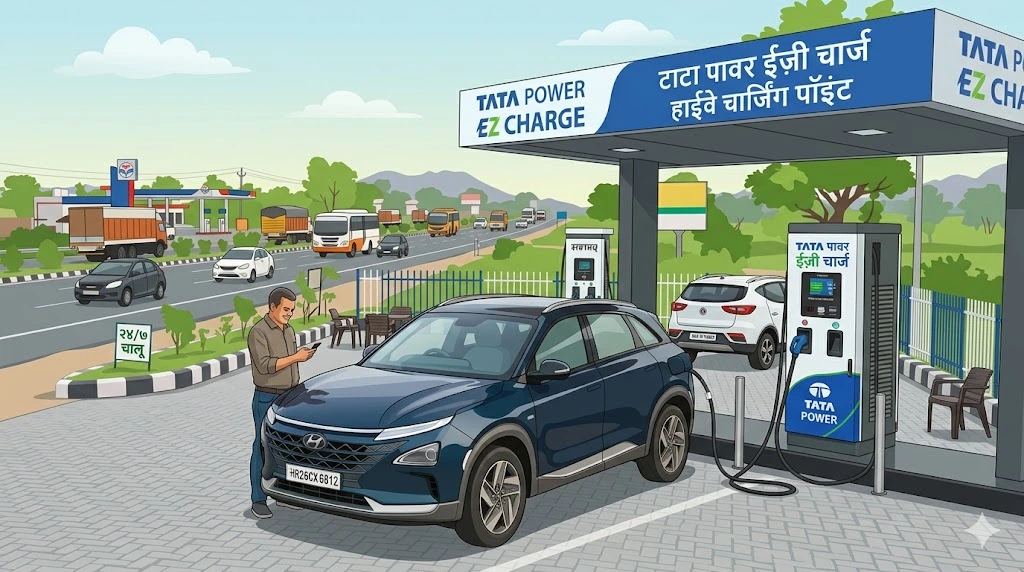
Delhi has one of India’s most developed EV charging networks where chargers are available at malls, office complexes, fuel stations and major highways. Tata Motors provides home-charging equipment with the Nexon EV, although charger specifications and installation terms may vary by variant and dealership. Using a 7.2 kW AC wall charger, the 30 kWh (MR) battery takes approximately 4.5 hours for a full charge (10 to 100%), while the 45 kWh battery takes approximately 6.5 hours. For faster top-ups, a DC fast charger can charge the MR battery from 10 to 80% in about 40 minutes and the 45 kWh battery in about 56 minutes. Overnight charging is the most convenient solution for most owners.
Nexon Petrol practicality
The petrol variant has no range anxiety. Delhi has fuel stations on virtually every major road. The petrol variants also give buyers manual and DCA automatic gearbox options that the EV does not, which some buyers prefer for control on hilly terrain or in heavy traffic.
Features Comparison at Similar Price Points
Here we compare the Nexon EV Creative Plus MR (approximately ₹13.17 Lakh on-road in Delhi) against the Nexon Petrol Creative DCA (₹13.03 Lakh on-road in Delhi).
| Feature | Nexon Petrol Creative DCA | Nexon EV Creative Plus MR |
| On-Road Price (Delhi) | ~₹13.03 Lakh | ~₹13.17 Lakh |
| Powertrain | 1.2L Turbo Petrol, DCA | Electric, Single-speed auto |
| Infotainment | 10.25-inch touchscreen | 7-inch touchscreen |
| Driver Display | 10.25-inch digital cluster | 7-inch digital cluster |
| Sunroof | No | No |
| Ventilated Front Seats | No | No |
| Connected Car (iRA) | Yes | Yes |
| 6 Airbags | Yes | Yes |
| TPMS | Yes | Yes |
| Wireless Android Auto / Apple CarPlay | Yes | Yes |
| Regenerative Braking | No | Yes |
| 360-degree Camera | Yes | No |
At nearly similar on-road prices, the Nexon EV Creative Plus MR offers regenerative braking that the petrol Creative DCA does not. The petrol variant, however, gives you the DCA twin-clutch automatic gearbox experience and the freedom to refuel in minutes anywhere in the city. Ventilated front seats on the Nexon EV are available from the Empowered trim onwards.
Who Should Buy Which?
Buy the Tata Nexon Petrol if:
- Your budget is under ₹12 Lakh on-road in Delhi
- You live in a flat or housing society without dedicated parking or charging access
- You frequently drive 300+ km on intercity trips and cannot plan charging stops
- You prefer a manual gearbox or Tata’s DCA automatic transmission
- You are not comfortable with the idea of managing charge levels as part of daily routine
Buy the Tata Nexon EV if:
- You have a dedicated parking spot at home where you can install a charger
- Your daily commute is under 80 km (MR variant) or under 150 km (45 kWh variant)
- You want the lowest possible monthly fuel bill and plan to keep the car for 4 or more years
- You want the smoothest, most effortless driving experience in Delhi city traffic
- You want a near-silent, premium cabin feel without spending significantly more
A Few Last Words
The answer to the Tata Nexon EV vs Nexon Petrol debate ultimately depends on your usage pattern. The petrol variant wins on upfront affordability, refuelling convenience and flexibility for long-distance travel. The EV, on the other hand, offers significantly lower running costs, a quieter cabin and a smoother driving experience in city traffic. If you have access to home charging and plan to keep the vehicle for several years, the Nexon EV can be a great choice. However, for buyers without dedicated parking or charging access, the petrol version can be the more practical option.
Prices and specifications mentioned in this article are subject to change. Please verify the latest details with Tata Motors before making a purchase decision.
Frequently Asked Questions
Yes. When charged mainly at home, the Nexon EV typically costs around ₹1.00 to ₹1.30 per km to run, compared to roughly ₹7.50 to ₹8.00 per km for the petrol version. The exact savings depend on electricity tariffs, fuel prices and driving conditions. However, frequent users can save well over ₹1 lakh annually on running costs.
The 30 kWh Medium Range variant typically delivers around 200 to 230 km in real-world Delhi driving with air conditioning and mixed traffic conditions. The 45 kWh variant generally returns around 330 to 380 km in mixed city and highway use, depending on driving style, traffic, weather and terrain.
Yes. Tata Motors provides home-charging equipment with the Nexon EV, though charger specifications and installation terms can vary by variant and dealership. A dedicated power connection and suitable parking space are required for most installations. Using a 7.2 kW AC charger, the 30 kWh (MR) battery takes approximately 4.5 hours for a full charge, while the 45 kWh battery takes approximately 6.5 hours. A DC fast charger can top up the MR from 10 to 80% in around 40 minutes.
The entry-level Nexon Petrol starts at around ₹8.28 Lakh on-road in Delhi, while the entry-level Nexon EV starts at approximately ₹13.17 Lakh on-road. Depending on the variants compared, the on-road price difference typically ranges from about ₹2 lakh to over ₹5 lakh. Buyers should compare similarly equipped variants before making a decision.
For regular long-distance driving, the Nexon Petrol is more convenient because you can refuel at any petrol station in under 5 minutes. The Nexon EV 45 kWh variant is capable of routes like Delhi to Jaipur or Delhi to Agra with a single charging stop, and the fast-charging network on these highways has improved considerably. However, the additional planning required for frequent long trips makes the petrol variant more hassle-free.
Yes. Under Delhi’s Electric Vehicle Policy, electric cars with an ex-showroom price up to ₹30 Lakh receive a 100% waiver on road tax and registration fees. Since the entire Tata Nexon EV lineup falls under this ₹30 Lakh threshold, you pay zero road tax. This single benefit slashes your initial on-road costs by approximately ₹80,000 to ₹1.50 Lakh compared to a petrol variant, significantly narrowing the upfront price gap.