EV Charging Stations on Indian Highways: Complete Guide (2026)
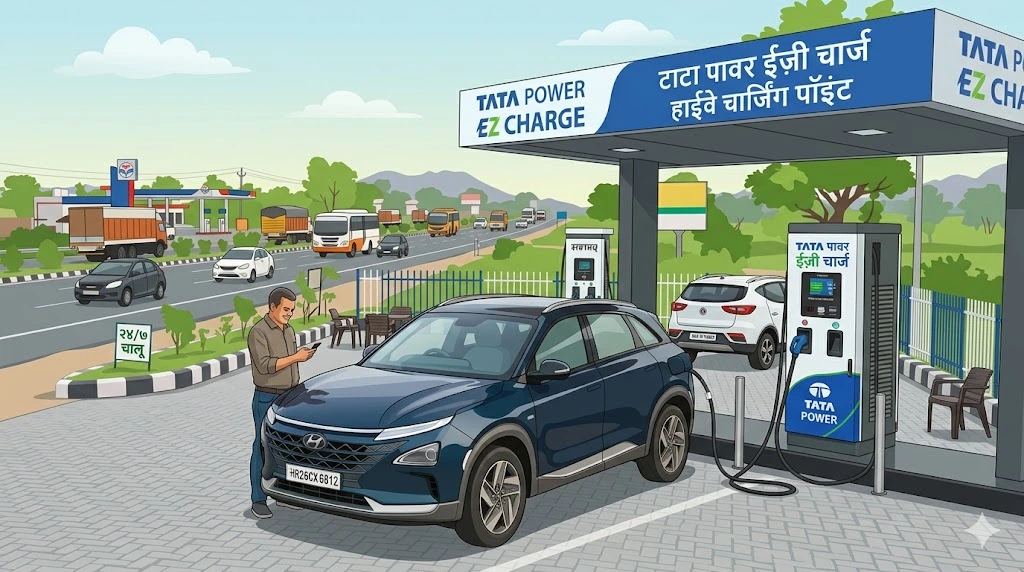
For people planning to buy an electric car, one of the biggest concerns is whether they can confidently take it on a long highway trip. This is also known as range anxiety and it was a genuine problem just a few years ago. While finding a reliable charger outside major cities required extensive planning, your entire journey could be disrupted by a single non-functional charging station.
The good news is that the situation has improved dramatically. India’s EV charging network has expanded at a rapid pace and thousands of new public charging stations have been added across cities, expressways and national highways. Leading routes, including Delhi-Jaipur, Mumbai-Pune, Bengaluru-Mysuru and Chennai-Trichy now have multiple charging options, which has made long-distance EV travel far more practical than before.
Some challenges still remain, but India’s highway charging infrastructure is no longer in its early stages. This guide explores the current state of EV charging on Indian highways, key charging corridors, government initiatives, major charging networks and practical tips for planning a stress-free EV road trip.
Current State of EV Charging on Indian Highways
Over the last few years, there has been impressive growth in India’s public EV charging infrastructure.
As of 2023, India had just over 6,500 public charging stations. However, the number has crossed 29,100 public charging stations nationwide by late 2025. According to the Press Information Bureau, the total number of electric vehicle charging stations was 29,151 by December 2025, which included 8,805 fast chargers and 20,346 slow chargers. The number of charging stations was highest in Karnataka at 6,096 followed by Maharashtra at 4,166. This represents one of the fastest infrastructure expansions in India’s automotive sector.
Government support and private investment from charging operators such as Tata Power EZ Charge, Statiq, ChargeZone, Zeon, and others has driven much of this growth.
Highway charging has become a particular focus area. Public charging stations are increasingly being installed at fuel stations, food plazas, hotels, toll plazas and highway rest stops. According to recent government and industry reports, over 91% of India’s national highway network now has access to a public EV charger within a 50-kilometre radius.
This doesn’t mean every highway is perfectly covered. While busy corridors connecting major metropolitan areas generally have excellent charger density, some remote stretches still require careful planning. However, compared to the situation even three years ago, EV drivers now have significantly better charging options available.
Long-distance travel has also become easier with the growing availability of CCS2-compatible fast chargers. Most modern electric cars sold in India support CCS2 charging standards, allowing drivers to use chargers from different networks without being restricted to a single operator. India’s EV charging network is growing quickly, and so is demand for electric cars. Passenger EV sales rose by around 69.5% compared to the same period last year in the opening months of 2026.
ALSO READ: BEST ELECTRIC CARS IN INDIA 2026
Key Highway EV Corridors in India
Charging infrastructure continues to expand under both government and private initiatives. Major transit routes have been transformed by higher charger density. As a result, many EV owners can now complete long-distance journeys with a single charging stop. Those who own modern, long-range EVs such as the Tata Curvv EV, Mahindra BE 6 or MG Windsor EV can complete their journeys even nonstop.
The structural landscape of India’s premier EV routes highlights this massive growth:
| Highway Corridor | Key Operators Active | Charging Coverage Status |
| Delhi–Jaipur (NH48) | Tata Power, Statiq, ChargeZone, Jio-bp Pulse | High Density: One of India’s best-served EV corridors with multiple DC fast-charging options available across the 280 km route. |
| Delhi–Agra (Yamuna Expressway) | Tata Power, ChargeZone, Indian Oil, Statiq, Jio-bp Pulse | High Density: Among India’s earliest EV highway corridors with reliable charging coverage for most modern EVs. |
| Mumbai–Pune Expressway | Tata Power, ChargeZone, Jio-bp Pulse, Statiq | Excellent Density: Frequent fast-charging stations are available at fuel stations, food courts, and hospitality hubs along the route. |
| Bengaluru–Mysuru Expressway | Zeon, ChargeZone, Ather Grid, Tata Power | High Density: Well-developed charging network supporting both passenger EVs and commercial fleets. |
| Chennai–Trichy Highway | Zeon, Statiq, BPCL | Rapidly Expanding: Strong charging coverage supported by Tamil Nadu’s growing EV ecosystem. |
| Hyderabad–Vijayawada | ChargeZone, Statiq, Tata Power, Thunderplus, Voltran | Good Coverage: Fast chargers are available at regular intervals, making intercity EV travel increasingly convenient. |
| Ahmedabad–Vadodara–Surat | ChargeZone, Tata Power, Statiq, Jio-bp Pulse | Priority Corridor: Strong charging infrastructure supported by Gujarat’s high EV adoption and industrial activity. |
As private and public operators ramp up installations, similar comprehensive charging coverage is expected to appear on additional highway routes over the next few years.
Government Schemes Powering This Infrastructure
Several government initiatives have played a major role in the expansion of India’s charging infrastructure.
FAME II
The Faster Adoption and Manufacturing of Electric Vehicles (FAME II) scheme laid the foundation for public charging infrastructure development. It supported the installation of charging stations in cities and on key transportation routes while encouraging EV adoption through incentives.
PM E-DRIVE
The government’s latest flagship initiative is the PM E-DRIVE scheme. Under this programme, ₹2,000 crore has been allocated specifically for EV charging infrastructure to install approximately 72,000 public charging stations across India—including deployment along 50 national highway corridors and high-footfall locations like airports, railway stations, and fuel stations.
To speed up the growth of EV charging infrastructure, the government has extended the PM E-DRIVE scheme until March 2028. This will help fund more charging stations on highways and in cities over the next few years. In 2026, the government approved ₹503.86 crore for the installation of 4,874 new public chargers across eight major states. A large number of these chargers will be installed at existing petrol pumps run by IOCL, HPCL, and BPCL, making long-distance EV travel easier than ever before.
Ministry of Power Guidelines
The Ministry of Power has also introduced guidelines encouraging widespread charger deployment. One key objective has been ensuring that EV users have access to charging facilities at regular intervals on highways and major intercity routes. These guidelines have helped create a more structured approach to infrastructure planning and reduced uncertainty for private charging operators.
Together, these policies are helping transform EV charging from a niche service into a mainstream transportation utility.
Major Charging Networks to Know
Several companies now operate nationwide charging networks.
- Tata Power EZ Charge: Tata Power operates one of India’s largest EV charging ecosystems. Its chargers are available across cities, highways, hotels, shopping centres, and fuel stations. The Tata Power EZ Charge app allows users to locate chargers, start charging sessions, and make payments digitally.
- Statiq: Statiq has rapidly expanded its footprint across urban centres and highway routes. The company offers app-based charger discovery, real-time availability information and support for multiple EV models.
- ChargeZone: ChargeZone focuses heavily on highway fast charging. Its network covers many long-distance travel routes and is popular among EV owners undertaking intercity journeys.
- Ather Grid: Initially developed for electric scooters, Ather Grid continues expanding and has become useful for both two-wheeler and four-wheeler EV users in many regions.
- Zeon Charging: Zeon has built a strong presence in southern India and is increasingly becoming a preferred choice for EV road trips in Tamil Nadu and neighbouring states.
The Road Ahead
Industry forecasts suggest India’s charging ecosystem will continue to grow aggressively through the decade. Tata.ev has announced plans supporting the expansion of charging infrastructure toward hundreds of thousands of charging points, including a significant increase in public fast chargers over the coming years.
How Far Apart Are Chargers on Highways?
This is one of the most common questions among prospective EV buyers. Government planning guidelines aim to ensure charging facilities are available roughly every 25 kilometres along major highways and intercity routes.
In practice, charger spacing varies. On popular routes such as Delhi-Jaipur, Mumbai-Pune, and Bengaluru-Mysuru, chargers may be available every 20-40 kilometres. On less-developed routes, there can be gaps of 60 kilometres or more.
The good news is that most modern EVs now offer real-world highway ranges of 250-500 kilometres. As a result, even moderate charger density is often sufficient for comfortable travel. Still, it is smart to check charging availability before starting a long trip.
Tips for Planning an EV Road Trip in India
A successful highway trip depends heavily on seamless digital planning. Historically, a major problem before drivers was to manage up to a dozen separate charging apps. To solve this fragmented experience, India has introduced the Unified Bharat eCharge (UBC) platform powered by open-network architecture. It functions like a “UPI for EV charging,” and allows you to locate, check live status, and pay across different networks like Tata Power, Statiq, ChargeZone, and public oil company stations using a single interface.
For a stress free highway journey, structure your trip using this step-by-step roadmap:
- Step 1: Check the Unified Bharat eCharge App (Before leaving home)
Instead of relying on fragmented individual networks, use the integrated platform to plot out fast-chargers across participating private and public operators directly along your route. - Step 2: Verify Live Charger Status (30 minutes prior to arrival)
A charger shown on a static map might be occupied or temporarily down. Use real-time network tracking to ensure the bay is vacant, online and active before pulling into the station. - Step 3: Identify a Nearby Backup Option (Route Planning Buffer)
Always pinpoint a secondary charging station within a 15–20 km radius of your primary stop. This ensures total peace of mind if localised power issues or unexpected queues affect your first choice.
Highway Charging Pro-Tip: Always prioritise DC Fast Chargers (CCS2 standard) located at major highway food plazas. A standard 10% to 80% fast-charge takes approximately 30–45 minutes.
- Start With a High State of Charge: Beginning a highway journey with a battery level above 90% gives greater flexibility and reduces dependence on intermediate charging stops.
- Monitor Weather and Traffic: Heavy traffic, high speeds, steep terrain and extreme temperatures can all affect EV range. Build a small buffer into your trip planning.
Challenges Still to Solve
India’s network has expanded rapidly, but some challenges remain.
Coverage is still uneven, with metropolitan regions and major corridors receiving significantly more chargers than rural areas.
Charger uptime is another concern. Many EV owners continue to report occasional outages, maintenance issues, or connectivity problems at public charging stations. Community feedback frequently highlights reliability as being just as important as charger count.
Fast charging infrastructure also needs further expansion. Although DC fast chargers are becoming more common, many public charging locations still rely on slower AC charging solutions. Addressing these issues will be critical as EV adoption continues to accelerate.
A Few Last Words
India’s EV highway charging network has expanded significantly in a short period. With more than 29,000 public charging stations already operational and tens of thousands more planned under the PM E-DRIVE scheme, long-distance EV travel is becoming increasingly practical across the country.
While some coverage gaps and reliability challenges remain, the overall trend is clearly positive. For most EV buyers today, highway charging is no longer a major barrier.