Manual vs Automatic: Which Is Better for Delhi-Gurugram Traffic?
 Published on 26 August 2026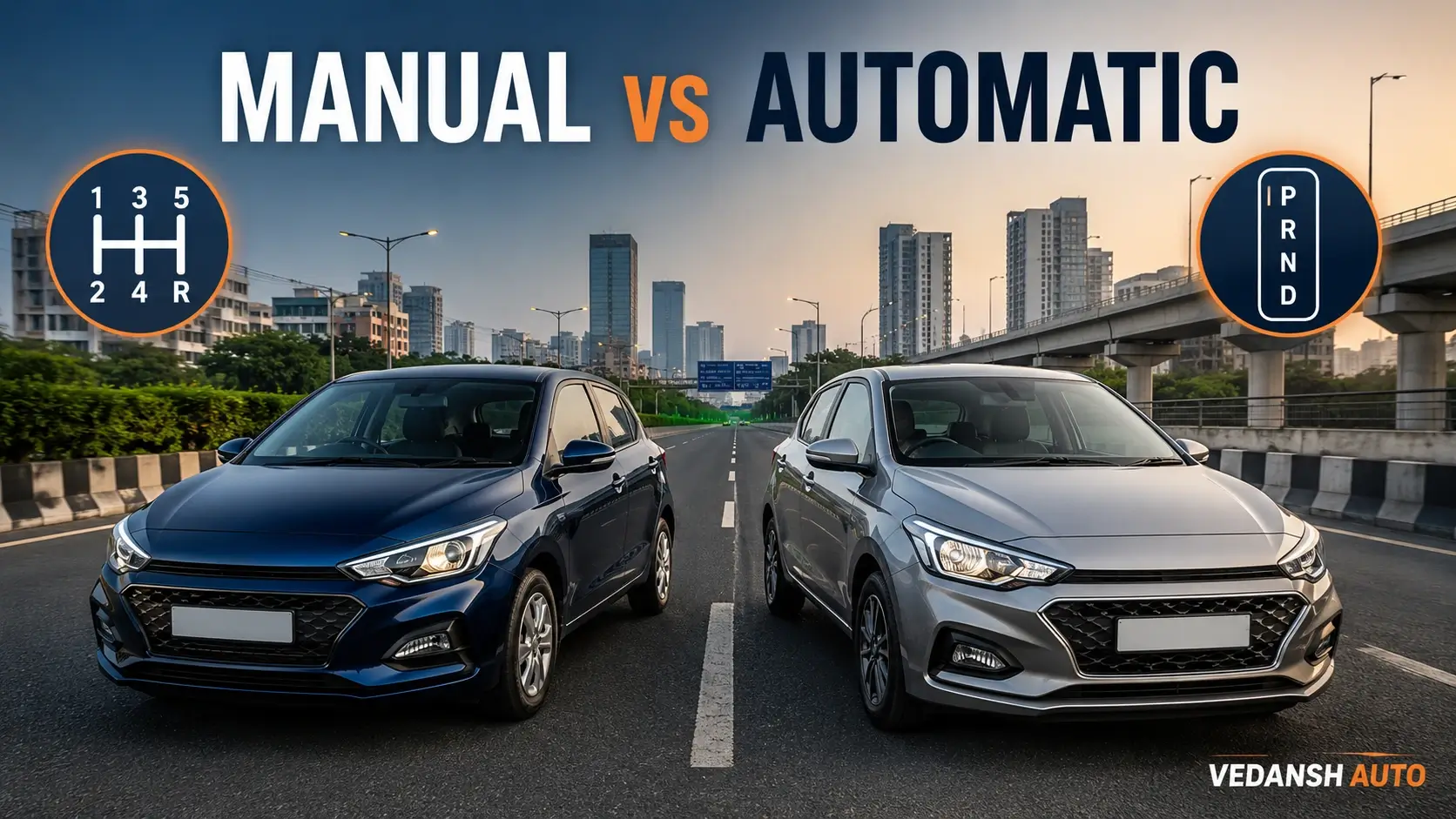
If you regularly drive between Delhi and Gurugram, you know how tiring the journey can become. A clear road can turn into a long traffic jam within minutes. Routes such as NH-48, Ring Road and the roads around Cyber Hub often involve repeated braking, slow movement and sudden lane changes.
In these conditions, the choice between a manual and an automatic car affects more than driving convenience. It can influence driver fatigue, fuel efficiency and how easy the car feels to handle every day.
So, which type of transmission is better for Delhi-Gurugram traffic? Let us look at how both options perform in real-world conditions.
Driving a Manual Car in Heavy Traffic
Driving a manual car in slow-moving traffic means repeatedly pressing the clutch, selecting first gear, moving forward and braking again. This cycle can continue for 30 minutes or longer during peak hours.
The biggest drawback is physical fatigue. Constant clutch use can put strain on the left leg, especially during a daily commute. By the time the road opens up, the driver may already feel tired from managing the clutch and gears.
A manual car also requires more attention at very low speeds. The driver must maintain the right balance between the clutch and accelerator to prevent the engine from stalling. This can become frustrating when traffic moves only a few metres at a time.
However, manuals still have their advantages. They provide more direct control over gear selection and acceleration. Some drivers enjoy this involvement, particularly on open roads where they can select the right gear according to the speed and road conditions.
A manual may therefore suit someone whose daily journey includes long stretches of open highway and only limited city traffic. It can also be a more affordable choice because manual variants generally cost less than their automatic counterparts.
How an Automatic Makes City Driving Easier
An automatic car does not require the driver to operate a clutch or change gears repeatedly. In most situations, the driver only needs to use the accelerator and brake.
This makes a noticeable difference in traffic. When vehicles are moving slowly near Rajiv Chowk, Dhaula Kuan or Cyber Hub, an automatic reduces the physical effort required to keep the car moving. The driver is less likely to experience clutch-related leg fatigue after a long commute.
An automatic can also reduce the mental effort involved in driving. Since there is no need to coordinate the clutch and gears, the driver can pay greater attention to surrounding vehicles, pedestrians, two-wheelers and changing traffic signals.
This does not mean an automatic car is automatically safer. Road safety still depends on the driver, the vehicle and the conditions. However, reducing driver fatigue may make it easier to remain attentive during a difficult commute.
Automatics can also be helpful during the monsoon. Poor visibility and slow traffic already require additional concentration. Not having to manage the clutch and gears makes driving slightly easier. However, drivers should avoid entering a waterlogged stretch if they cannot safely judge the depth of the water.
AMT, CVT, Torque Converter and DCT Explained
Not all automatic cars provide the same driving experience. Indian buyers will commonly come across four types of automatic transmissions.
AMT
An automated manual transmission, or AMT, is based on a manual gearbox. However, the clutch and gear changes are controlled electronically.
AMTs are generally the most affordable type of automatic transmission. They are commonly available in small hatchbacks and compact cars. They remove the need to operate a clutch, which makes them convenient in traffic.
The main drawback is that some AMTs produce a noticeable pause or slight head movement while changing gears. This can be more apparent at lower speeds, although newer AMTs have become smoother.
An AMT is a sensible option for buyers who want an affordable automatic mainly for city use.
CVT
A continuously variable transmission, or CVT, is known for delivering smooth power at lower speeds. It does not change gears in the same way as a regular automatic, so gear shifts are usually not noticeable.
This smoothness makes a CVT well suited to slow and crowded city roads. However, during hard acceleration, the engine speed may rise before the car gains speed. Some drivers describe this as a rubber-band effect.
This behaviour is less noticeable during normal city driving, where acceleration is usually gentle.
Torque Converter Automatic
A torque converter automatic generally provides smooth and predictable acceleration. It works well in both city traffic and on highways, making it a versatile option.
Modern torque converter automatics have become more responsive and efficient than older units. However, they are usually available on more expensive variants and may add significantly to the price of the car.
DCT
A dual-clutch transmission, or DCT, can change gears quickly and works particularly well during faster driving. It is commonly offered with turbo-petrol engines.
However, some DCTs may not feel as smooth as CVTs or torque converter automatics when traffic is moving very slowly. Buyers should also follow the manufacturer’s driving and maintenance recommendations, particularly when using a DCT regularly in heavy traffic.
Which One Delivers Better Mileage?
There is no simple rule that says a manual will always deliver better mileage than an automatic.
Older torque converter automatics were often less fuel-efficient than manual cars. However, automatic gearbox technology has improved considerably. Some modern AMTs and CVTs can match or even deliver better claimed mileage than the manual versions of the same car.
Actual mileage in Delhi-Gurugram traffic depends on several factors, including:
- The type of transmission
- Traffic conditions
- Driving style
- Air-conditioner use
- Vehicle load
- Tyre pressure
- Engine and gearbox combination
Many newer cars also have idle start-stop technology. It switches off the engine when the car is stationary and restarts it when required. This can help reduce unnecessary fuel use at long traffic signals. The feature is available in both manual and automatic cars.
Instead of assuming that one transmission will be more efficient, buyers should compare the claimed mileage of the exact variants they are considering. A proper test drive can also help them understand how the car behaves in slow traffic.
Purchase Price and Maintenance
Manual variants are usually cheaper than automatic variants of the same car. This makes them attractive to buyers working with a limited budget.
Automatic transmissions add convenience, but the additional price varies according to the gearbox. An AMT usually has a smaller price difference, while a CVT, DCT or torque converter automatic can cost considerably more.
Maintenance costs also depend on the transmission and the car. A manual clutch may need replacement after extended use, particularly if the car is driven regularly in heavy traffic. Automatic transmissions do not have a driver-operated clutch, but certain gearbox repairs can be expensive.
Before buying, check the warranty, recommended service schedule and expected maintenance cost of the exact variant.
Which One Makes More Sense for Delhi-Gurugram?
A manual car may be suitable if:
- You have a limited purchase budget.
- Most of your driving takes place on open roads.
- You enjoy changing gears and want greater involvement.
- You do not regularly face heavy traffic.
An automatic may be the better option if:
- Your daily commute involves congested roads.
- You frequently travel during peak hours.
- You want to reduce clutch-related leg fatigue.
- Different members of your family will drive the car.
- Ease of driving is more important than the lowest purchase price.
For someone who regularly travels through Ring Road, NH-48, Dhaula Kuan or Cyber Hub during busy hours, an automatic is likely to make the daily commute less tiring. An AMT can provide this convenience at a lower price, while a CVT or torque converter automatic may offer a smoother experience.
Final Verdict
There is no single correct choice for every buyer. A manual car costs less and provides greater control, while an automatic makes slow and crowded journeys easier.
For occasional city use and frequent open-road driving, a manual can still be a practical and enjoyable choice. For a daily Delhi-Gurugram commute involving long traffic jams, an automatic is generally the more convenient option.
The final decision should depend on your route, budget, expected monthly driving and comfort preferences. Test-driving both versions in traffic is the best way to understand which one suits you.