New Car PDI Checklist: What to Check Before Taking Delivery
Published on 29 August 2026
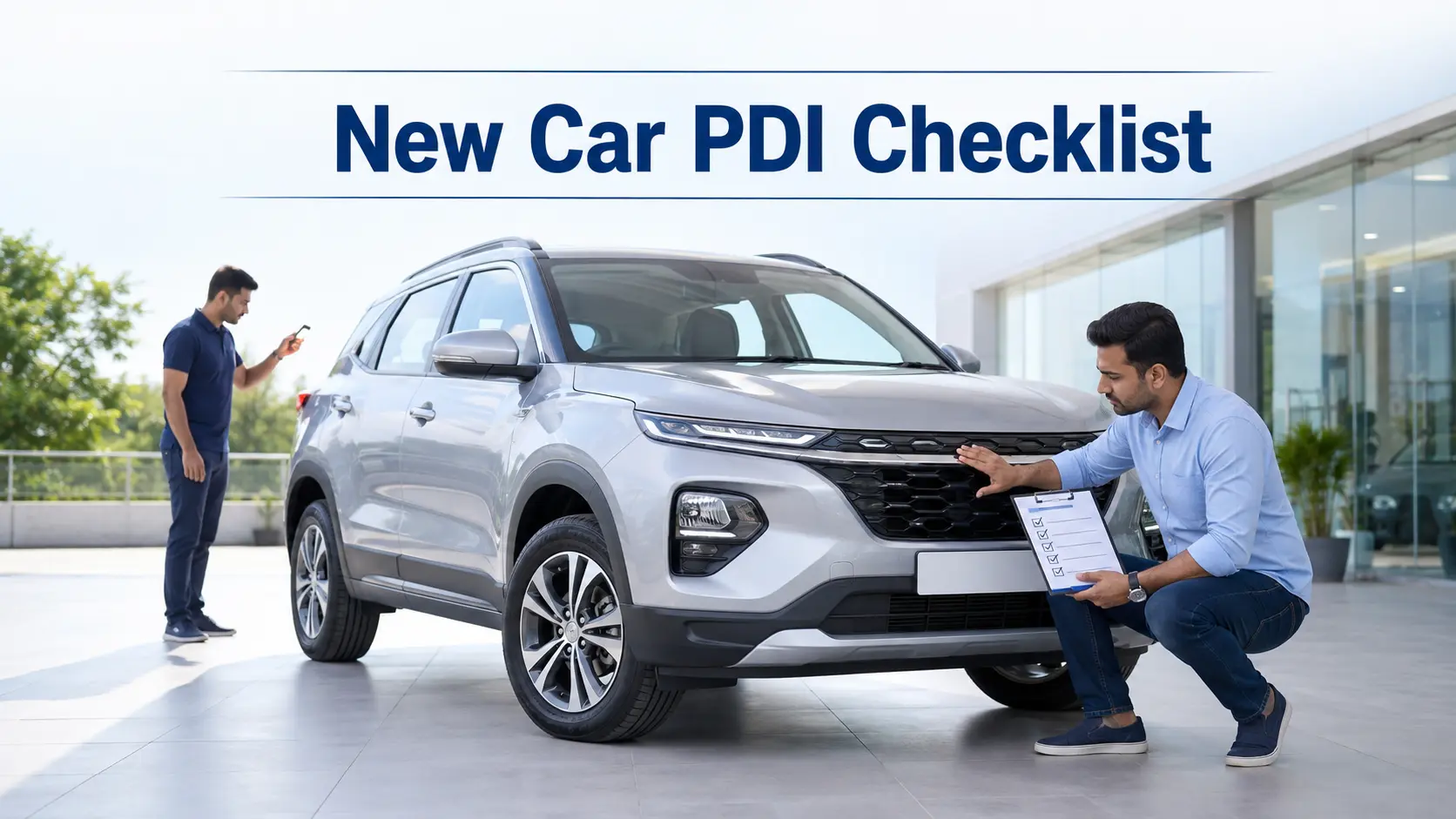
Buying a new car is an exciting experience, but it is worth slowing down before accepting the keys. A careful new car PDI checklist can help you identify scratches, missing accessories, incorrect documents or other problems before the car is registered and delivered.
PDI stands for pre-delivery inspection. The dealership normally conducts its own inspection, but you should also examine the exact vehicle allotted to you. You do not need to be a mechanic to do this. Around 30 to 60 minutes in good daylight is usually enough to check the car carefully.
Here is a complete PDI checklist for new car buyers in India.
What Is a New Car PDI?
A pre-delivery inspection is a detailed examination of a new car before taking delivery. It allows you to check whether the vehicle:
- Is the correct model, variant and colour
- Matches the booking and invoice
- Has any visible damage
- Has all the promised features
- Is mechanically and electrically functional
- Includes the required documents, tools and accessories
The dealer also performs an internal PDI before delivery. This usually involves checking fluid levels, electrical equipment, tyre pressure, warning lights and the general condition of the vehicle.
However, the dealer’s inspection does not replace your own check. You need to confirm that the allotted vehicle is in acceptable condition and matches what you ordered.
When Should You Conduct the PDI?
Ideally, inspect the allotted car before it is submitted for registration in your name. Discuss this with the salesperson early instead of raising the request only on delivery day.
A practical buying sequence is:
- Book the selected model and variant.
- Ask the dealer to share the VIN of the allotted vehicle.
- Visit the dealership or stockyard to inspect the car.
- Record any concerns and ask the dealer to resolve them.
- Confirm that you accept the allotted vehicle.
- Allow the dealer to proceed with registration.
- Inspect the car once more during final delivery.
Dealership and lender procedures can differ. You may already have paid a booking amount, and a lender may require certain steps before releasing the loan. The important point is to request an opportunity to see the exact car before approving its registration and final delivery.
Once the car has been registered in your name, replacing it can become considerably more difficult.
What to Carry for a New Car PDI
You do not need specialised equipment for a basic inspection. Carry the following:
- Mobile phone with a camera and flashlight
- Copy of the booking form
- Official variant feature list or brochure
- This PDI checklist
- Charging cable to test USB ports
- Microfibre cloth to check marks or stains
- Tyre-pressure gauge, if available
- Another person who can help inspect the vehicle
A paint-thickness gauge can help identify repainted panels, but it is optional. Most buyers do not need to purchase one for a single inspection.
Try to inspect the car outdoors or in a brightly lit area. Scratches, small dents and variations in paint are much harder to notice inside a dark stockyard.
1. Verify the Car’s Identity
Begin by confirming that you are inspecting the exact vehicle allotted to you.
Check:
- Make and model
- Variant
- Exterior colour
- Fuel type
- Transmission
- VIN or chassis number
- Engine number or motor number
- Manufacturing month and year
- Odometer reading
Photograph the VIN and other identification numbers. These details should match the invoice, insurance policy and registration documents.
Vehicle-registration documents in India record important identification details. Form 20 includes the chassis and engine or motor number, while Form 21 is the sale certificate. Form 22 certifies compliance with applicable road-worthiness, emission and noise standards.
Official forms are available through Parivahan: Form 20, Form 21 and Form 22.
VIN formats vary between manufacturers. An online VIN decoder may help, but do not depend entirely on a generic decoder. Ask the dealer to confirm the manufacturing details through the manufacturer’s records and documents.
2. Check the Exterior Carefully
Walk around the car slowly and examine every panel from different angles.
Look for:
- Scratches and dents
- Paint chips
- Colour mismatch between panels
- Signs of repainting
- Uneven panel gaps
- Cracked bumpers or body cladding
- Rust marks
- Water stains
- Loose trim
- Damage underneath the bumpers
- Scratches on door handles and mirrors
Open and close all doors, the bonnet and the boot. They should operate smoothly and should not require unusual force. Check whether the doors sit evenly when closed.
Inspect the roof as well. It is easy to miss dents or transport damage on the roof of an SUV.
Check the windscreen and every window for cracks, chips or deep scratches. Examine the headlamps, tail lamps, fog lamps and indicators for moisture, damage or poor alignment.
Also test:
- Outside rear-view mirrors
- Wipers
- Windscreen washers
- Door locks
- Fuel-filler flap
- Charging-port cover on an EV
- Sunroof operation, where provided
A light layer of dust is common in a stockyard. However, the dealer should allow you to clean a suspicious area gently so you can determine whether it is dirt or permanent damage.
3. Inspect the Tyres and Wheels
Check all four tyres and the spare wheel, if the car includes one.
Confirm:
- Correct tyre size
- Tyres are from an appropriate specification
- No cuts, cracks or bulges
- No unusual wear
- Wheels are free from major scratches
- Wheel covers are fitted correctly
- Spare wheel is present and inflated
- Jack and wheel spanner are provided
- Tyre inflator or repair kit is included, where applicable
- Towing hook is present
You can find the tyre manufacturing date on its sidewall. Tyres fitted to the same car may not always have the exact same manufacturing week. A small difference is not automatically a problem, but unusually old or visibly deteriorated tyres require clarification.
Check whether the tyre specification matches the variant. Higher and lower variants of the same car may use different wheel and tyre sizes.
4. Check the Interior
Enter the car and examine the cabin before switching on the ignition.
Inspect:
- Seat upholstery
- Dashboard
- Door pads
- Roof lining
- Carpet
- Floor mats
- Centre console
- Steering wheel
- Gear lever or drive selector
- Glovebox
- Cup holders
- Boot lining
- Parcel tray
Look for scratches, stains, cuts, loose fittings or signs of water entry. A strong damp smell, wet carpet or unusual staining deserves further investigation.
Adjust the front seats and test every adjustment. Fold the rear seats if the model allows it. Check every seat belt, buckle and adjustable head restraint.
Confirm that both keys are available. If the model provides a smart key, test its lock, unlock and boot-release functions.
5. Test the Electrical Features
Switch on the ignition and observe the instrument cluster. Warning lights normally illuminate briefly during the self-check and then go off after the engine starts or the EV becomes ready.
Pay attention if any warning light remains illuminated.
Test all features available on your variant, including:
- Headlamps
- Daytime running lamps
- Indicators
- Hazard lights
- Tail lamps
- Brake lamps
- Fog lamps
- Cabin lights
- Horn
- Power windows
- Central locking
- Electrically adjustable mirrors
- Auto-folding mirrors
- Rear defogger
- Rear wiper
- Parking sensors
- Rear-view camera
- 360-degree camera
- Cruise control
- Steering-mounted controls
- Wireless charger
- USB ports
- 12-volt socket
- Powered seats
- Ventilated seats
- Ambient lighting
- Sunroof
Ask another person to stand outside while you test the lights. This makes it easier to confirm that every lamp is working.
Use the official brochure or feature list for your exact variant. Do not expect equipment that is available only on a higher trim.
6. Test the Infotainment System
Switch on the touchscreen and check:
- Display quality
- Touch response
- Speakers
- Radio
- Bluetooth connection
- Android Auto
- Apple CarPlay
- USB connectivity
- Navigation, where provided
- Voice commands
- Connected-car functions
Play audio through every speaker. Check for distortion, crackling or a speaker that is not working.
If the car has connected features, ask when the account will be activated and whose mobile number and email address will be registered. The account should be linked to the owner, not permanently left under a dealership employee’s details.
7. Check the Air Conditioning
Start the car and switch on the air conditioning. It should begin cooling within a reasonable period.
Test:
- Every blower speed
- Different airflow directions
- Temperature controls
- Front vents
- Rear AC vents
- Automatic climate-control functions
- Front and rear defoggers
- Heater, if practical
Listen for unusual noises from the blower or compressor. A mild smell may occur in a car that has been standing, but a strong damp or chemical smell should be investigated.
8. Basic Mechanical Checks
You are not expected to perform a workshop-level mechanical inspection. A few basic checks can still reveal obvious problems.
With the engine running, observe:
- Whether the engine starts normally
- Whether the idle is stable
- Unusual knocking, rattling or vibration
- Excessive smoke
- Burning smells
- Warning lights
- Visible fluid leaks
- Brake-pedal feel
- Clutch operation in a manual car
- Gear-lever or selector operation
- Parking-brake operation
- Steering movement
Look under the car for fresh fluid. Water dripping after the air conditioner has been running can be normal condensation. Coloured, oily or strongly smelling fluid requires attention.
Open the bonnet and check for loose wires, damaged covers, leaking fluids or signs of rodent activity. Do not touch hot or moving components.
9. Additional Checks for an Electric Car
An electric car requires a few additional checks.
Confirm:
- Battery charge level
- Charging-port operation
- Charging-port cover and locking mechanism
- Portable charging cable
- Home-charger documents, if included
- Charging status displayed correctly
- Drive selector works
- Regenerative-braking controls work
- No EV-system warning is displayed
- Vehicle enters ready mode normally
- Both charging and vehicle keys are provided
Ask the dealer to explain the charging procedure and demonstrate the supplied portable charger. Confirm who will arrange the home-charger installation and whether any installation cost is included in the quotation.
Do not treat the displayed driving range as a fixed battery-health test. Estimated range changes with charge level, recent driving, climate-control use and software calculations.
10. Is the Odometer Reading Acceptable?
A new car does not always show zero kilometres. It may be moved around the factory, transport yard, dealership, fuel station or stockyard. The dealer may also drive it briefly during its internal inspection.
There is no single kilometre reading that applies to every new car.
A modest reading with a reasonable explanation is normally not a concern. If the odometer appears unusually high, ask:
- Why the car has covered that distance
- Whether it was transferred from another dealership
- Whether it was used as a display or test-drive vehicle
- Whether the dealer can provide another vehicle
- Whether its condition matches the explanation
Do not judge the car only by the odometer. Check the tyres, pedals, seat bolsters, steering wheel and door handles for signs of extended use.
11. Ask for a Short Movement Check
The allotted car may not yet be registered or insured for use on public roads. Do not insist on driving it outside the dealership.
If the dealer permits, move it a short distance within the premises and check:
- Steering response
- Brake response
- Clutch operation
- Gear changes
- Reverse gear
- Parking camera
- Parking sensors
- Unusual suspension noise
- Whether the car pulls noticeably to one side
A short movement check cannot replace a proper test drive. Ideally, test-drive the same model and powertrain before booking, then use the PDI to inspect the condition of the allotted car.
12. Verify the Documents
Check every document carefully before signing or taking delivery.
Important documents may include:
- Tax invoice
- Insurance policy
- Registration details
- Form 21 sale certificate
- Form 22 road-worthiness certificate
- Warranty booklet
- Owner’s manual
- Service booklet or digital service details
- Extended-warranty certificate
- Roadside-assistance details
- FASTag documents
- Accessory invoice
- Loan documents
- Hypothecation details, if financed
- Battery and charger warranty documents for an EV
Confirm that your name, address and contact details are correct. The model, variant, colour, chassis number and engine or motor number should match the allotted vehicle.
Review the insurance policy as well. Check the Insured Declared Value, policy period, add-ons, nominee details and vehicle identification numbers.
13. Check the Accessories and Supplied Items
Compare the car with the written quotation and booking form.
Check for:
- Both keys
- Spare wheel or puncture-repair kit
- Jack
- Wheel spanner
- Towing hook
- Floor mats
- Mud flaps
- Parcel tray
- FASTag
- Number plates
- First-aid kit, where supplied
- Warning triangle
- Portable charger for an EV
- Dealer-promised accessories
- Accessory invoice
Standard equipment and complimentary dealer items are not the same. If the salesperson promised an accessory or benefit, it should be mentioned in writing.
Inspect dealer-installed accessories carefully. Poor installation of cameras, lights, seat covers or electrical equipment can damage trim or wiring.
Red Flags During a New Car PDI
Pause the delivery process if you notice:
- Major repainting
- Structural damage
- Uneven panels suggesting repair
- Flood or water-entry signs
- Rust in unusual areas
- Cracked glass
- Persistent warning lights
- Fluid leakage
- A VIN that does not match the documents
- Wrong variant, colour or powertrain
- Unexplained high odometer reading
- Excessive signs of use
- Missing keys
- Serious electrical or mechanical faults
- Pressure to accept undocumented damage
A missing floor mat or minor removable accessory does not normally justify rejecting a car. It can usually be corrected before delivery.
Major body repair, structural damage, water exposure or a mismatched identity is much more serious. Do not approve the car until you receive a satisfactory resolution.
What Should You Do If You Find a Problem?
Follow a simple process:
- Photograph or record the issue.
- Inform the salesperson and sales manager.
- Describe the concern in writing through email or WhatsApp.
- Ask whether it can be corrected before delivery.
- Request written confirmation of the agreed action.
- Ask for another vehicle if the issue is serious.
- Do not sign a satisfactory-delivery acknowledgement until the matter is resolved.
Stay calm and distinguish between a minor correctable issue and a major defect. If the dealer proposes a repair, ask what work will be performed and whether it will affect the vehicle’s warranty or value.
Check the Car Again on Delivery Day
The main PDI may happen several days before delivery. Inspect the vehicle once more before driving away.
Confirm:
- No new scratches or dents have appeared
- The registration number is correct
- Number plates are fitted properly
- FASTag is installed
- Promised accessories are present
- Both keys are available
- Documents are complete
- Tyre pressure appears correct
- Fuel or battery charge is sufficient
- Warning lights go off normally
- Connected-car services are activated
- The dealer has explained the main controls
Check the odometer again and compare it with the reading recorded during the PDI. A small increase may be expected due to registration, fuelling, cleaning or movement within the dealership.
Take photographs of the car at delivery, including all four sides and the odometer.
Quick New Car PDI Checklist
You can save or screenshot this checklist before visiting the dealership:
- Model, variant, fuel and transmission verified
- Exterior colour verified
- VIN and engine or motor number checked
- Manufacturing details confirmed
- Odometer photographed
- Paint, panels and bumpers inspected
- Glass, mirrors and lights checked
- Tyres, wheels and spare inspected
- Doors, bonnet and boot tested
- Seats, dashboard and roof lining checked
- Seat belts and head restraints tested
- AC and blower tested
- Infotainment and speakers tested
- Cameras and parking sensors tested
- Power windows and locks tested
- No warning lights remain illuminated
- No unusual noise, smell or leakage found
- Both keys available
- Spare wheel or repair kit present
- Jack and tools present
- Accessories checked
- Invoice and insurance details verified
- Registration documents verified
- Warranty information received
- Final delivery-day inspection completed
FAQs
What does PDI mean when buying a new car?
PDI means pre-delivery inspection. It is an inspection of the exact vehicle allotted to you before you accept delivery.
Should PDI be done before registration?
Ideally, ask to inspect the allotted car before it is registered in your name. Dealer and lender procedures can vary, so discuss this requirement with the salesperson early.
Can a dealer refuse to allow a PDI?
Dealer policies differ, particularly when the vehicle is stored in a restricted stockyard. Ask for an inspection at the dealership or another safe location. If the dealer refuses to let you inspect the allotted car at any stage before registration, ask for the reason in writing and decide whether you are comfortable proceeding.
How much odometer reading is acceptable on a new car?
There is no universal limit. New cars accumulate some kilometres during movement, transport and inspection. Ask for an explanation if the reading seems unusually high and check for signs of extended use.
How can I find the manufacturing date of a car?
The VIN can contain manufacturing information, but its format differs between manufacturers. Confirm the month and year through the dealer, manufacturer records and vehicle documents rather than relying only on a generic online decoder.
Should I reject a new car with a scratch?
A very small surface mark may be corrected before delivery. Major repainting, deep damage or unexplained body repair deserves greater concern. Photograph the issue and agree on a resolution before accepting the vehicle.
Can I take a mechanic for the PDI?
You can ask the dealer whether an independent mechanic or experienced person may accompany you. For most new cars, a careful visual and functional inspection is sufficient, but professional help can be useful if you are not confident.
Is the PDI process different for an electric car?
Most exterior, interior and documentation checks remain the same. An EV also requires inspection of the charging port, supplied cable, charge level, home-charger documents, EV warning messages and battery-related warranty.
What documents should I receive with a new car?
You should receive the invoice, insurance policy, registration details, warranty information, owner’s manual and applicable sale and road-worthiness documents. Loan, extended-warranty, accessory and EV-charger documents may also apply.
How long does a new car PDI take?
A careful inspection usually takes around 30 to 60 minutes. Take more time if you find a concern or need the dealer to demonstrate several features.
Final Thoughts
A new car PDI is not about searching for reasons to reject the vehicle. It is about confirming that the exact car you are paying for is in the expected condition and matches your booking.
Inspect it in good light, verify the identification numbers, test the important features and record any concern before registration and delivery. A little patience at this stage can help you begin ownership with greater confidence and fewer surprises.