AMT vs CVT for City Driving: Which One Should You Choose?
Published on 28 August 2026
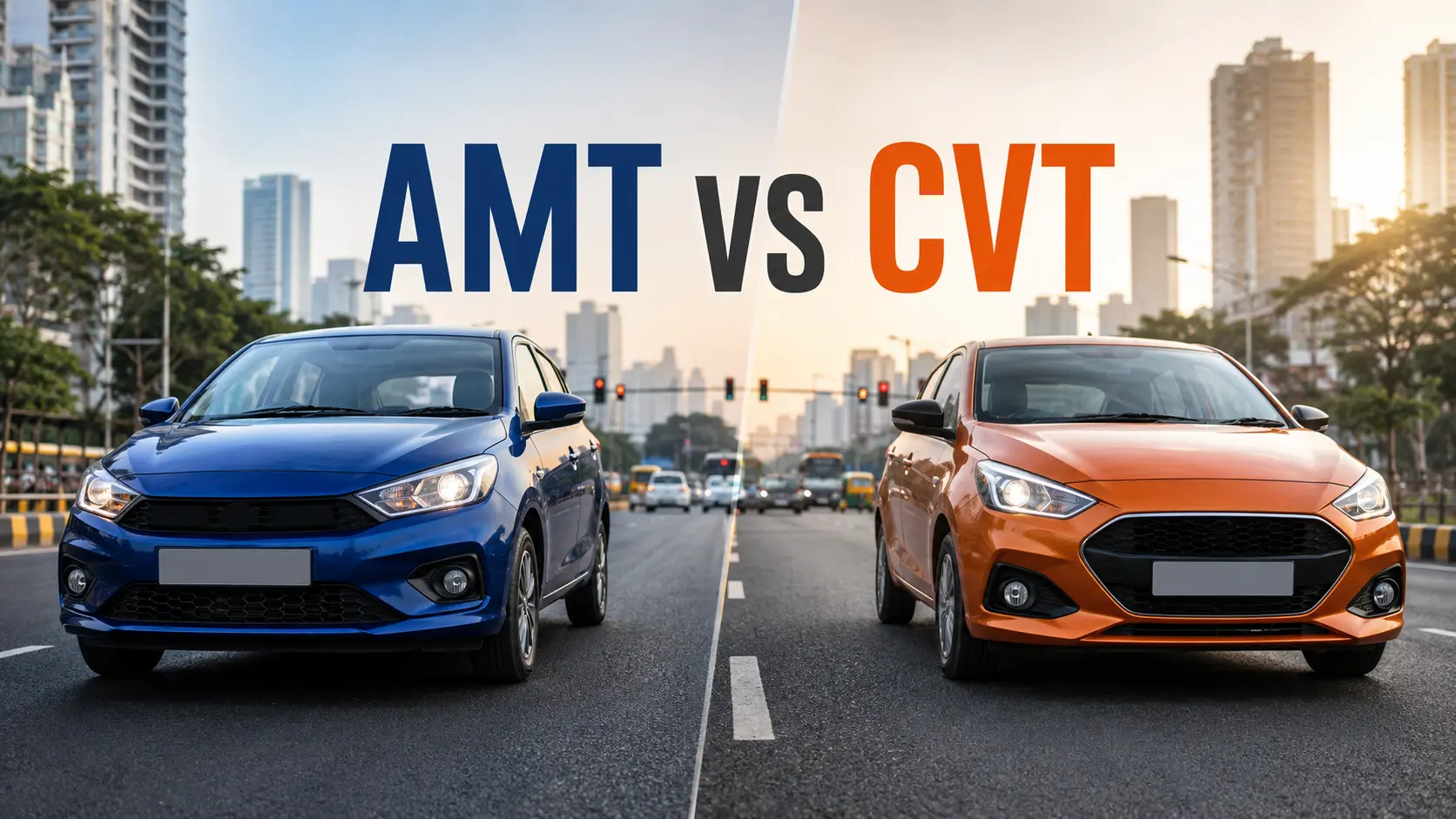
If you drive mostly in city traffic, choosing the right automatic transmission can make a noticeable difference to your daily commute. Two popular options available in India are AMT and CVT. Cars such as the Maruti Swift AMT and Tata Nexon AMT use the first type, while the Honda City CVT, Honda Amaze CVT and Nissan Magnite Turbo CVT use the second.
Both allow you to drive without operating a clutch pedal. However, they work differently and do not offer the same driving experience. An AMT is generally more affordable and fuel-efficient, while a CVT is usually smoother in slow-moving traffic.
In this comparison, we explain AMT vs CVT for city driving using current car examples, so you can decide which transmission suits your budget and daily commute.
What Is an AMT?
AMT stands for Automated Manual Transmission. It is essentially a manual gearbox in which the clutch and gear changes are controlled electronically. The driver does not need to operate a clutch pedal or change gears manually, although most AMTs also provide a manual mode.
Cars such as the Maruti Swift AMT, Maruti Dzire AMT, Tata Tiago AMT and Tata Nexon AMT use this technology. Maruti calls its system AGS, or Auto Gear Shift, but it works on the same basic principle.
AMTs are popular in India because they are less expensive to manufacture than most other automatic transmissions. This allows manufacturers to offer automatic variants without increasing the price too much.
However, because an AMT still changes between fixed gears, you may notice a brief pause during gear shifts. This is particularly noticeable if you accelerate quickly.
We have covered the Swift’s transmission choices separately in our Maruti Swift AMT vs Manual comparison.
What Is a CVT?
CVT stands for Continuously Variable Transmission. Instead of using a set number of fixed gears, a conventional CVT uses a belt-and-pulley arrangement that can continuously adjust the transmission ratio.
As there are no conventional gear changes, power delivery is generally smooth. This makes a CVT particularly comfortable in slow-moving traffic where the car has to stop and move repeatedly.
Current CVT cars in India include:
- Honda Amaze CVT
- Honda City CVT
- Honda Elevate CVT
- Nissan Magnite Turbo CVT
Some CVTs provide simulated gear steps through paddle shifters or software. These can make the transmission feel more familiar, but the gearbox still does not operate like a conventional automatic with fixed gears.
CVTs are generally available in more expensive cars and variants. They are also more complex than AMTs and require the correct transmission fluid and timely maintenance.
AMT vs CVT: Key Differences
| Factor | AMT | CVT |
| Basic design | Manual gearbox with an automated clutch and gear selection | Uses continuously changing ratios instead of conventional fixed gears |
| Gear changes | Shifts can be felt | Usually smooth without noticeable gear changes |
| Low-speed driving | Creep function is available, but shifts may cause head movement | Smooth and progressive in slow traffic |
| Purchase price | Usually the more affordable automatic option | Generally available in higher-priced cars and variants |
| Fuel efficiency | Often close to or better than the equivalent manual | Can keep the engine within an efficient operating range |
| Hard acceleration | A pause may be felt during gear changes | Engine speed may rise before the car gains speed |
| Maintenance | Generally affordable, but clutch wear is possible | Requires the correct fluid and major repairs can be expensive |
| Best suited for | Buyers prioritising affordability and mileage | Buyers prioritising smoothness and comfort |
Which Is Better for City Driving?
For most drivers, a CVT offers the smoother experience in city traffic. However, that does not mean an AMT is unsuitable for daily use.
AMT in city traffic
Most modern AMTs have a creep function. This allows the car to move forward slowly when you release the brake, without pressing the accelerator. It is useful in bumper-to-bumper traffic and while parking.
However, an AMT has to operate the clutch and change gears just like a manual transmission. You may feel a pause or slight head-nod movement when it shifts from one gear to another. This hesitation is commonly called AMT lag.
The effect becomes more noticeable if you press the accelerator suddenly. With gentle and progressive accelerator inputs, an AMT can feel considerably smoother.
Some drivers also briefly ease off the accelerator when they expect an upshift. This can reduce the head-nod effect, although it may take time to learn the gearbox’s behaviour.
CVT in city traffic
A CVT does not make conventional gear changes, so there is no pause between first, second and third gears. The car generally builds speed in a smooth and progressive manner.
This can make a real difference during long commutes in cities such as Delhi, Mumbai and Bengaluru. If you spend a lot of time moving slowly between signals or crawling through congestion, a CVT is likely to feel less tiring.
However, smoothness does not always mean faster response. If you press the accelerator hard, the engine speed may rise quickly while the car takes a moment to build speed. This sensation is sometimes called the rubber-band effect.
It is less noticeable during gentle city driving but may bother drivers who prefer a more direct and sporty response.
For more general guidance on choosing a transmission for congested roads, read our Manual vs Automatic for Delhi-Gurugram Traffic comparison.
Fuel Efficiency: AMT vs CVT
There is no universal rule that every AMT is more efficient than every CVT, or the other way around. Mileage depends on several factors, including:
- Engine size and tuning
- Vehicle weight
- Traffic conditions
- Driving style
- Gearbox calibration
- Air-conditioning use
- Tyre pressure
AMTs are often highly fuel-efficient because they are based on lightweight manual gearboxes. In some cars, the claimed mileage of the AMT version is slightly higher than that of the manual version.
A CVT can also deliver good mileage because it adjusts the transmission ratio to keep the engine operating efficiently. However, frequent hard acceleration can cause the engine to run at higher revolutions and increase fuel consumption.
Therefore, it is better to compare the claimed and real-world mileage of the exact models you are considering instead of selecting a transmission purely on general assumptions.
For example, you should compare a Swift AMT with a similar AMT hatchback, while a Honda City CVT should be compared with other sedans in its price range.
You can find the official and expected real-world figures in our detailed Honda City Mileage guide.
Purchase Price and Cost of Ownership
Purchase price
AMT is usually the most affordable way to buy an automatic car in India. It is commonly offered in budget hatchbacks, compact sedans and compact SUVs.
CVTs are generally found in higher-priced models and variants. However, the total price difference cannot be attributed to the transmission alone. The engine, car segment, variant and features also affect the final price.
For this reason, comparing the price of a Swift AMT directly with a Honda City CVT would not tell you how much extra the CVT technology costs.
Maintenance
An AMT uses a conventional manual gearbox and clutch, so routine maintenance is generally affordable. However, the clutch can wear over time. Wear may increase if the car is frequently held on an incline using the accelerator instead of the brake or handbrake.
The electronic or hydraulic actuators responsible for operating the clutch and gears can also require attention as the car gets older.
A CVT requires the manufacturer-recommended transmission fluid to be changed at the correct interval. Using the wrong fluid or ignoring the service schedule can affect its performance and reliability. Routine maintenance is not necessarily expensive, but a major internal repair can cost more than a typical AMT clutch replacement.
Whichever transmission you choose, follow the manufacturer’s service schedule and avoid skipping recommended fluid inspections or replacements.
Resale value
Resale value depends more on the car’s brand, model, condition, service history and local demand than on the transmission type alone.
Both AMT and CVT cars can maintain good resale value when they have been serviced properly. A complete service record can be especially important when selling a used automatic car because buyers may be concerned about gearbox repairs.
Popular AMT and CVT Cars in India
Popular AMT cars
- Maruti Swift AMT
- Maruti Dzire AMT
- Maruti Baleno AMT
- Toyota Glanza AMT
- Hyundai Grand i10 Nios AMT
- Tata Tiago AMT
- Tata Punch AMT
- Tata Nexon AMT
The Tata Nexon is also available with other transmission options on selected variants, so check the engine and gearbox combination carefully before booking.
You can learn more about its city-driving performance in our Tata Nexon AMT Review.
Popular CVT cars
- Honda Amaze CVT
- Honda City CVT
- Honda Elevate CVT
- Nissan Magnite Turbo CVT
The CVT choices available in India are fewer than AMT options, particularly in the budget hatchback segment.
AMT or CVT: Which One Should You Buy?
Choose an AMT if:
- You want an affordable automatic car
- Fuel efficiency is one of your main priorities
- You mostly drive in light or moderate traffic
- You do not mind feeling some gear changes
- You are willing to adjust your accelerator inputs for smoother shifts
Choose a CVT if:
- You regularly drive through heavy city traffic
- Smooth low-speed progress is a priority
- You want a more relaxed daily commute
- You do not want to feel conventional gear changes
- You are willing to spend more for additional refinement
Verdict
For buyers on a limited budget, an AMT offers a practical combination of convenience and fuel efficiency. Cars such as the Maruti Swift AMT and Tata Nexon AMT remove the need to operate a clutch pedal while remaining relatively affordable.
For regular driving in heavy city traffic, a CVT is generally the more comfortable option. Models such as the Honda City CVT, Honda Amaze CVT and Nissan Magnite Turbo CVT provide smoother low-speed progress without the pauses associated with AMT gear changes.
However, transmission tuning can vary significantly between cars. A well-calibrated AMT may feel better than expected, while some CVTs may feel slow or noisy under hard acceleration. Take a proper test drive in traffic before deciding. Do not limit the test drive to an empty road around the dealership.
FAQs
Is AMT good for daily city traffic in India?
Yes, an AMT works well for daily city driving and removes the need to operate a clutch pedal. However, you may feel a brief pause during gear changes. Gentle accelerator inputs can make the experience smoother.
Is CVT better than AMT for city driving?
A CVT is generally smoother than an AMT in slow-moving traffic because it does not make conventional gear changes. However, it usually comes in more expensive cars and variants. An AMT may offer better value if your budget is limited.
Do AMT cars move forward after releasing the brake?
Most modern AMT cars have a creep function. The car moves forward slowly when you release the brake while the transmission is in Drive. The exact behaviour can vary between models.
Which is cheaper to maintain, AMT or CVT?
An AMT is generally more affordable to maintain because it is based on a manual gearbox. However, its clutch will eventually wear and may need replacement. A CVT requires the correct transmission fluid, and major repairs can be expensive if an internal component fails.
Does AMT lag reduce with a change in driving style?
Yes, the hesitation can become less noticeable if you use gentle accelerator inputs and briefly ease off the accelerator during expected upshifts. However, it cannot be removed completely because it is part of how an AMT operates.
Does a CVT feel slow during acceleration?
A CVT may feel unusual during hard acceleration because the engine speed rises before the car gains speed. This is known as the rubber-band effect. During gentle city driving, a CVT usually feels smooth and relaxed.
How long does a CVT last?
A properly maintained CVT can provide many years of reliable service. Its lifespan depends on the gearbox design, driving conditions, timely fluid replacement and whether the manufacturer’s maintenance schedule has been followed.
Should I test-drive an AMT and CVT before buying?
Yes. Transmission behaviour varies between manufacturers and models. Try both cars in slow traffic, on an incline and during quick acceleration. This will give you a much clearer idea of which one feels more comfortable.