Tata Punch EV Real-World Range, Charging and Price
 Published on 4 July 2026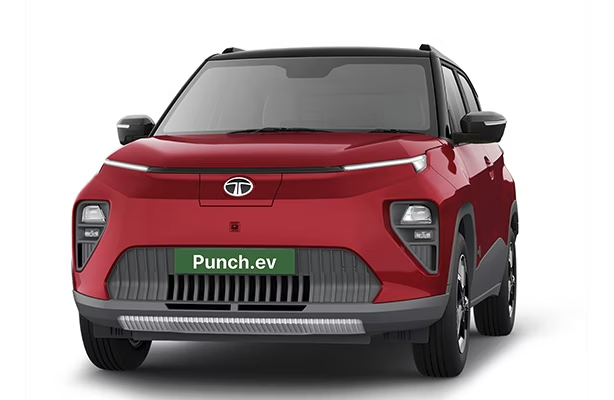
The Tata Punch EV has always been one of the most compelling electric SUVs for first-time EV buyers. With the 2026 facelift, Tata has given it bigger batteries, faster charging and a properly usable real-world range. But how much of that translates from the brochure to your daily commute? In this guide, we look beyond the claimed figures and break down what the Punch EV actually delivers on Indian roads, along with full pricing details for every variant.
Tata Punch EV 30 vs 40: The Two Battery Options
The Punch EV comes with two LFP prismatic cell battery packs, a 30 kWh unit and a 40 kWh unit. Both use a permanent magnet synchronous motor and drive the front wheels, but the numbers differ quite a bit.
| Spec | Punch EV 30 | Punch EV 40 |
| Motor power | 65 kW | 95 kW |
| Torque | 154 Nm | 154 Nm |
| Drive modes | City, Sport | Eco, City, Sport |
| 0-100 km/h | 13.5 sec | 9.0 sec |
| Certified full charge range | 365-375 km | 468 km |
| C75 real-world range | ~260-275 km | ~335-355 km |
| Battery warranty | 8 years or 1,60,000 km | Lifetime, unlimited km@ |
The 40 kWh version is the quicker, longer-range option and also comes with a jeweled control knob for drive mode selection, a feature exclusive to the 40 kWh variants. Paddle shifters for controlling the multi-mode regenerative braking system are unavailable only on the base Smart 30 variant and are offered on all other variants, including the Smart+ 30.
Real-World Range: Claimed vs Actual
This is where most EV buyers get confused, and rightly so. Tata publishes two sets of numbers: the MIDC certified full charge range (tested under lab conditions) and the C75 range (what Tata says 75 percent of real-world users can expect).
Tata introduced the C75 figure to give buyers a more realistic estimate of everyday driving range. Unlike laboratory-certified MIDC numbers, the C75 estimate is based on Tata’s internal testing and is intended to reflect what around 75% of drivers can realistically achieve under typical Indian driving conditions.
For the Punch EV 30, that means a certified range of 365-375 km, but a realistic C75 figure closer to 260-275 km. For the Punch EV 40, the certified range is 468 km, while the C75 figure sits at 335-355 km.
Independent test drives back this up fairly closely. Reviewers who have driven the facelifted Punch EV report that around 350 km is achievable in normal, mixed driving conditions on the 40 kWh version, without resorting to extreme efficiency-focused driving. That is a meaningful jump from the pre-facelift Punch EV, which managed closer to 300 km in the same real-world conditions with its older, smaller battery.
A few things swing this number up or down in daily use:
- AC usage: Running the air conditioning constantly, especially in Indian summers, can knock off a noticeable chunk of range.
- Drive mode: Sport mode gives you quicker acceleration but eats into efficiency. Eco mode (only on the 40 kWh version) stretches range the most.
- Load and terrain: A fully loaded car climbing hills will always return less range than a lightly loaded car on flat city roads.
- Driving style: Smooth, steady acceleration and braking help you get closer to the C75 figure than aggressive city driving.
If your daily commute is under 40-50 km, even the smaller 30 kWh battery comfortably handles a full week without charging.
Charging Experience: What to Actually Expect
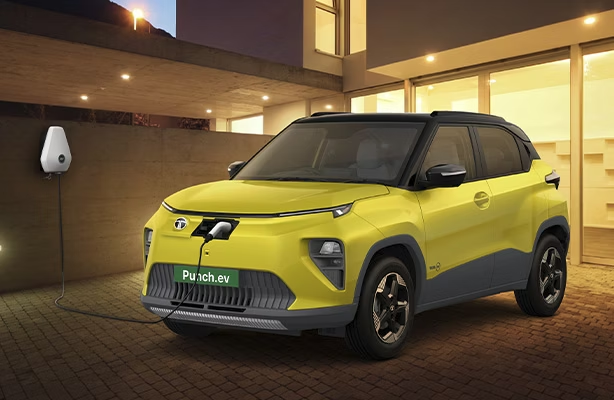
Charging speed is one of the biggest real-world upgrades on the facelifted Punch EV. Here is how it plays out:
- Home AC charging (any 15A socket): around 11.9 hours for the 30 kWh battery and 14.8 hours for the 40 kWh battery, from 10 to 100 percent.
- 7.2 kW AC fast charger: brings this down to 4.5 hours and 5.3 hours respectively, though this wall box is not standard fitment and may need to be purchased separately.
- DC fast charging (65 kW and above): 20 to 80 percent in just 26 minutes, regardless of battery size.
- Quick top-up: a 15-minute charge adds up to 135 km of C75 range on the 40 kWh version and 110 km on the 30 kWh version.
In practical terms, this means overnight home charging works fine for most owners, and the DC fast charging speed makes the Punch EV genuinely usable for the occasional highway trip, provided you plan your charging stops around India’s growing but still uneven public charging network.
Driving Experience and Efficiency Features
The Punch EV’s real-world efficiency also comes down to how well its smart drive features work together. Higher variants get paddle shifters for multi-mode regenerative braking, while the Smart variants do not. There is also a customisable single pedal drive mode that lets you drive using just the accelerator in most traffic conditions.
The i-6-in-1 box, Tata’s integrated EV drive unit, combines the motor, controller, onboard charger and other components into a single, more efficient package. This is part of why the facelifted Punch EV extracts noticeably more real-world range from a similarly sized battery compared to the outgoing model.
On the road, the car retains the easy, city-friendly character of the regular Punch, with 195 mm of ground clearance that handles Indian road conditions well, and a turning radius under 5 metres that makes it easy to manoeuvre in tight parking spaces.
Running Costs: How Much Does It Actually Cost to Drive?
Based on an average home electricity rate of around ₹8-10 per unit, charging a 30 kWh battery from empty costs roughly ₹240-300, working out to about ₹1-1.10 per km for the smaller battery version. This is significantly cheaper than running a petrol or CNG Punch over the same distance, and the gap widens further if you charge mostly at home overnight on a lower tariff.
Tata also offers a Battery-as-a-Service (BaaS) option, which lowers the upfront price considerably in exchange for a per-km battery rental charge, worth considering if you want a lower initial outlay and don’t mind a variable running cost.
Tata Punch EV Price in India (2026)
Here is the complete, variant-wise ex-showroom price list, as per Tata’s official pricing:
| Variant | Battery | Ex-showroom Price |
| Smart 30 | 30 kWh | ₹9,69,000 |
| Smart+ 30 | 30 kWh | ₹10,29,000 |
| Smart+ 40 | 40 kWh | ₹10,99,000 |
| Adventure 40 | 40 kWh | ₹11,74,000 |
| Empowered 40 | 40 kWh | ₹12,49,000 |
| Empowered+ S 40 | 40 kWh | ₹12,79,000 |
With the Battery-as-a-Service (BaaS) option, prices start even lower at ₹6.49 lakh, with an additional battery rental charge of approximately ₹2.6 per km.
Do note that these are ex-showroom prices, and your on-road price will be higher once you add registration, insurance and applicable road tax, which vary from state to state. Prices are also subject to change at Tata’s discretion, so it is always worth confirming the latest figures with your nearest Tata.ev dealer before booking.
Which Punch EV Should You Buy?
If your driving is mostly limited to city commutes under 40 km a day, the Smart+ 30 offers a sensible balance of price and features without paying for a range you will not use. If you occasionally step out of the city or simply want the peace of mind of a longer range and the lifetime battery warranty, the 40 kWh variants are the better long-term choice. Among these, the Empowered 40 stands out as the value pick, adding the 360-degree camera, larger touchscreen and digital cockpit without going all the way to the top-spec Empowered+ S.
Frequently Asked Questions
What is the real-world range of the Tata Punch EV?
The Punch EV 30 realistically delivers around 260-275 km on a full charge, while the Punch EV 40 delivers around 335-355 km, based on Tata’s C75 real-world testing standard and independent reviews.
How long does it take to fast charge the Tata Punch EV?
Using a 65 kW or higher DC fast charger, the Punch EV charges from 20 to 80 percent in about 26 minutes, regardless of whether you choose the 30 kWh or 40 kWh battery.
What is the price difference between the 30 kWh and 40 kWh Punch EV?
The Smart+ 30 is priced at ₹10,29,000 ex-showroom, while the Smart+ 40 starts at ₹10,99,000, a difference of ₹70,000 for the larger battery and extra drive mode.
Is the Tata Punch EV worth buying over the petrol or CNG Punch?
If most of your driving is within city limits and you have access to home charging, the Punch EV works out cheaper to run over time, along with a smoother and quieter driving experience. Buyers who frequently drive long distances and do not have reliable charging access may still prefer the petrol or CNG version.
Is the Tata Punch EV suitable for long-distance travel?
Yes, especially the 40 kWh version. Its C75 range of around 335–355 km and support for 65 kW DC fast charging make occasional highway trips practical. However, planning charging stops remains important due to variations in public charging infrastructure.
Note: Range and charging figures are as per ARAI/MIDC certification and Tata’s internal C75 testing standard. Actual range and charging time may vary based on driving conditions, battery health and usage patterns.