How to Choose the Right Car Tyre Size: A Simple Guide
Published on 10 September 2026
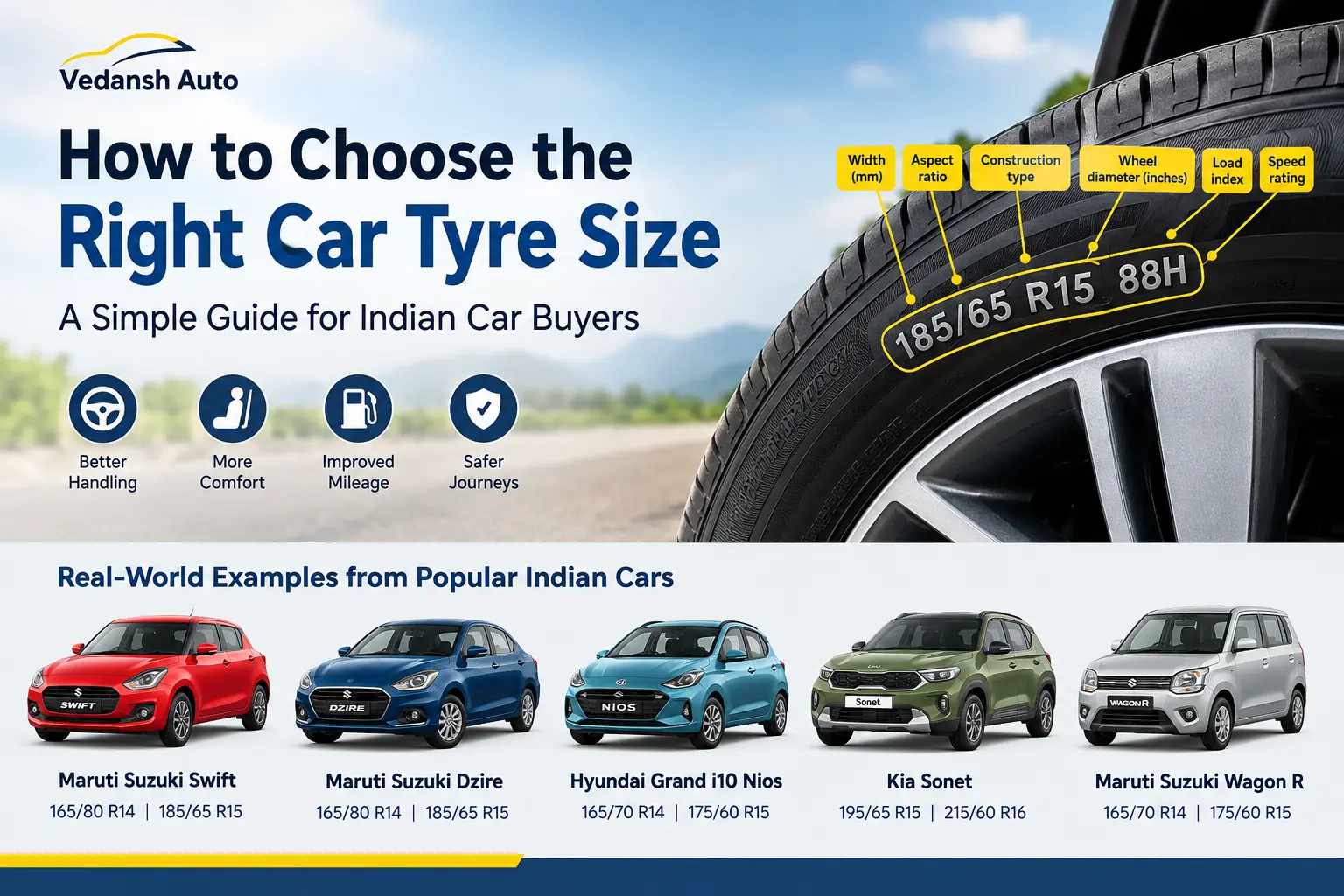
Buying new tyres for your car can seem straightforward until you look at the numbers printed on the sidewall. A marking such as 185/65 R15 88H may look confusing at first, but each number and letter tells you something important about the tyre.
Choosing the right size is not simply about finding a tyre that fits the wheel. Tyre width, sidewall height, wheel diameter, load rating and speed rating can all affect how your car rides and handles.
This is particularly important in India, where cars regularly deal with potholes, speed breakers, rough roads and long highway journeys.
Here’s how to understand tyre sizes and choose the right replacement for your car.
How to Read a Car Tyre Size
Let’s take a common example:
185/65 R15 88H
Each part has a specific meaning.
- 185 is the tyre width in millimetres.
- 65 is the aspect ratio, expressed as a percentage of the tyre’s width.
- R means the tyre uses radial construction.
- 15 is the wheel diameter in inches.
- 88 is the load index.
- H is the speed rating.
The first four figures describe the tyre’s dimensions, while the load and speed ratings tell you how much weight it can carry and the maximum speed at which it can carry that load.
Michelin recommends checking the vehicle’s owner’s manual or the tyre information sticker, usually found around the driver’s door area, for the manufacturer’s recommended specification.
What Does Tyre Width Mean?
The first number in a tyre size indicates its section width in millimetres.
For example, a 185/65 R15 tyre is nominally 185 mm wide. A 195/65 R15 tyre is 195 mm wide.
A wider tyre can provide a different steering feel and potentially more grip, but wider is not automatically better. It can also increase rolling resistance and cost, depending on the tyre and vehicle.
This is why you should not choose a wider tyre simply because it looks better on your car.
The manufacturer considers the tyre size along with the car’s suspension, steering, brakes, wheel design and overall weight. Changing the width without checking compatibility can affect how the car behaves.
What Is the Aspect Ratio?
The second number is the tyre’s aspect ratio. It represents the sidewall height as a percentage of the tyre’s width.
For example, in a 185/65 R15 tyre:
- Width = 185 mm
- Aspect ratio = 65
- Approximate sidewall height = 120 mm
A lower aspect ratio generally means a shorter sidewall. This can give the car a sharper steering response, but a taller sidewall generally provides more cushioning over bumps and potholes.
You can see this difference in the Hyundai Grand i10 Nios. Depending on the variant, Hyundai specifies either 165/70 R14 or 175/60 R15 tyres.
The 15-inch setup has a larger wheel and a lower-profile tyre. That does not mean it is automatically better for every road condition. The two sizes are part of the specifications approved for different configurations of the car.
What Does the R Mean?
The R in a tyre marking stands for radial construction.
Most passenger cars sold in India use radial tyres, so this isn’t usually something buyers need to choose between when replacing tyres. It is still useful to understand what the marking means.
What Does the Wheel Size Mean?
The number after the R indicates the diameter of the wheel in inches.
For example:
185/65 R15
means that the tyre is designed to fit a 15-inch wheel.
A larger wheel is often paired with a lower-profile tyre so that the overall tyre diameter remains suitable for the vehicle.
The Maruti Suzuki Swift is a useful real-world example. Its specifications include 165/80 R14 and 185/65 R15, depending on the configuration.
The two tyres look quite different on paper. The 14-inch version has a narrower tread and taller sidewall, while the 15-inch version is wider and has a lower aspect ratio.
This is why simply fitting a larger wheel and choosing a tyre that looks right is not enough. The complete wheel-and-tyre combination needs to be compatible with the car.
What Are Load Index and Speed Rating?
You may also see something like 88H after the tyre size.
The 88 is the load index. It corresponds to the maximum load that one tyre can carry under specified conditions.
The H is the speed rating. It indicates the maximum speed at which the tyre can carry its maximum rated load.
These ratings matter when buying replacement tyres. Michelin notes that tyres of the same physical dimensions can have different load and speed ratings.
You should therefore avoid looking only at the first four parts of the tyre marking.
For example, if your car requires a particular load or speed rating, buying a tyre simply because it has the correct width, aspect ratio and wheel diameter is not enough.
What Can We Learn From Actual Indian Cars?
Looking at cars sold in India makes tyre sizing easier to understand.
Maruti Suzuki Swift
The Swift is available with 165/80 R14 and 185/65 R15 tyre sizes depending on the variant.
This demonstrates how a manufacturer can offer different wheel and tyre combinations on the same model.
However, don’t assume that the 14-inch and 15-inch combinations can simply be swapped whenever you want. Your car’s specific variant and manufacturer’s recommendation should be the starting point.
Maruti Suzuki Dzire
The Dzire provides another useful example. Maruti’s specifications list 165/80 R14 tyres with steel wheels and 185/65 R15 with alloy wheels.
This is a good reminder that tyre size can vary according to the wheel and variant fitted to the car.
Hyundai Grand i10 Nios
Hyundai specifies 165/70 R14 and 175/60 R15 configurations for the Grand i10 Nios.
Here, the wider tyre is also paired with a larger wheel and a lower aspect ratio.
Kia Sonet
The Sonet gives us an example from the compact SUV segment. Kia lists 195/65 R15 and 215/60 R16 tyre sizes depending on the version.
Interestingly, Kia’s owner’s information specifically advises owners to use the same tyre size originally supplied with the vehicle. It warns that using a different size can affect driving performance and may cause problems with related components.
That is useful advice for anyone considering a tyre upgrade.
Should You Change Your Car’s Original Tyre Size?
This is where you should be particularly careful.
You may have seen cars with larger wheels and wider tyres and wondered whether you can do the same to your car. The answer is not simply yes or no.
A different tyre size can affect:
- Ride comfort
- Steering response
- Ground clearance
- Speedometer accuracy
- Rolling resistance
- Braking and handling
- Clearance between the tyre and suspension or bodywork
There is also more to consider than the tyre’s outside diameter. Wheel width, offset, load rating and speed rating can all matter.
If your car is still running its factory wheels and tyres, the safest approach is to replace them with the manufacturer’s recommended specification.
If you are considering changing the wheel or tyre size, check the manufacturer’s approved options and speak to a reputable tyre professional before making the change.
How to Find the Correct Tyre Size for Your Car
You don’t need to guess the correct tyre size.
Start with these sources:
1. Check the driver’s door sticker
Many cars have a tyre information label on or around the driver’s door or door pillar. It can provide the recommended tyre size and inflation pressure. Michelin also recommends checking this information.
2. Check the owner’s manual
The owner’s manual normally contains the manufacturer’s recommended tyre and wheel specifications.
3. Look at the existing tyre
The size is printed clearly on the sidewall.
However, don’t automatically assume the tyre currently fitted is correct, particularly if you have bought a used car. Previous owners may have changed the wheels or tyres.
4. Check the manufacturer’s specifications
This is particularly useful if you are unsure whether your car came with different tyre sizes depending on the variant.
What About Upsizing Your Tyres?
Upsizing generally means moving to a larger wheel and/or wider tyre while trying to maintain a suitable overall tyre diameter.
It can change the appearance and steering feel of the car, but there are trade-offs.
A larger wheel with a lower-profile tyre may offer sharper handling, but the shorter sidewall provides less cushioning against potholes and sharp road impacts.
A wider tyre can also cost more and may have a different effect on rolling resistance.
So if your main priority is comfortable daily driving on Indian roads, don’t assume that the largest wheel available for your model is automatically the best choice.
Should You Buy the Same Tyre Size as the Factory-Fitted One?
For most owners, yes.
If you need to replace worn tyres and aren’t deliberately modifying the car, sticking with the manufacturer’s recommended size is the simplest and safest option.
You should also make sure that the replacement tyre meets the required load and speed ratings. Michelin notes that a higher load or speed rating can be acceptable in appropriate circumstances, but the vehicle’s own maximum permissible load remains the limiting factor.
The Kia Sonet owner’s manual takes an even more direct approach, recommending the same size originally supplied with the vehicle.
Common Tyre Size Mistakes Car Owners Make
A few mistakes are particularly easy to avoid.
Choosing tyres only by price: The cheapest tyre isn’t necessarily the right tyre for your car.
Assuming wider is better: A wider tyre can change grip and steering characteristics, but it also changes other aspects of the car’s behaviour.
Ignoring the load and speed ratings: Two tyres with the same dimensions can have different ratings.
Changing wheel size without checking compatibility: A larger wheel requires the correct tyre and needs to work with the car’s suspension, steering and wheel arches.
Assuming the current tyre is the correct one: This can be particularly risky with a used car.
Mixing unsuitable tyre specifications: Your tyres should be matched appropriately for the vehicle and axle, rather than simply being chosen based on what happens to fit the wheel.
A Simple Checklist Before Buying New Tyres
Before ordering your next set of tyres, check:
- Tyre width
- Aspect ratio
- Wheel diameter
- Load index
- Speed rating
- Manufacturer-approved size
- Recommended tyre pressure
- Tyre condition and age
- Whether the wheel itself is compatible with the tyre
If you are replacing tyres without changing the wheels, the easiest route is usually to match the manufacturer’s recommended specification.
The Bottom Line
Choosing the right tyre size isn’t about finding the widest tyre or the biggest wheel that will fit your car.
The correct tyre has to work with the vehicle as a complete package. Width, aspect ratio, wheel diameter, load index and speed rating all matter.
Cars such as the Maruti Suzuki Swift, Maruti Suzuki Dzire, Hyundai Grand i10 Nios and Kia Sonet show how manufacturers can use different wheel and tyre combinations across variants.
For most Indian car owners, the safest approach is simple: check the owner’s manual or tyre information sticker, match the manufacturer’s recommended specification and don’t change tyre size just because a different setup looks better.
That is especially worth remembering when buying tyres for a car that spends most of its time dealing with potholes, speed breakers and crowded city roads.