Toyota Glanza vs Maruti Suzuki Baleno: Which One to Buy?
Published on 23 July 2026
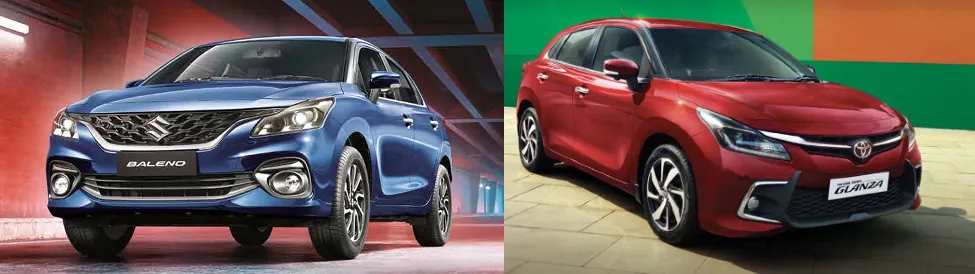
If you are comparing Toyota Glanza and the Maruti Suzuki Baleno, you may have noticed something interesting. Both cars look almost the same on paper. That is because they are built together. The Glanza is a rebadged Baleno, made on the same production line, with the same 1.2 litre K series engine, the same platform, and mostly the same features.
So rather than which car is better, the real question is which badge is worth the extra money. This comes down to pricing, design details, safety features, warranty terms, and after sales support, not performance or mileage. Let us look at the full comparison.
Specs at a Glance
Both cars use Maruti’s 1197cc K series Dual Jet, Dual VVT petrol engine. This is not a coincidence since it is literally the same engine.
| Spec | Toyota Glanza | Maruti Baleno |
| Engine | 1197cc, 4 cylinder | 1197cc, 4 cylinder |
| Max Power | 89.7 PS @ 6000 rpm | 89.7 PS @ 6000 rpm |
| Max Torque | 113 Nm @ 4400 rpm | 113 Nm @ 4400 rpm |
| Mileage (Petrol MT) | 22.35 km/l | 22.35 km/l |
| Mileage (Petrol AMT) | 22.94 km/l | 22.94 km/l |
| Mileage (CNG) | 30.61 km/kg | 30.61 km/kg |
| Transmission | 5MT / AMT | 5MT / AMT |
| Length x Width x Height | 3990 x 1745 x 1500 mm | 3990 x 1745 x 1500 mm |
| Boot Space | 318 litres | 318 litres |
| Seating | 5 | 5 |
As you can see, the specifications are almost identical, but the real differences show up in pricing and features, which are covered below.
Price Comparison: Glanza vs Baleno
This is where the two cars actually differ. The Glanza costs more than the equivalent Baleno variant at nearly every trim level.
Toyota Glanza On-Road Price (New Delhi)
| Variant | Fuel | Transmission | Ex-Showroom | On-Road (Delhi) |
| E | Petrol | 5MT | ₹6.73 Lakh | ₹8.06 Lakh |
| S | Petrol | 5MT | ₹7.63 Lakh | ₹9.05 Lakh |
| S AMT | Petrol | AMT | ₹8.28 Lakh | ₹9.77 Lakh |
| S CNG | CNG | 5MT | ₹8.49 Lakh | ₹10.02 Lakh |
| G | Petrol | 5MT | ₹8.65 Lakh | ₹10.18 Lakh |
| G AMT | Petrol | AMT | ₹9.25 Lakh | ₹10.85 Lakh |
| G CNG | CNG | 5MT | ₹9.53 Lakh | ₹11.17 Lakh |
| V | Petrol | 5MT | ₹9.48 Lakh | ₹11.10 Lakh |
| V AMT | Petrol | AMT | ₹9.99 Lakh | ₹11.66 Lakh |
Maruti Baleno, On-Road Price (New Delhi)
| Variant | Fuel | Transmission | Ex-Showroom | On-Road (Delhi) |
| Sigma | Petrol | 5MT | ₹5.99 Lakh | ₹6.91 Lakh |
| Delta | Petrol | 5MT | ₹6.85 Lakh | ₹8.06 Lakh |
| Delta AMT | Petrol | AMT | ₹7.35 Lakh | ₹8.63 Lakh |
| Delta CNG | CNG | 5MT | ₹7.77 Lakh | ₹9.11 Lakh |
| Zeta | Petrol | 5MT | ₹7.75 Lakh | ₹9.08 Lakh |
| Zeta AMT | Petrol | AMT | ₹8.25 Lakh | ₹9.65 Lakh |
| Alpha | Petrol | 5MT | ₹8.67 Lakh | ₹10.13 Lakh |
| Alpha AMT | Petrol | AMT | ₹9.17 Lakh | ₹10.69 Lakh |
| Zeta CNG | CNG | 5MT | ₹8.67 Lakh | ₹10.13 Lakh |
The takeaway: The Baleno’s base Sigma variant is about ₹1.15 lakh cheaper on-road than the Glanza’s base E variant. The Glanza’s entry trim already comes closer to the Baleno’s Delta trim in features, so it is not a fair apples to apples comparison at the very bottom of the range.
Across the rest of the lineup, the gap is not fixed at ₹1 to ₹1.15 lakh. It actually ranges from about ₹0.91 lakh to ₹1.20 lakh, depending on the variant. The gap is smallest at the CNG trims (around ₹0.91 to ₹1.04 lakh) and widest at the G AMT trim, where the Glanza costs about ₹1.20 lakh more on-road than the equivalent Baleno Zeta AMT.
At the top end, the Glanza V AMT costs about ₹0.97 lakh more than the Baleno Alpha AMT for the same mechanical package (this is close to ₹1 lakh, but not quite there).
In simple words, the Baleno badge saves you roughly ₹0.91 lakh to ₹1.20 lakh across most variants, for a car that is mechanically identical to the Glanza.
Design and Exterior Features Compared
Since both cars share the same body shell, wheelbase, and dimensions, the exterior differences are mostly in styling details, not in size or shape.
- Front grille and bumper: Toyota gives the Glanza a sportier front bumper with a carbon fibre texture element and a wider grille with a horizontal chrome bar. The Baleno gets its own NEXWave grille design with a chrome strip, which looks less aggressive and more premium in the NEXA style.
- Headlamps and tail lamps: Both get LED projector headlamps and LED tail lamps on the higher variants, and halogen units on the base trims. Feature availability is nearly the same on both cars.
- Blacked out pillars: The Glanza has a “floating roof effect” with black A, B, and C pillars, giving it a slightly sportier look. This is a Toyota specific styling touch.
- Alloy wheels: Both offer 16 inch alloy wheels on top variants and steel wheels with covers on lower trims, though the wheel designs are different.
- Colour options: The Baleno is available in seven shades, including Nexa Blue, Grandeur Grey, Arctic White, Splendid Silver, Opulent Red, Luxe Beige, and Bluish Black. Toyota offers the Glanza in its own colour palette, with red as one of the signature shades.
Overall, the two cars look different enough at first glance because of grille, bumper, and pillar treatment, even though the body underneath is the same.
Interior and Convenience Features Compared
Inside, both cars offer a dual tone cabin, but there are a few differences worth knowing about.
- Dashboard and seats: Both get dual tone interiors with piano black inserts. Maruti calls its seat design “wrap around” for extra comfort. Toyota describes it as a similar “Classy Dual Tone” treatment across dashboard and seats.
- Touchscreen infotainment: The top Baleno Alpha variant gets a 22.86 cm SmartPlay Pro+ touchscreen with Surround Sense audio powered by Arkamys. The Glanza’s top V variant also gets a 22.86 cm touchscreen (Smart Playcast).
- Voice assistant: Maruti’s onboard assistant wakes up with “Hi Suzuki” on the Zeta and Alpha trims. Toyota’s Glanza has its own “Hey Toyota” wake word on the G and V trims, and additionally supports “Hello Google” and “Hey Siri” through smartphone connectivity.
- Smartwatch connectivity: This is a useful difference for buyers to know. Maruti Suzuki Connect works with smartwatches on both Android 7.0 and above, and iOS 12.0 and above. Toyota’s smartwatch connectivity for the Glanza is available only on Apple iOS devices. Android smartwatch users will not get this feature on the Glanza.
- Head Up Display and 360 view camera: Both cars offer these on their higher trims, with almost identical functionality.
- Cruise control, rear AC vents, rear fast charging USB: Available on both, on the equivalent higher variants.
In short, the cabin experience is very similar, with the main differences being the missing Arkamys sound system on the Glanza and the Apple only smartwatch support on Toyota’s side.
Safety Features Compared
Safety is one area where both cars are genuinely equal, since crash structure and safety hardware come from the same base platform.
- 6 airbags as standard on both cars, across all variants.
- Electronic Stability Program (ESP) with Hill Hold Assist on both, badged as ESP on the Baleno and Vehicle Stability Control on the Glanza.
- ABS with EBD and brake assist standard on both.
- ISOFIX child seat anchorages, seat belt reminders for all occupants, and seat belt pre-tensioners with force limiters, available on both.
- Rear parking sensors and reverse parking camera on higher variants of both cars.
- Maruti calls its safety body structure the Heartect platform, while Toyota markets the same underlying structure as the TECT body. The names are different, but the platform is shared.
There is no meaningful safety advantage on either side. If crash safety is your main concern, either car gives you the same protection.
Other Differences That Matter
Warranty Coverage
Both brands now offer the same standard warranty, 3 years or 1,00,000 km, whichever comes first. The difference shows up in the extended warranty options.
- Maruti Baleno: extendable up to 6 years or 1,60,000 km through Platinum, Royal Platinum, or Solitaire plans.
- Toyota Glanza: extendable up to 5 years or 2,20,000 km.
If you drive a high yearly distance, the Glanza’s extended plan covers more kilometres. If you plan to keep the car for many years without covering huge distances, Maruti’s 6 year plan works out better.
Ownership Perks
Toyota promotes a few ownership benefits for the Glanza that are not commonly advertised for the Baleno, including Express Maintenance (periodic service completed in around 60 minutes at select dealers) and 24 hour roadside assistance. Maruti does not market an equivalent express service scheme, though Baleno maintenance costs are known to be quite low, estimated between ₹20,000 and ₹25,000 over five years.
Dealer Network
Toyota states a network of around 650 touchpoints across 362 cities in India. Maruti’s combined Arena and Nexa network is much larger and reaches deeper into smaller towns, which matters if you live away from a major city and want easy access to authorised service.
Resale Value
This part is a bit subjective, but worth mentioning. Toyota’s brand image for reliability often supports a slightly better resale value in the used car market, even though the Glanza is mechanically the same as the Baleno. Buyers in the second hand market sometimes pay a small premium for the Toyota badge, which can offset some of the higher upfront cost if you plan to sell the car after a few years.
CNG Variants: Nearly Identical
Both the Glanza and Baleno offer factory fitted S-CNG or E-CNG options on the same 1197cc engine, with the same output figures in both petrol mode and CNG mode, and the same 30.61 km/kg mileage rating. Both use dual ECUs, stainless steel fuel lines, and a microswitch that stops the engine from starting during refuelling, since it is the same hardware on both cars. The only real difference is price, where the same pattern continues. Glanza CNG variants cost more than the matching Baleno CNG variants.
Who Should Buy Which
Buy the Maruti Baleno if:
- You want the lowest on-road price for the same mechanical package
- You live in a smaller town where Maruti’s service network is easier to reach
- You are fine with Maruti’s standard after sales experience
- You want Android smartwatch support along with iOS
Buy the Toyota Glanza if:
- You value Toyota’s brand reputation and slightly stronger expected resale value
- You drive a lot every year and want a warranty that covers more kilometres
- You want access to Express Maintenance and 24 hour roadside assistance
- The extra cost is not a major concern for you
FAQs
Q: Is the Toyota Glanza just a rebadged Maruti Baleno?
Yes. Both are made by Maruti Suzuki and share the same platform, engine, dimensions, and most features. Toyota sells the Glanza under a badge engineering agreement with Maruti.
Q: Why is the Glanza more expensive than the Baleno if they are the same car?
The price gap comes from Toyota’s brand positioning, its dealer network costs, and extra ownership perks like Express Maintenance and longer roadside assistance, not from any mechanical advantage.
Q: Which one has better mileage, Glanza or Baleno?
Neither. Both give the same ARAI certified mileage since they use the same engine and gearbox, 22.35 km/l on the manual and 22.94 km/l on the AMT.
Q: Does the Glanza have a longer warranty than the Baleno?
The standard warranty is the same on both cars, 3 years or 1,00,000 km. Toyota’s extended plan goes up to 5 years or 2,20,000 km, while Maruti’s extends to 6 years or 1,60,000 km. Which one is “longer” depends on whether you care more about years or kilometres.
Q: Does the Glanza have any feature the Baleno does not?
Not really. If anything, the Baleno’s top Alpha variant gets the Arkamys Surround Sense audio system, which is not listed for any Glanza variant. Toyota does add Apple exclusive smartwatch support and its own “Hey Toyota” voice assistant, but these are more like brand differences than true feature advantages.
Q: Which one has better resale value?
The Glanza is generally expected to hold resale value a little better because of Toyota’s brand reputation, though the difference is usually small since the car underneath is identical.